
Commercial Landlord Insurance Utah: A Landlord’s Guide To Coverage
Owning rental property in Utah comes with real financial exposure. Tenant injuries, property damage, and lost rent can drain your savings fast.
Commercial landlord insurance in Utah protects your investment from these exact risks. At Direct Insurance Services, we help landlords understand what coverage actually matters and how to get it right.
What Your Landlord Policy Actually Covers
Your landlord insurance policy covers three core areas that protect your rental investment. First, it covers the building structure itself-the walls, roof, foundation, and permanent fixtures. This includes damage from fire, hail, wind, theft, and vandalism.
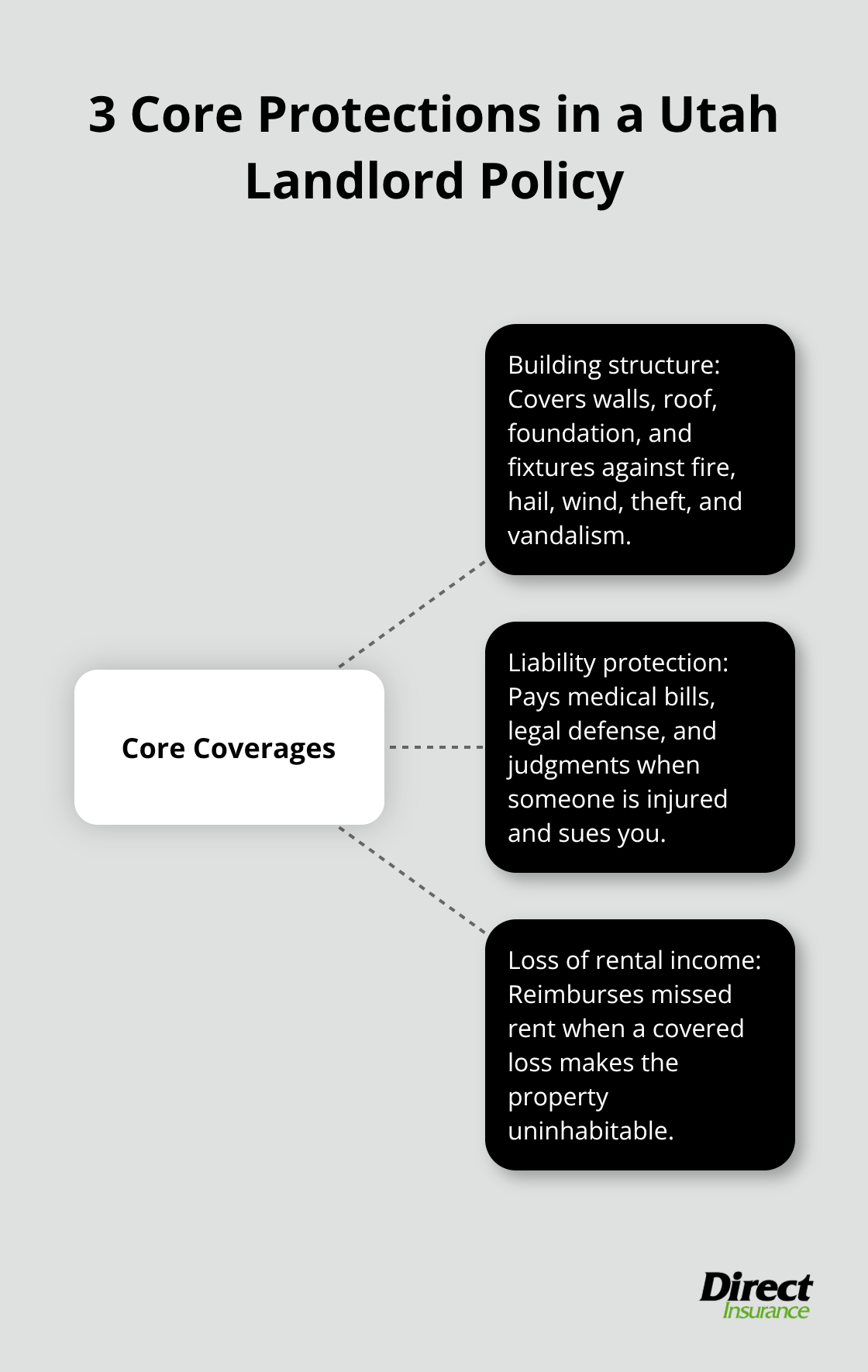
Standard policies also cover permanent improvements like built-in cabinets or flooring you’ve added to the property. Second, the policy provides liability protection when someone is injured on your property and sues you for damages. This covers medical bills, legal fees, and court judgments up to your policy limits. Third, it reimburses you for lost rental income if the building becomes uninhabitable due to a covered loss. If a fire forces tenants to leave for three months while repairs happen, your policy covers those three months of missed rent. Most Utah landlord policies cost 15 to 25 percent more than a comparable homeowner policy because rental properties carry higher liability exposure.
The Building Structure Coverage You Need
Your policy covers the dwelling structure, but many landlords misunderstand what this includes. It protects the building envelope and permanent systems like electrical wiring, plumbing, and HVAC equipment that are built into the property. However, it does not cover tenant belongings, tenant improvements they’ve made, or business inventory inside the leased space. This is why you must require tenants to carry their own commercial property insurance. Tenants’ contents insurance typically costs between $800 and $3,000 per year per $1 million of protection, which is reasonable compared to the financial devastation of an uninsured loss. Utah’s winter weather creates specific risks you must address. Frozen pipes cause significant damage when units aren’t heated properly between tenants, and ice dams form when attic insulation is inadequate. You should verify your coverage limits match your property’s actual replacement cost, not its market value.
Liability Coverage and Injury Claims
Liability coverage protects you when someone is injured on your property and holds you legally responsible. Utah Code § 57-22, known as the Utah Fit Premises Act, requires landlords to maintain safe premises and make health and safety repairs within three days of tenant notice. If you fail to meet this obligation and someone is injured as a result, your liability exposure increases significantly. Standard commercial general liability policies in Utah typically start at $1 million per occurrence and $2 million aggregate, though some landlords layer on umbrella policies for an additional $1 million of coverage at roughly $600 per year. Medical expense coverage within your liability policy commonly covers $5,000 in on-site injuries regardless of fault, and you can raise this to $10,000 to discourage lawsuits. This coverage applies whether the injury happens in common areas or inside a tenant’s leased space. You should match your policy limits to your property’s risk profile-higher-traffic commercial properties need higher limits than single-tenant industrial spaces.
Lost Rent Coverage During Repairs
Loss of rental income coverage reimburses you when your property becomes uninhabitable after a covered loss. If a pipe burst floods the building and tenants must relocate for two months, your policy covers those two months of lost rent. This coverage protects your cash flow during the repair period. Without it, you still owe your mortgage, property taxes, and maintenance costs even though you collect zero rent. Many landlords underestimate how long repairs take. A significant fire or water damage claim can require four to six months of repairs, not two weeks. Your policy should provide at least 12 months of coverage, with 18 months worth considering if your property is in a remote area where contractors move slowly. Some policies limit coverage to actual rent lost, while others cover additional expenses like temporary relocation costs. You should verify which version your policy provides, because the difference between 12 and 18 months of coverage could mean $20,000 to $30,000 in unprotected losses for a property generating $1,695 per month in rent.
What Tenants Must Cover Themselves
Your landlord policy covers the building structure only and does not cover tenants’ contents, improvements, or business interruption inside the leased space. Tenants must carry their own commercial property insurance to protect their equipment, furniture, and supplies. A two-week closure after damage may cause $5,000 to $25,000 in lost revenue for a tenant, which underscores why you should require business interruption coverage in your lease. You should also require tenants to name you as an additional insured on their liability policy and provide certificates of insurance before occupancy.
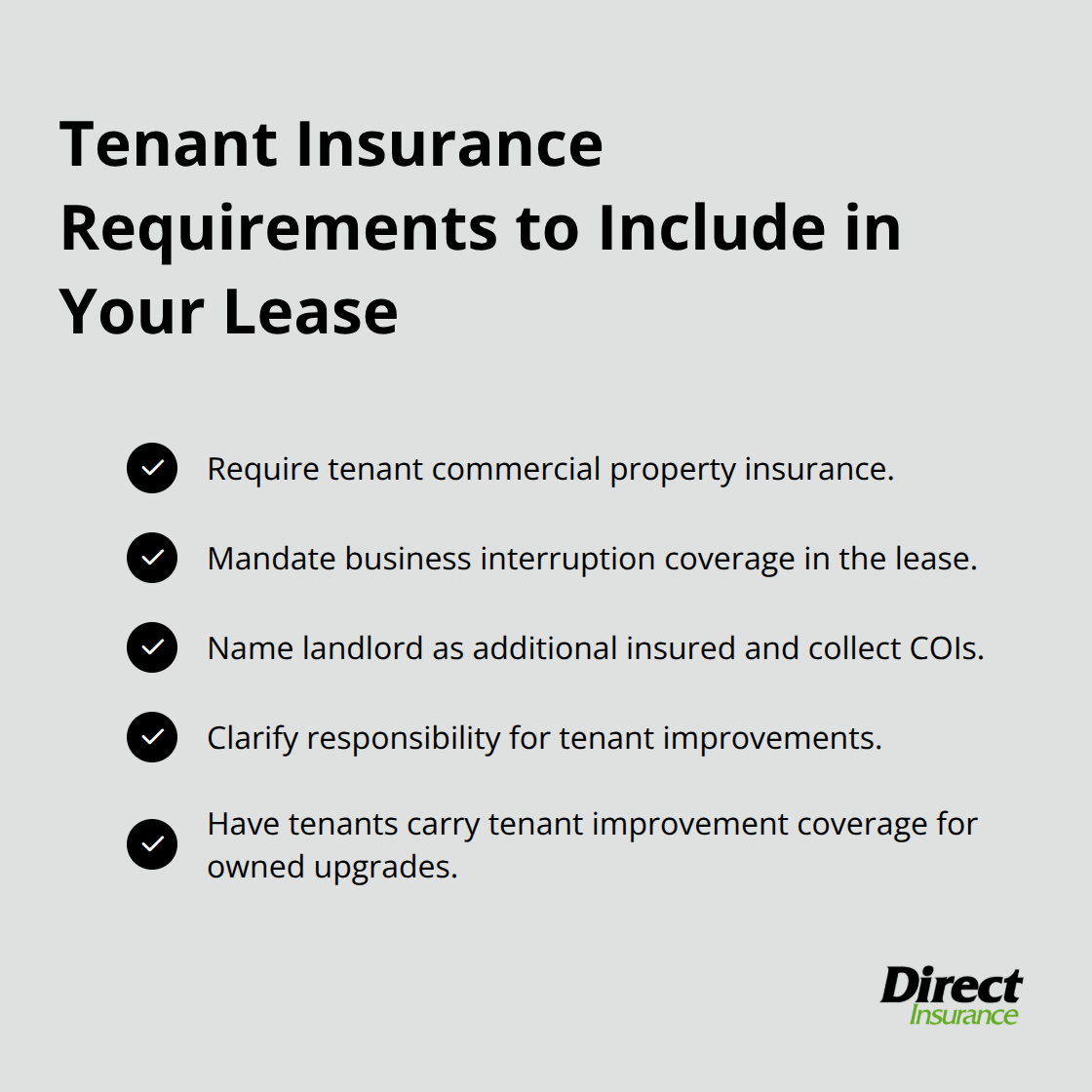
This protects you from gaps between your coverage and theirs. When tenants make improvements to the space (new flooring, custom shelving, or upgraded systems), those betterments are typically not covered by your landlord policy. You must specify in your lease whether tenants or you cover these upgrades, and tenants should carry tenant improvement coverage if they own the upgrades. The combination of your landlord policy and strong tenant insurance requirements creates a complete protection framework that addresses typical Utah commercial property risks.
Why Utah Landlords Face Unique Insurance Needs
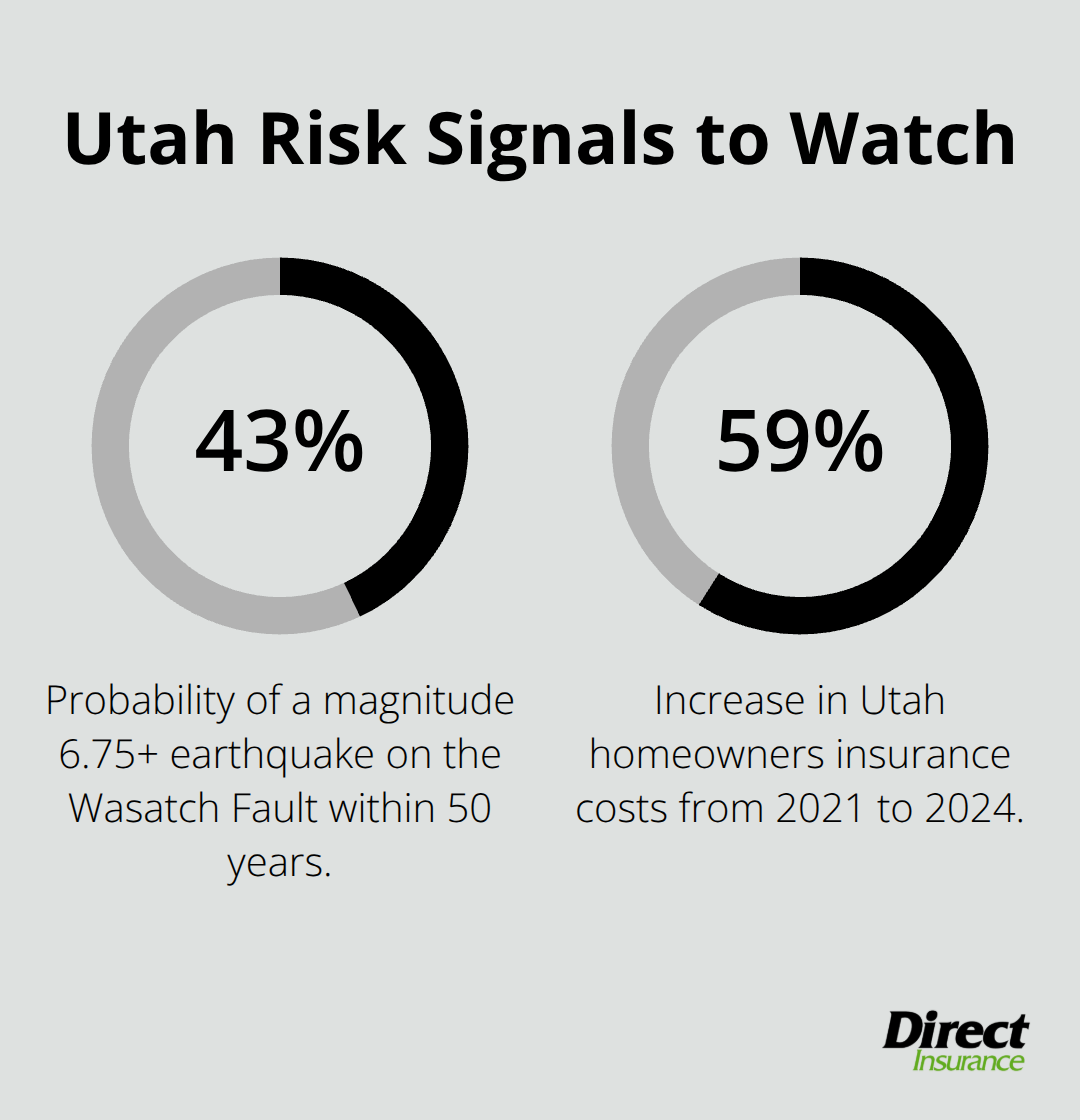
Utah’s geography and climate create specific financial risks that standard homeowner policies cannot address. The Wasatch Front experiences roughly 500 earthquakes per year, and the Utah Insurance Department estimates a 43 percent chance of at least one magnitude 6.75 or stronger earthquake in the next 50 years along the Wasatch Fault, which runs directly beneath major population centers including Salt Lake City. Wildfire exposure has intensified dramatically-homeowners insurance costs across Utah jumped 59 percent between 2021 and 2024, with FEMA’s National Risk Index rating the Wasatch and Wasatch Back regions as relatively high risk. Winter temperatures regularly drop below freezing, causing frozen pipes and ice dams that destroy interiors when properties sit vacant between tenants. Standard homeowner policies do not cover earthquake damage, and flood policies require separate purchase.
A landlord policy addresses these exact exposures with targeted coverage that a homeowner policy simply does not provide. Without it, a single earthquake, wildfire, or frozen-pipe incident could cost you $50,000 to $150,000 in uninsured losses while you still owe your mortgage and property taxes.
Mortgage Lenders Require It, and So Does Utah Law
Your lender will not fund a rental property purchase without proof of commercial landlord insurance naming the lender as mortgagee. Most lenders demand minimum coverage of $1 million in liability protection and replacement-cost property coverage matching the building’s reconstruction value, not its market price. Utah Code § 57-22 imposes legal obligations on you as a landlord to maintain safe premises and complete health and safety repairs within three days of tenant notice. Failure to meet this standard exposes you to tenant claims and regulatory action. If a tenant reports a broken heating system and you ignore it for a week, and pipes freeze as a result, you face both tenant litigation and potential liability under state law. Your landlord policy covers the financial fallout from these scenarios, including legal defense costs. Without adequate coverage, you personally absorb court judgments, medical bills, and repair costs. This is not a theoretical risk-Utah courts routinely award damages to tenants who suffer injuries or property loss due to landlord negligence. A $2 million umbrella policy, which adds roughly $600 annually per $1 million of coverage, becomes essential insurance for protecting your personal assets from judgments that exceed your base policy limits.
Tenant Claims and Business Interruption Threats
Tenant-related claims represent your largest financial exposure as a landlord. Slip-and-fall injuries in common areas, chemical exposure claims, or disputes over security deposits can trigger lawsuits costing $10,000 to $50,000 in legal fees alone before any settlement. Your liability coverage defends you and covers these costs up to your policy limits. More damaging than individual claims is business interruption from property damage. If a fire forces tenants to vacate for four months while the building undergoes reconstruction, you lose $6,780 in rent on a property generating $1,695 monthly, plus you still pay mortgage, property taxes, and utilities. Many landlords assume this scenario is rare, but water damage from burst pipes, hail damage requiring roof replacement, or electrical fires forcing evacuation happen regularly in Utah. Loss of rental income coverage reimburses this lost revenue, protecting your cash flow when you need it most. Without it, you face financial pressure to rush repairs unsafely or accept partial rent from displaced tenants. Requiring tenants to carry business interruption insurance protects them from the same exposure and prevents them from suing you when their operations suffer after a covered loss. This shared responsibility structure, enforced through your lease and verified annually via certificates of insurance, creates financial stability for both parties and sets the foundation for selecting the right policy to match your specific property and risk profile.
Picking the Right Coverage Amount for Your Utah Property
Calculate Your True Replacement Cost
Start with your actual replacement cost, not your property’s market value. A rental home worth $400,000 might cost $500,000 to fully rebuild after a total loss because reconstruction includes labor, materials, and local Utah building code upgrades. Contact three contractors in your area and ask what they would charge to rebuild your exact property from the ground up. This number becomes your target coverage limit for the dwelling structure. Most Utah landlords underestimate replacement cost by 20 to 30 percent, which leaves them exposed to significant out-of-pocket losses.
Once you know your replacement cost, add 10 to 15 percent more coverage to account for code upgrades required by current Utah building codes that didn’t exist when your property was originally built. If your property sits in a wildfire-prone area rated as high risk by FEMA’s National Risk Index, add another 15 percent to cover potential code-upgrade costs for fire-resistant materials and defensible space requirements.
Match Liability Limits to Your Property’s Risk Profile
For liability coverage, match your limits to your property’s actual traffic and risk profile. A single-tenant industrial warehouse generates far less liability exposure than a multi-unit commercial building in downtown Salt Lake City with foot traffic and public access. Start with the standard $1 million per occurrence and $2 million aggregate that most Utah lenders require, but increase to $2 million per occurrence and $4 million aggregate if your property has multiple tenants, common areas, or regular visitor traffic.
Set Loss of Rental Income Coverage
Loss of rental income coverage should cover at least 12 months of lost rent. For a property generating $1,695 monthly rent, that equals $20,340 in annual coverage. However, if your property is in a remote area or has complex systems requiring extended repair timelines, purchase 18 months of coverage at $30,510 to avoid a coverage gap that could force you to absorb three to six months of uncovered losses.
Compare Quotes Across Multiple Insurers
Try quotes from at least three different insurers before making a decision, because premium variation for identical coverage can exceed 40 percent depending on the insurer’s appetite for Utah rental properties and your specific risk profile. When comparing quotes, verify that each one includes the same coverage components: replacement-cost property coverage for the dwelling structure, $1 million or higher liability per occurrence, loss of rental income for your chosen duration, and water damage coverage that extends to frozen-pipe claims.
Ask each insurer whether their quote includes earthquake coverage as a separate endorsement with a percentage-based deductible, because standard policies exclude earthquake damage entirely and the Utah Insurance Department reports a 43 percent probability of a magnitude 6.75 or stronger earthquake on the Wasatch Fault within 50 years. Request that each insurer quote their policy with the deductible set at $2,500 for property damage claims so you can compare apples-to-apples quotes. A $1,000 deductible versus a $2,500 deductible might save $300 to $600 annually in premiums, but only if you can absorb the higher deductible without financial strain when a claim occurs.
Avoid the Cheapest Quote Trap
Many landlords select an insurer based solely on premium price, then discover during a claim that the policy excludes critical coverages or requires endorsements they did not purchase. Review each policy’s exclusions section carefully and confirm that flood, earthquake, and ordinance-or-law coverage gaps are addressed through separate policies or endorsements before you commit. The cheapest quote often reflects an insurer’s decision to exclude or limit coverage for Utah-specific risks like frozen pipes or wildfire damage rather than genuine savings. When you shop multiple insurers, you gain the ability to identify which companies offer the best value for your specific property type and risk exposure (not just the lowest price).
Final Thoughts
Commercial landlord insurance in Utah protects your rental investment from the specific risks that threaten your cash flow and personal assets. The coverage you need combines replacement-cost property protection, liability limits matched to your property’s traffic and exposure, and loss of rental income that covers at least 12 months of lost rent. Without these three components working together, a single fire, frozen-pipe incident, or tenant injury claim costs you $50,000 to $150,000 in uninsured losses while you still owe your mortgage and property taxes.
Your next step involves calculating your property’s true replacement cost by contacting local Utah contractors, then requesting quotes from at least three different insurers using identical coverage specifications. When you compare quotes, verify that each one addresses Utah-specific risks like earthquake damage, frozen pipes, and wildfire exposure through either included coverage or available endorsements. Avoid selecting an insurer based solely on the lowest premium, because the cheapest quote often reflects excluded coverages rather than genuine savings.
We at Direct Insurance Services understand the unique insurance needs of Utah landlords and shop multiple top-rated insurance companies to find you the best coverage at competitive rates. Our team knows the Wasatch Front’s earthquake risk, wildfire exposure, and winter weather threats firsthand and works with you to build a landlord insurance package that protects your investment without overpaying for unnecessary coverage. Contact us today for a personalized quote and policy review that addresses your property’s exact needs.
Disclaimer: The information provided in this blog is for general informational purposes only and does not constitute legal, financial, or insurance advice. Coverage options, terms, and availability may vary. Please consult with a licensed professional for advice specific to your situation

