

Umbrella Insurance For Families: What You Need To Know
Most families don’t realize their homeowners and auto insurance policies leave them exposed to serious financial risk. A single lawsuit from a car accident or injury on your property could wipe out years of savings.
Umbrella insurance for families fills those gaps by providing extra liability protection when your standard policies max out. At Direct Insurance Services, we help families understand how this affordable coverage works and why it matters for protecting what you’ve built.
What Umbrella Insurance Actually Covers
Umbrella insurance provides extra liability protection that sits on top of your existing auto and homeowners policies. When a lawsuit or major claim exceeds what your standard policies will pay, umbrella coverage steps in to cover the remaining damages up to your policy limit. Most families start with $1 million in umbrella coverage, with options to increase to $2 million or $5 million as assets grow. Your umbrella only activates after your underlying policies hit their limits. If you have $300,000 in auto liability coverage and face a $500,000 claim from a serious accident, your auto policy pays $300,000 and your umbrella covers the remaining $200,000. This layering approach means you’re not paying for duplicate coverage-the umbrella fills the gap your primary policies leave behind.
What incidents trigger umbrella protection
Umbrella policies cover a wide range of liability situations beyond what most families expect. Motor vehicle accidents, slip-and-fall injuries on your property, dog bites, and rental property liability all fall under standard umbrella coverage. The policies also protect against personal injury claims like libel, slander, and privacy violations-situations your homeowners policy likely won’t touch. Umbrella coverage can extend to watercraft and RVs when those assets are insured under your existing policies.
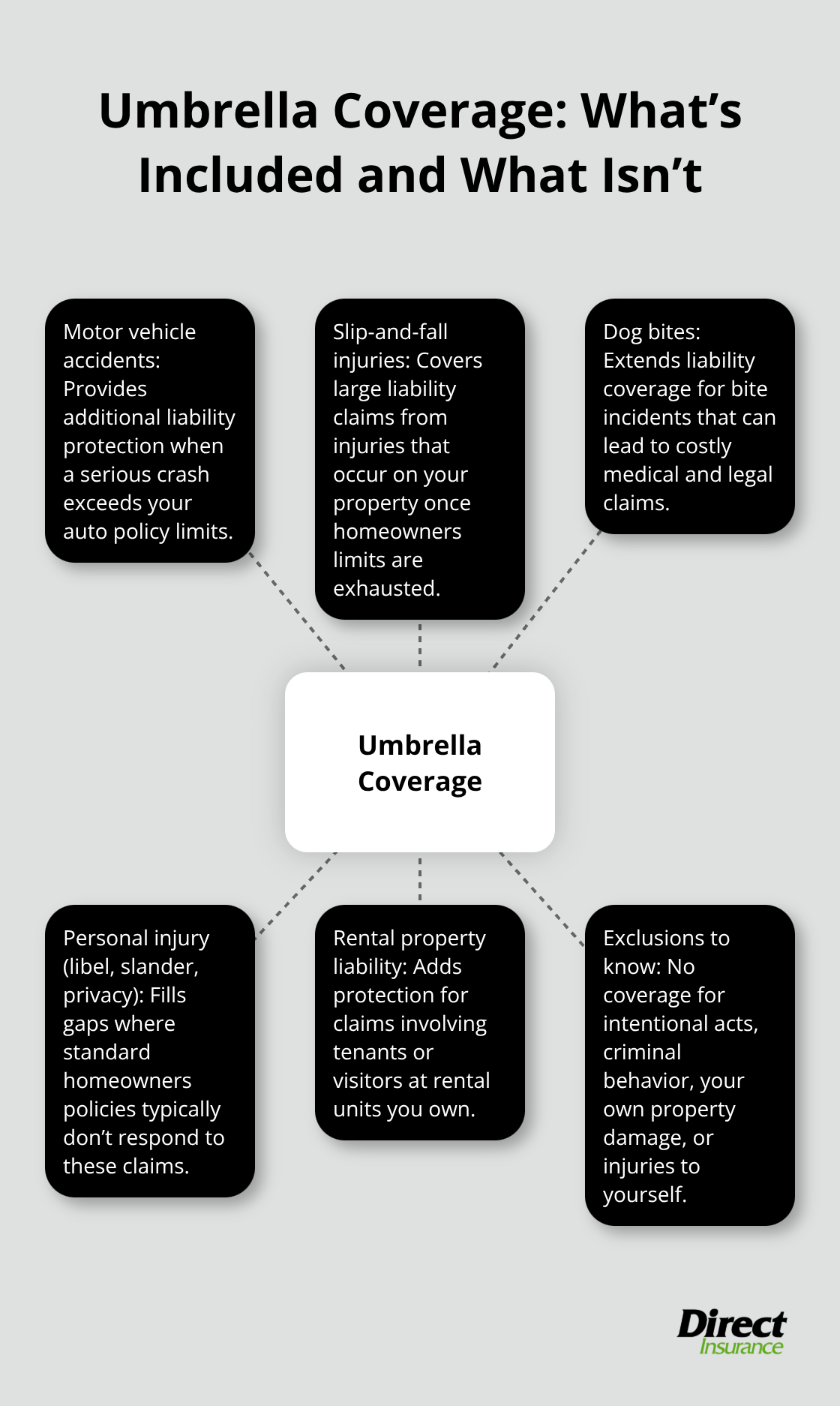
Your umbrella doesn’t cover intentional acts, criminal behavior, or professional malpractice. It also won’t pay for damage to your own property or injuries you cause to yourself. This means umbrella insurance protects your assets from what others claim you did wrong, not from your own mistakes or deliberate actions.
Minimum requirements and real costs
Most insurers require minimum underlying liability limits before they’ll sell you umbrella coverage. You typically need at least $250,000 to $300,000 in auto liability and $300,000 in homeowners liability to qualify. These aren’t random numbers-they’re designed to ensure your primary policies handle smaller claims while the umbrella handles the serious ones. Umbrella insurance surprises most families with its affordability. Typical annual costs for $1 million in coverage range from $150 to $300 per year when bundled with your auto and home policies. Real quotes show even better pricing in some cases: some customers report paying $116 to $127 annually for $1 million in umbrella coverage, while families with multiple policies through the same insurer pay around $330 per year. Moving from $1 million to $5 million in coverage often costs only slightly more-one example shows a $5 million umbrella running about $740 annually. Geographic location matters significantly, with costs varying substantially by state and region. Umbrella insurance offers an exceptional protection-to-cost ratio, making it one of the most efficient ways to shield your family’s financial future.
How much coverage your family actually needs
The right umbrella limit depends on your total assets and potential liability exposure. A practical rule of thumb suggests you match your umbrella coverage to your net worth and future earnings potential. If you own a home, multiple vehicles, or rental property, your liability exposure increases significantly. Families with teen drivers face higher auto liability risk, which makes umbrella protection even more valuable. Your assets include your home equity, savings, investments, and vehicles-anything a lawsuit could target. Most families find that $1 million provides solid protection, but those with substantial assets or higher-risk situations should consider $2 million to $5 million. The cost difference between these limits remains modest, so many families opt for higher coverage without straining their budgets. When you shop for umbrella insurance, an agent can help you assess your specific situation and recommend appropriate limits based on what you own and your family’s activities.
Why Your Family Needs Extra Liability Protection
One lawsuit destroys what you’ve spent decades building. The Insurance Information Institute reports that auto liability claims average $24,211 for bodily injury and $5,313 for property damage, and courts increasingly award settlements that dwarf standard homeowners and auto policy limits. A serious car accident involving multiple vehicles, a guest who suffers a severe injury on your property, or a situation where someone claims you caused them financial harm through defamation can all result in judgments that your primary policies won’t fully cover.
Standard policies leave dangerous gaps
Standard auto policies typically max out at $250,000 to $300,000 in liability coverage, while homeowners policies often cap personal liability at $300,000. These limits made sense decades ago, but they fall dangerously short in today’s litigation environment. If you face a $500,000 judgment and your auto policy covers only $300,000, you become personally responsible for the remaining $200,000. That means creditors can pursue your savings, investment accounts, and future earnings to satisfy the debt. Umbrella insurance closes this gap without the expense most families assume it requires.
Your household faces constant exposure
Your assets face claims you didn’t anticipate. Teen drivers significantly increase your household’s auto liability risk, with insurance costs rising substantially after they obtain licenses and begin driving independently. Families with rental properties face landlord liability from tenants and visitors, a coverage area where standard homeowners policies provide minimal protection. Dog ownership creates documented liability exposure, with dog bite claims averaging thousands of dollars and serious incidents reaching six figures.
Even your social media activity carries risk: defamation claims from posts or comments aren’t covered by standard homeowners insurance, but umbrella policies typically protect against libel and slander claims. The National Association of Insurance Commissioners notes that families with meaningful assets should integrate umbrella coverage into their overall risk management strategy.
Umbrella coverage costs far less than you think
Real pricing data shows that $1 million in umbrella coverage costs between $150 and $300 annually when bundled with existing policies, with some customers paying as little as $116 per year. Moving to $5 million in coverage often costs only $400 to $750 annually, making it economically irrational to skip this protection if you own a home or have accumulated any significant savings. The protection-to-cost ratio makes umbrella insurance one of the most efficient ways to shield your family’s financial future.
Understanding what triggers umbrella protection matters just as much as knowing the cost. The next section breaks down exactly which incidents activate your coverage and what situations fall outside the umbrella’s scope.
Picking the Right Umbrella Limit for Your Situation
Start with an honest asset inventory
Start with a realistic inventory of what you own. Your home equity, vehicles, savings accounts, investment portfolios, and any rental properties represent the assets a lawsuit could target. Add these numbers together to get your net worth, then compare it against your current umbrella options. Progressive recommends choosing limits at least equal to your net worth to protect your assets from lawsuits.
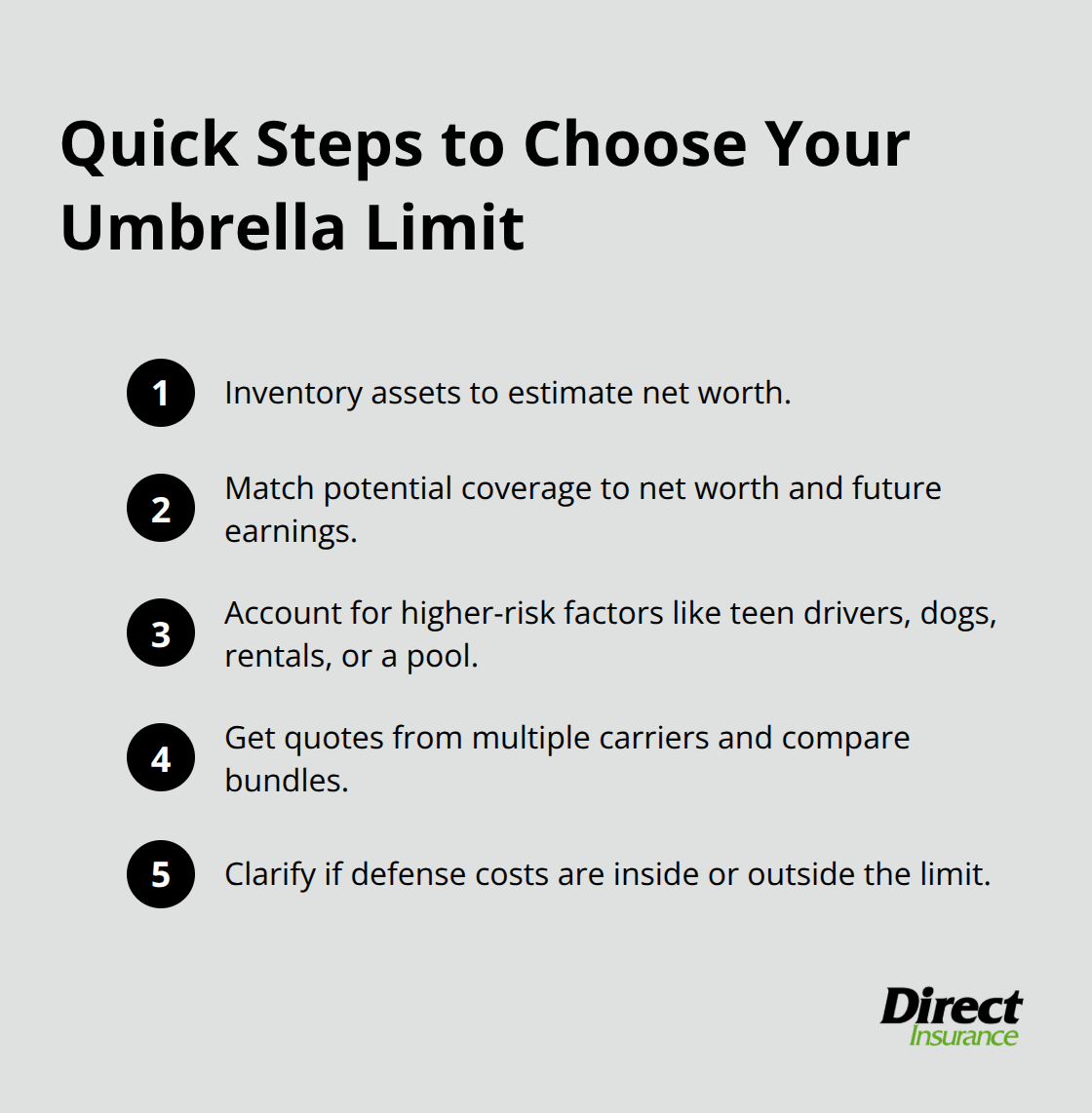
If you own a home worth $400,000 with $150,000 in equity, drive two vehicles worth $50,000 combined, and have $100,000 in savings, that’s roughly $300,000 in exposed assets. A $1 million umbrella provides substantial protection above that baseline. However, if your home equity alone exceeds $500,000 or you’re building retirement savings aggressively, try $2 million or $5 million coverage given how little the premium difference costs.
Real pricing shows moving from $1 million to $5 million coverage typically adds only $200 to $400 annually, making the higher limit economically rational for families with meaningful assets.
Assess your family’s specific risk factors
Your family’s specific risk factors matter equally. Teen drivers dramatically increase your liability exposure since they cause more accidents than any other age group, with insurance costs rising substantially when they obtain licenses. Families with dogs, especially larger breeds, face documented bite liability claims averaging thousands of dollars.
Hosting frequent gatherings, owning rental property, or maintaining a swimming pool all increase your household’s exposure to serious claims. These circumstances push many families toward higher coverage limits even if their net worth alone wouldn’t suggest it. The combination of assets plus risk exposure determines what truly protects your family.
Get real quotes from multiple carriers
Compare actual quotes from multiple insurers rather than relying on estimates. Contact at least three major carriers and provide identical information about your vehicles, home, household members, and current coverage limits. Real quotes vary dramatically by location and insurer.
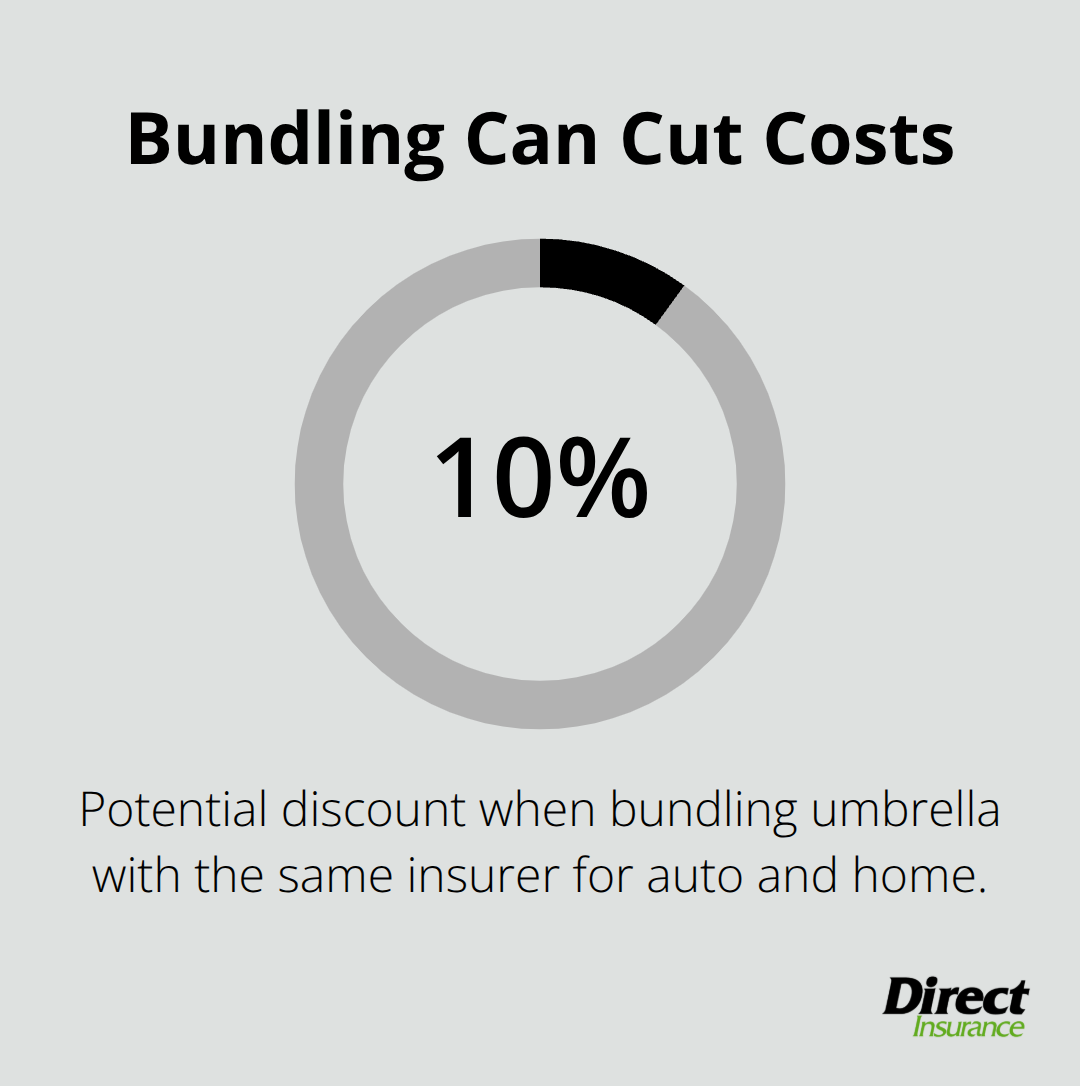
A $1 million umbrella costs $116 to $127 annually in some markets but reaches $1,200 per year in high-cost states like New Jersey. Bundling your umbrella with the same insurer handling your auto and home policies consistently produces better pricing, often yielding discounts up to 10 percent. One customer reported paying just $330 annually for $1 million in coverage when consolidating policies with a single carrier.
Clarify what defense costs actually cover
When you request quotes, confirm whether defense costs and attorney fees reduce your policy limit or sit outside it. Some insurers cover legal expenses separately while others deduct them from your stated limit, significantly affecting your actual protection. Ask each carrier about minimum underlying liability requirements, since higher underlying limits sometimes reduce umbrella premiums or unlock higher coverage options without additional underwriting.
If your current auto liability sits at $100,000, raising it to $250,000 might cost less than you expect while simultaneously reducing your umbrella premium. Shopping strategically across these variables typically saves families hundreds of dollars annually while securing better coverage than their initial quotes suggested.
Final Thoughts
Umbrella insurance for families isn’t a luxury reserved for the wealthy-it’s an affordable safeguard that protects what you’ve worked to build. Standard auto and homeowners policies leave dangerous gaps, and a single serious claim wipes out years of savings. Yet families add $1 million in umbrella coverage for as little as $150 to $300 annually, making the cost argument for skipping this protection impossible to justify.
Your family’s specific situation determines the right coverage limit. If you own a home, drive multiple vehicles, have teen drivers, or maintain rental property, your liability exposure is substantial. Inventory your assets, assess your household’s risk factors, and compare real quotes from multiple carriers-moving from $1 million to $5 million in coverage typically costs only $200 to $400 more per year, so higher limits often make financial sense.
Umbrella insurance covers motor vehicle accidents, slip-and-fall injuries, dog bites, defamation claims, and rental property liability (situations where standard policies either cap out or don’t cover at all). Defense costs and attorney fees are paid separately in many cases, meaning your policy limit stays intact to cover actual damages. Contact Direct Insurance Services to review your current coverage and get quotes on umbrella policies tailored to your family’s needs.
Disclaimer: The information provided in this blog is for general informational purposes only and does not constitute legal, financial, or insurance advice. Coverage options, terms, and availability may vary. Please consult with a licensed professional for advice specific to your situation

