Business Interruption Insurance Utah: Protect Revenue During Downtime
A single day without power, a flooded facility, or a broken production line can cost your Utah business thousands in lost revenue. Most business owners focus on protecting their physical assets but overlook what happens when operations grind to a halt.
Business interruption insurance Utah fills that gap by covering your lost income during forced closures. At Direct Insurance Services, we’ve seen too many Utah companies unprepared for downtime-and the financial damage that follows.
What Business Interruption Insurance Actually Covers
Business interruption insurance reimburses the income your Utah business loses when operations shut down due to a covered event. This isn’t about replacing damaged equipment or inventory-it’s about replacing the money you stop earning. If a fire forces you to close for three weeks, BI insurance covers your lost sales, not the cost of repairs.
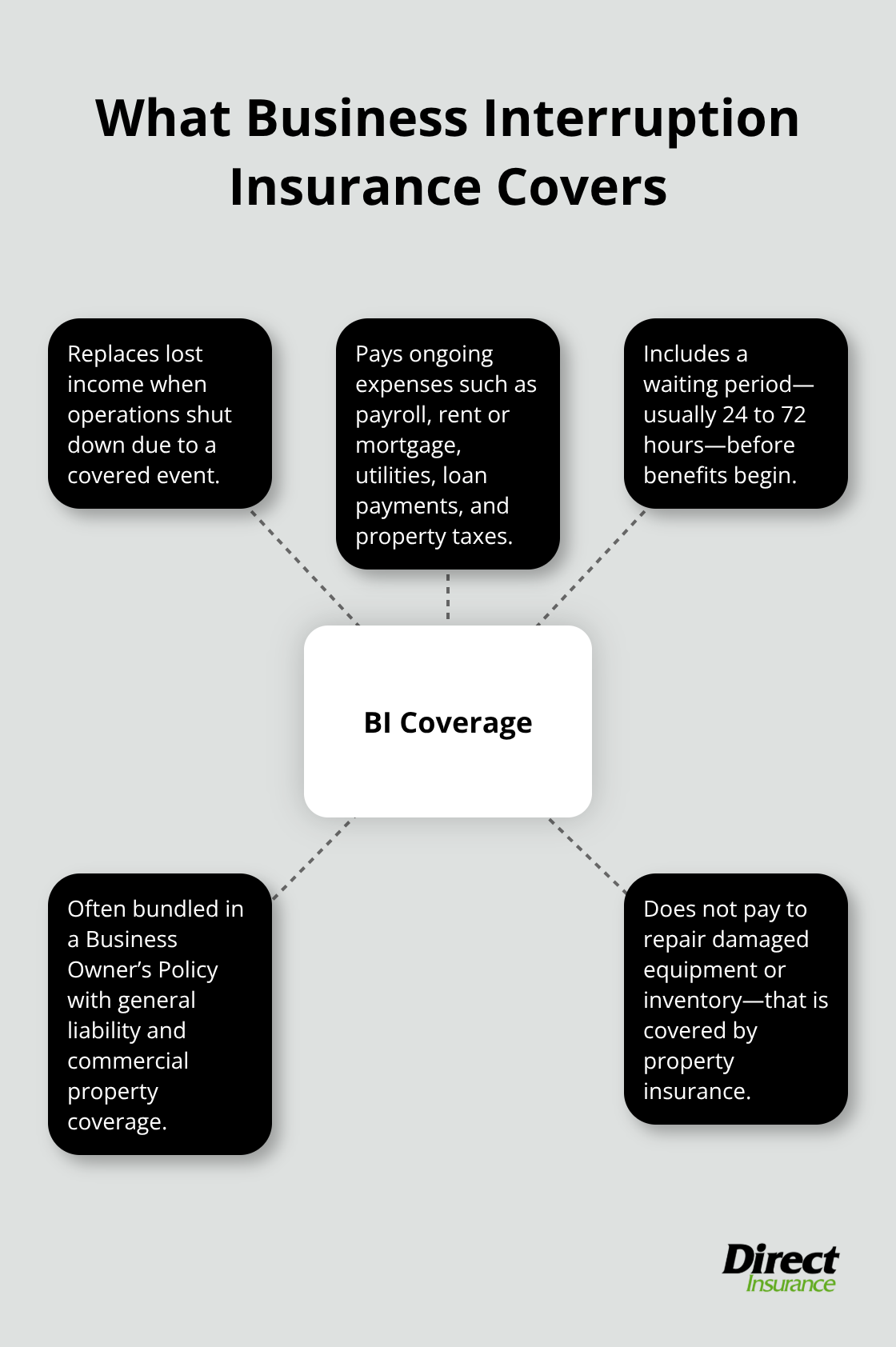
The coverage also pays ongoing expenses that don’t pause when your doors close: payroll for key staff, rent or mortgage, utilities, loan payments, and property taxes. According to the National Association of Insurance Commissioners, nearly 8 million commercial policies include BI coverage, with roughly 90 percent serving small businesses with 100 or fewer employees. Most Utah businesses obtain BI as part of a business owner’s policy rather than as a standalone product, bundled alongside general liability and commercial property coverage. The policy typically includes a waiting period-usually 24 to 72 hours-before payments begin, which means very short shutdowns may not trigger claims.
Why Most Utah Businesses Get This Wrong
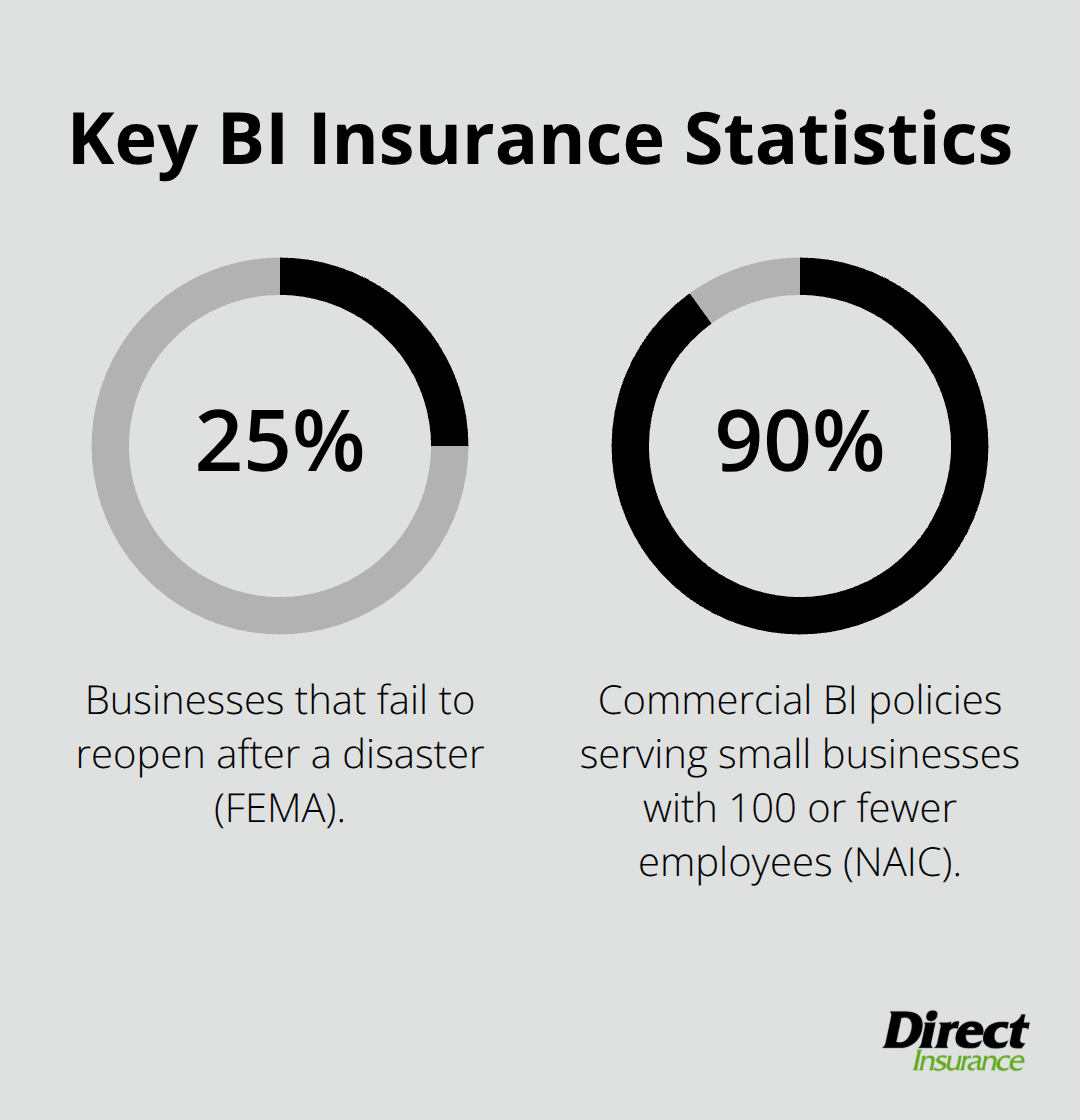
Many business owners assume their standard property insurance covers lost income during downtime. It doesn’t. Property insurance pays to fix or replace damaged assets, not to replace your revenue stream. The Federal Emergency Management Agency reports that roughly 25 percent of businesses fail to reopen after a disaster, and cash flow problems-not just physical damage-are the primary reason. Only 30 to 40 percent of small businesses carry BI insurance according to the National Association of Insurance Commissioners, leaving most Utah firms exposed.
A Fort Collins retailer with a 14-day shutdown claimed $38,700 in losses: $27,000 in lost sales, $7,200 in payroll, and $4,500 in IT costs to restore systems. That business had a $150,000 BI sublimit and a $5,000 deductible. Without that coverage, the owner would have absorbed every dollar. The real damage occurs when you can’t pay staff, suppliers demand cash on delivery instead of net terms, and customers take their business elsewhere during your absence.
How BI Limits Work in Utah’s Economy
Coverage limits should reflect your maximum potential downtime loss, not just a guess. Calculate your gross profit per month, add all fixed expenses that continue during closure, then multiply your realistic recovery timeline. If you gross $50,000 monthly and have $15,000 in fixed costs, a three-week shutdown costs $47,500 in lost income plus ongoing expenses. A Salt Lake City SaaS company with a three-day outage claimed $61,000 under a $250,000 BI limit: $42,000 in lost revenue, $15,000 in emergency IT support, and $4,000 in client credits to retain accounts. The National Association of Insurance Commissioners data shows coinsurance penalties of 50 to 80 percent are standard, meaning underinsurance at claim time reduces your payout significantly. Utah businesses in high-risk locations (areas prone to wildfires or severe weather) face higher premiums, making it even more important to set limits accurately rather than choosing arbitrary numbers. An independent agent can model your specific downtime scenario and help you ensure limits match your actual exposure, not just your comfort with the premium cost.
What Happens When You Underestimate Your Exposure
Setting BI limits too low creates a dangerous gap between what you claim and what you actually receive. Coinsurance clauses penalize underinsurance by reducing payouts proportionally-if you insure for 50 percent of your actual loss, you recover only 50 percent of your claim. A Colorado Springs healthcare provider with a $500,000 BI limit faced a breach that cost $243,000 in lost billings, compliance expenses, notification costs, and extra staffing. That organization had adequate coverage because it calculated exposure correctly. Most Utah businesses never perform this calculation, instead picking a round number that feels safe. The result: when downtime strikes, the claim falls short, and the business absorbs the difference. Your recovery timeline matters more than you think-some incidents require two weeks or more of coverage, and your limits must account for that reality.
Moving Forward With Accurate Coverage
The next step is assessing your specific revenue and operating expenses to determine what BI limits actually protect your business. This calculation forms the foundation of choosing the right policy and avoiding the costly mistakes that leave Utah businesses vulnerable.
Common Causes of Business Interruption in Utah
Weather and Natural Disasters Strike Without Warning
Weather and natural disasters top the list of business interruption triggers in Utah, but the damage extends far beyond what most owners anticipate. Wildfires pose the most immediate threat to Utah operations. A wildfire closure doesn’t just stop your revenue; it halts payroll, suspends loan payments, and can trigger civil authority coverage if government orders prohibit access to your premises.
Colorado and Utah have experienced a 63 percent rise in severe cyber claims over five years, underscoring how quickly threats multiply in the region. Winter storms, flash floods, and hail damage also disrupt operations across the state, often with little warning. These events force immediate shutdowns that can last weeks while repairs and inspections occur.
Equipment Failures Halt Operations Unexpectedly
Equipment failures and system breakdowns hit differently because they often occur without warning and affect businesses that assume their operations are protected by standard property insurance. A manufacturing facility with a failed production line, a dental practice with a failed HVAC system, or a retail operation with a flooded basement all face immediate downtime costs that property insurance won’t cover.
These mechanical or electrical failures fall outside standard property policies unless you carry equipment breakdown coverage as a separate rider. The National Association of Insurance Commissioners data shows that many Utah businesses lack this protection, leaving them vulnerable to sudden losses. A single equipment failure can cost thousands daily in lost revenue while technicians diagnose and repair the problem.
Regulatory Issues and Unexpected Closures
Unexpected closures and regulatory issues represent the least visible but increasingly common cause of interruption. Health inspections, electrical code violations, or water quality issues can force immediate shutdowns that last days or weeks while remediation occurs. A restaurant closure due to a health inspection finding can cost $3,000 to $5,000 daily in lost revenue plus the expense of corrective action and re-inspection fees.
These closures often surprise business owners because they don’t anticipate regulatory action. A water main break combines property damage, equipment failure, and potential regulatory involvement-multiple interruption risks hit simultaneously. Your BI policy limits must account for the longest realistic recovery timeline across all these scenarios, not just the most obvious one.
Calculating Your Actual Exposure
Most Utah business owners set coverage limits based on a single worst-case scenario when they should model their specific operational vulnerabilities and the time required to restore each critical function. A manufacturing operation faces different recovery timelines than a service business; a retail location in a wildfire zone faces different risks than one in an urban area. The next step involves assessing your revenue and operating expenses to determine what BI limits actually protect your business against these varied threats.
How to Choose the Right Business Interruption Insurance Policy
Calculate Your Actual Exposure With Financial Records
Start with two years of financial records: profit and loss statements, tax returns, and revenue projections. This step is not optional. Your BI limit should equal your gross profit per month multiplied by your realistic recovery timeline, plus all fixed expenses that continue during closure. If you gross $40,000 monthly with $12,000 in fixed costs and expect a two-week recovery, your exposure is roughly $104,000.
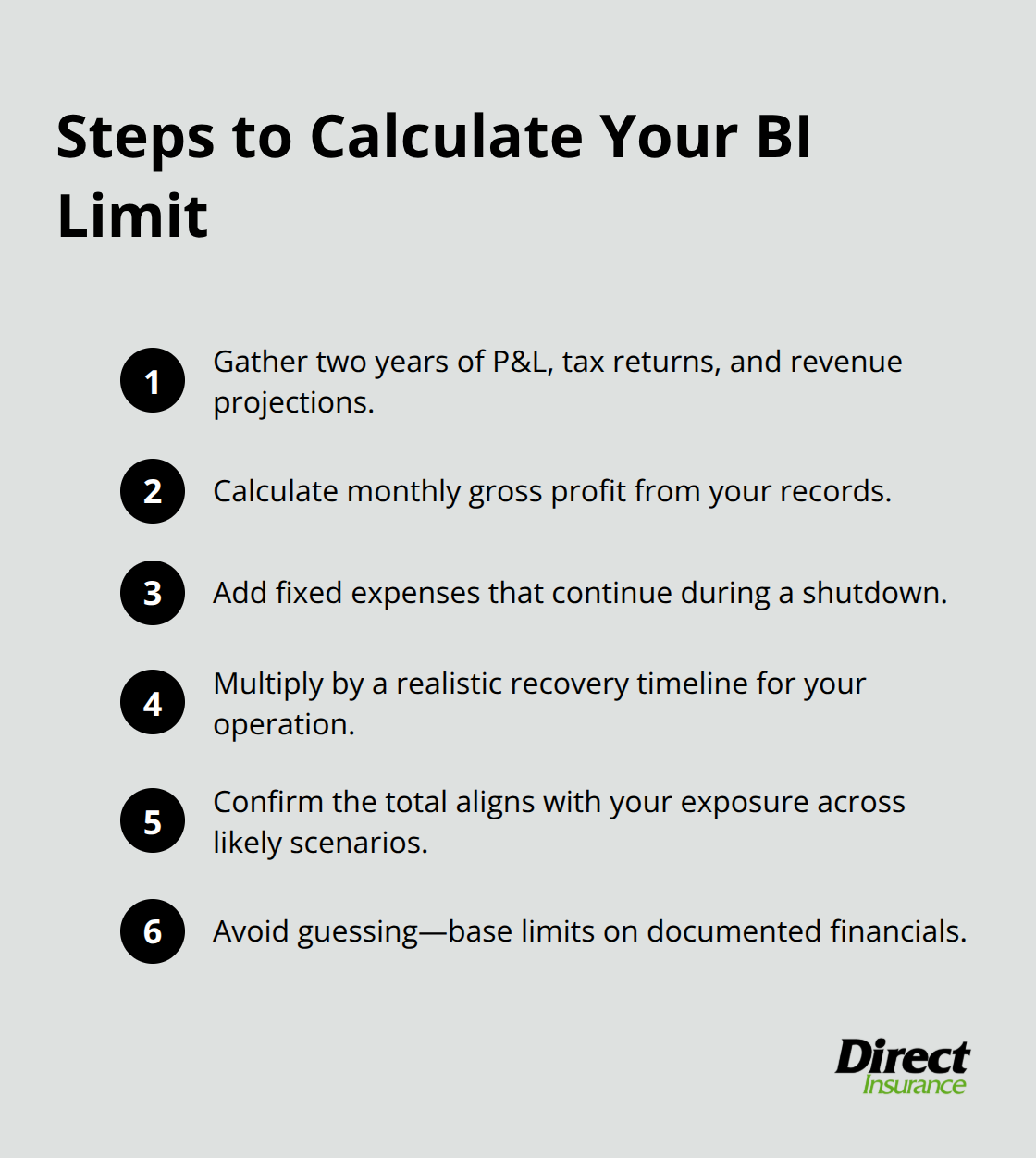
Most Utah business owners skip this calculation and pick a number that sounds reasonable, then face coinsurance penalties at claim time that reduce their payout by 50 to 80 percent. The National Association of Insurance Commissioners data confirms that underinsurance is widespread, and it is entirely preventable.
Learn From Real Claims in Your Region
A Salt Lake City SaaS company with a three-day outage claimed $61,000 under a $250,000 BI limit, covering $42,000 in lost revenue, $15,000 in emergency IT support, and $4,000 in client credits. That claim succeeded because the limit matched the actual exposure. A Fort Collins retailer with a 14-day shutdown claimed $38,700 under a $150,000 sublimit, recovering $27,000 in lost sales, $7,200 in payroll, and $4,500 in IT restoration costs. These are not theoretical scenarios; they are real claims from real Utah-adjacent businesses that planned their coverage correctly.
Select a Waiting Period That Fits Your Cash Position
Your waiting period matters as much as your limit. Most policies include a 24 to 72-hour deductible before coverage begins, which means shutdowns shorter than that window do not trigger claims. If your business can survive three days without income, a 72-hour waiting period reduces your premium. If you operate with minimal cash reserves and need coverage immediately, choose a 24-hour waiting period instead. An independent agent can model your specific downtime risk by examining your supplier dependencies, equipment criticality, and location hazards.
Account for Your Unique Operational Vulnerabilities
If you rely on a single supplier with a six-week lead time, your recovery could stretch beyond typical assumptions. If you operate in a wildfire zone, your exposure differs dramatically from a downtown location. An independent agent shops multiple carriers and compares how each insurer calculates payroll coverage, handles contingent business interruption for supplier disruptions, and prices civil authority coverage for government-ordered closures. The difference between guessing and calculating is often the difference between recovering fully and absorbing thousands in uninsured losses when downtime strikes.
Final Thoughts
Business interruption insurance in Utah protects your revenue when operations stop, but only if you set limits that match your actual exposure. The data proves this point: 25 percent of businesses fail to reopen after a disaster, and most of those failures stem from cash flow problems, not physical damage. You now understand what BI covers, why Utah businesses face specific interruption risks, and how to calculate limits that prevent coinsurance penalties at claim time.
Gather your last two years of financial records and identify your realistic recovery timeline for the most damaging scenarios your business could face. Account for lost revenue, payroll, rent, utilities, and any extra expenses required to restore operations. If you operate in a wildfire zone, factor in longer recovery periods, and if you rely on suppliers with extended lead times, model that dependency into your exposure calculation. This foundation determines whether your business interruption insurance coverage actually protects you or leaves you vulnerable.
An independent agent makes this process faster and more accurate than shopping carriers alone. We at Direct Insurance Services work with multiple top-rated insurers to compare how each one calculates payroll coverage, prices civil authority protection, and handles contingent business interruption for supplier disruptions. Contact us for a free quote and let us help you protect your Utah business with coverage that actually matches your exposure.
Disclaimer: The information provided in this blog is for general informational purposes only and does not constitute legal, financial, or insurance advice. Coverage options, terms, and availability may vary. Please consult with a licensed professional for advice specific to your situation

