
Vacation Home Policy Utah: Understanding Your Coverage
Owning a vacation home in Utah comes with unique insurance challenges that standard homeowners policies simply don’t address. Many property owners discover too late that their coverage leaves significant gaps when guests get injured or weather damages their second home.
At Direct Insurance Services, we help Utah vacation home owners find the right protection for their specific situation. This guide walks you through the coverage options, cost factors, and practical steps to secure a vacation home policy Utah that actually fits your needs.
Understanding Vacation Home Insurance in Utah
What Counts as a Vacation Home
A vacation home in Utah is any residential property you own but don’t occupy as your primary residence. This includes seasonal cabins in Park City, second homes in Moab, condos near Bear Lake, or mountain properties you rent out part of the year. The critical distinction is that your primary residence-where you live most of the time-falls under standard homeowners insurance, while your vacation property needs separate coverage. Utah’s Division of Insurance treats vacation homes differently because they carry rental income exposure and extended vacancy periods that standard policies simply don’t cover.
If you rent your property through Airbnb, VRBO, or Booking.com, your insurance company classifies it as a short-term rental investment, not a vacation home you occasionally use. This matters because your primary homeowners policy likely excludes rental activities entirely. Many Utah vacation home owners mistakenly assume their primary residence policy extends to their second home or that a basic seasonal home endorsement provides adequate protection. It doesn’t.
A seasonal or vacation home policy covers similar losses to standard coverage but often excludes liability for rental activities, leaving you exposed if a guest gets injured on your property. Property type also affects how insurers classify your home-a stand-alone cabin costs more to insure than a condo because standalone structures face higher wind, wildfire, and burglary risk in Utah’s climate.
Why Standard Policies Leave You Unprotected
Your primary homeowners policy was designed for owner-occupied properties, not income-generating rentals. Standard homeowners insurance explicitly excludes coverage for short-term rentals, which means any damage caused by guests, injuries on the property during rental periods, or lost rental income falls completely on you. The Utah Division of Insurance has reported rising property damage claims tied to vacation rentals, yet most homeowners don’t realize their existing coverage provides zero protection.
If a guest damages your hardwood floors, breaks furniture, or causes water damage, you absorb the full cost. If someone slips on your deck and sues, your homeowners policy won’t defend that claim because it occurred during a rental period. Loss of income represents another critical gap-if a fire renders your property uninhabitable for six weeks during peak season, you lose thousands in rental revenue with no way to recover it. A real-world example from the Utah market showed six weeks of lost rental income exceeding a $10,000 water damage claim, demonstrating how catastrophic income loss can be.
Standard policies also don’t cover property entrustment, meaning theft or vandalism by guests isn’t covered. Utah’s climate adds another layer of complexity. Heavy snowfall, flash floods, and wildfires are common in Utah destinations like Moab and Park City, yet standard policies may require higher deductibles or exclude certain weather-related damage if the property sits vacant for extended periods.
Utah’s Climate and Seasonal Risks
Utah’s geography creates specific insurance challenges that vacation home owners must address. Park City receives over 350 inches of snow annually and attracts 600,000 visitors yearly according to the U.S. Economic Development Administration, but heavy snow also means roof damage, ice dam formation, and interior water damage are constant risks. Moab faces flash flood exposure during spring runoff and late-summer storms, with water damage potentially rendering properties uninhabitable for weeks.
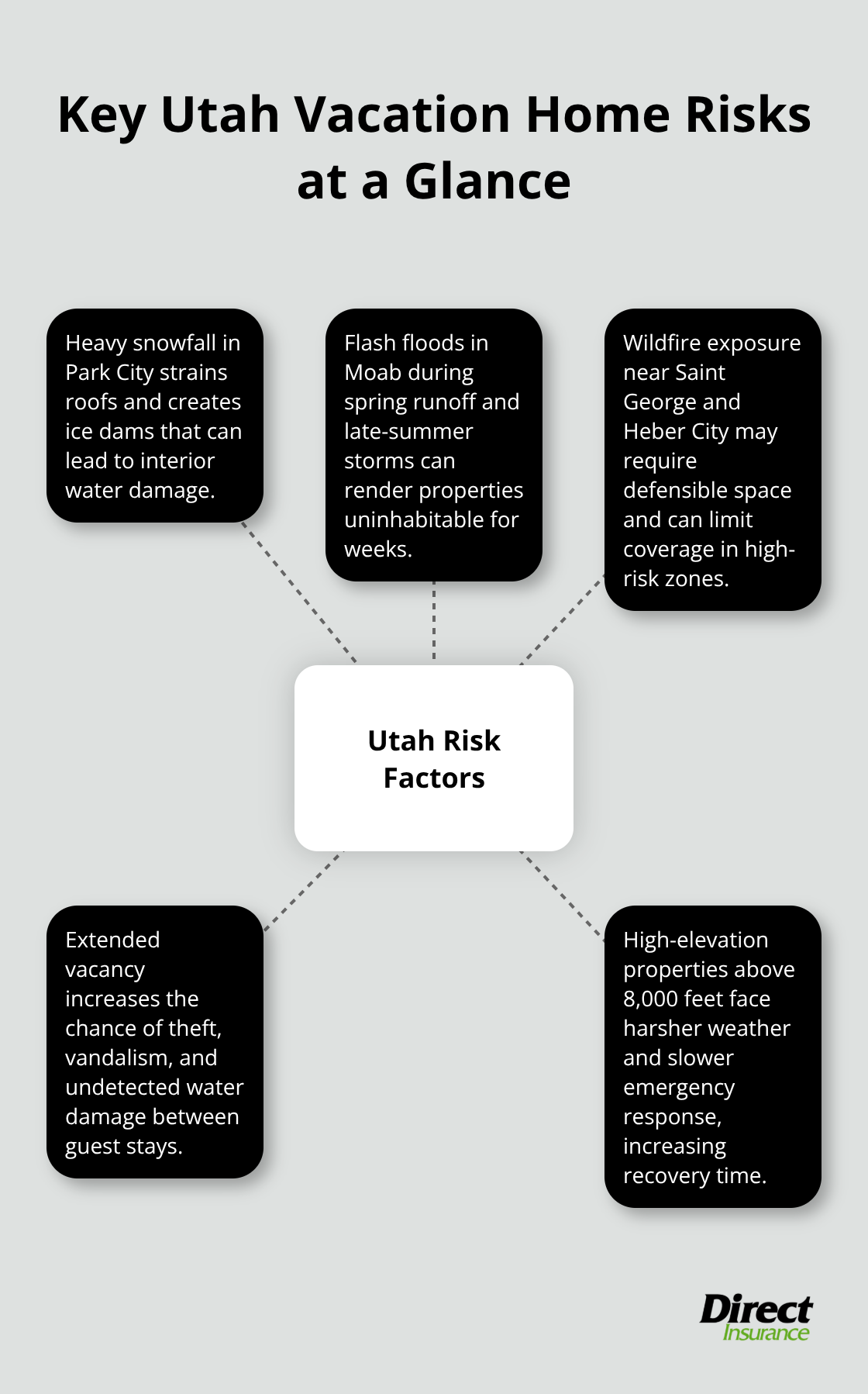
Wildfires pose a serious threat across central and southern Utah, particularly in areas near Saint George and Heber City. Standard homeowners policies may exclude or limit coverage for wildfire damage in high-risk zones, or they may require you to maintain defensible space around the property. Guidelines recommend at least 30 feet of defensible space, though requirements can vary by municipality.
Extended vacancy periods common in vacation rentals create additional exposure-insurers worry that vacant properties experience more theft, vandalism, and undetected water damage. A vacation rental policy that covers the property during vacancy periods is essential, but not all standard seasonal home policies include this protection. Utah’s elevation also matters. Properties above 8,000 feet face different weather patterns and may have limited emergency responder access, increasing repair costs and recovery time after a loss.
Location-Specific Exposures and Next Steps
Before purchasing a vacation home policy, discuss your property’s specific location with an agent who understands Utah’s regional risks. The right coverage depends on where your property sits, what type of structure it is, and how you plan to use it. Your next step involves identifying which coverage options actually protect your investment and income stream.
Coverage Options for Utah Vacation Homes
Your vacation home needs three distinct layers of protection that standard homeowners policies simply don’t provide. Each layer addresses specific risks that owner-occupied properties don’t face, and each requires careful attention to limits and exclusions.
Dwelling and Structure Protection
Dwelling coverage protects the building itself-the roof, walls, foundation, and permanent fixtures. In Utah, this means coverage for snow load damage on roofs, hail impact from summer storms, and wildfire exposure in high-risk zones. You need replacement cost value, not actual cash value, because rebuilding a mountain cabin or Moab property costs significantly more than the depreciated value of an older structure.
Utah insurers increasingly require that vacation homes maintain replacement cost coverage at 80 to 100 percent of the home’s rebuild value, not just its market value. The distinction matters enormously. A $400,000 vacation home might cost $600,000 to rebuild after a total loss because labor and materials in remote Utah locations carry premiums.
The number 100% seems to be not appropriate for this chart. Please use a different chart type. If your cabin has a hot tub, pool, or detached garage, those must be specifically listed on your policy. Many property owners under-insure their dwellings and face significant out-of-pocket costs after a major claim.
Personal Property and Contents Coverage
Personal property coverage protects your furnishings, appliances, linens, and décor inside the home. This includes items you leave for guest use-kitchen equipment, bedding, entertainment systems, and outdoor furniture. Guest-caused damage to personal property represents a substantial portion of claims, with average damages ranging from $2,000 to $8,000 per incident.
Coverage should reflect the actual replacement cost of items in the home, not just a percentage of the dwelling limit. If your property is furnished for rental, inventory everything and photograph it before the rental season starts. This documentation proves what was in the home if theft or damage occurs.
Liability Protection for Guest Injuries and Accidents
Liability protection is where most vacation home owners face dangerous exposure. This coverage defends you if a guest injures themselves on your property or damages someone else’s belongings, and it covers legal expenses and medical bills up to your policy limit. A slip on icy deck steps, a fall from a loft, or a guest injured by a broken hot tub jet can generate lawsuits exceeding $100,000 in medical costs and pain-and-suffering claims.
Standard homeowners policies typically cap liability at $100,000 to $300,000, which proves insufficient for rental properties with multiple guests. Minimum liability limits of $1,000,000 work better for active vacation rentals, particularly in high-traffic destinations like Park City or Moab. If your property attracts families with children or adventure tourists engaging in activities like hiking or water sports, liability exposure intensifies. Guest screening reduces but doesn’t eliminate risk-accidents happen regardless of tenant quality.
Your policy should also cover injuries caused by your property’s condition, such as a defective railing or deteriorating deck boards that cause someone to fall.
Loss of Rental Income During Property Closures
Loss of rental income coverage completes the protection picture. If a covered claim-fire, severe weather, or water damage-makes your property uninhabitable, this coverage reimburses your lost rental revenue during the repair period. A six-week closure during peak season in Park City could mean $12,000 to $20,000 in lost bookings. Without this coverage, you absorb both repair costs and lost income simultaneously.
This coverage applies only if the interruption stems from a covered event specified in your policy, so verify what events trigger reimbursement before you experience a loss. The right combination of these three coverage layers protects both your investment and your income stream, but selecting appropriate limits requires understanding your specific property and how you use it.
Cost Factors and Ways to Reduce Premiums
Location and Property Characteristics
Vacation home insurance premiums in Utah vary significantly based on factors you control and factors you cannot. Location matters enormously. A cabin in Park City costs substantially more to insure than an identical structure in a quieter area. Moab properties face flash flood exposure during spring runoff, which pushes premiums higher. Properties in wildfire-prone zones near Saint George or Heber City trigger additional surcharges or require proof of defensible space maintenance before insurers will quote.
Stand-alone homes cost more than condos or townhomes because isolated structures face greater wind and theft exposure. A property sitting at 8,000 feet elevation costs more to insure than one at lower altitude because emergency responder access is limited and repair costs climb. Your property type, age, roof material, and construction method all factor into the quote. A newer cabin with metal roofing and concrete foundation costs less than an older wood-frame structure with a composition roof. If you own a property with a pool, hot tub, or detached garage, expect higher premiums because those features expand liability exposure and require separate coverage endorsements.
Security Features and Safety Upgrades
You control several cost factors that directly reduce your premiums. Installing security features like deadbolts, window locks, and alarm systems lowers theft and vandalism claims, and most insurers offer 5 to 15 percent discounts for verified security systems. Upgrading to impact-resistant windows and reinforced doors in high-wind or hail-prone areas qualifies for additional discounts.
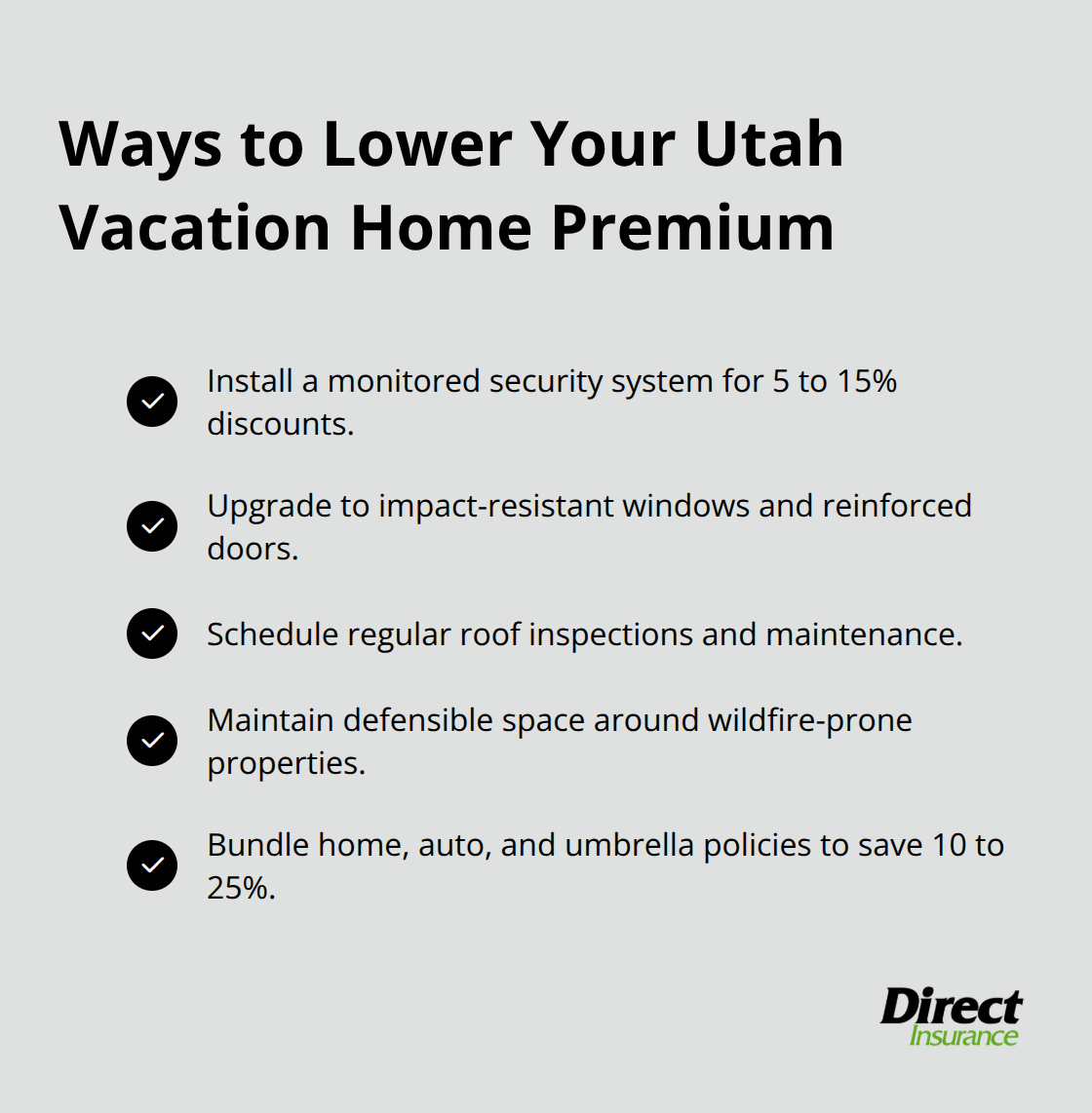
Regular roof inspections and maintenance prevent weather-related damage claims, and insurers reward this with lower rates.
Fire suppression systems and maintained defensible space around wildfire-prone properties earn discounts from carriers focused on loss prevention. Some insurers offer discounts if you personally occupy the property for a minimum number of days per year, so clarifying your actual usage pattern matters when requesting quotes. The most significant savings come from accurate property valuation and honest occupancy reporting. Undervaluing your dwelling limit to save premium dollars backfires after a claim when you discover rebuild costs exceed your coverage. Misrepresenting how many days per year you occupy the property or how frequently guests stay creates coverage gaps and claim denials.
Bundling Policies and Discount Opportunities
Bundling your vacation home policy with your primary residence policy, auto insurance, and umbrella coverage typically saves 10 to 25 percent across all policies. Shopping multiple top-rated insurance companies helps you find the best combination of coverage and discounts for your specific situation, which means you avoid overpaying for protection you don’t need while maintaining adequate limits where exposure exists. An independent insurance agency can compare options across carriers to identify which discounts apply to your property and usage pattern.
Final Thoughts
Protecting your Utah vacation home requires more than hoping your primary residence policy covers rental activity. Standard homeowners insurance leaves you exposed to guest-related damage, liability claims, lost rental income, and weather-specific risks that Utah properties face year-round. A proper vacation home policy Utah addresses these gaps with dwelling protection at replacement cost, personal property coverage for furnishings, liability limits appropriate for guest exposure, and loss of income protection during property closures.
Your specific costs depend on location, property type, security features, and how you use the home. A cabin in Park City costs more to insure than an identical structure elsewhere because of snow load exposure and high visitor traffic. Moab properties face flash flood risk, while wildfire-prone areas require defensible space maintenance. You control other factors-installing security systems, maintaining your roof, and upgrading to impact-resistant materials all reduce premiums, and bundling your vacation home policy with auto and primary residence coverage typically saves 10 to 25 percent across all policies.
We at Direct Insurance Services have been helping Utah property owners since 1973. Our team shops multiple top-rated insurance companies to find the best combination of coverage and discounts for your situation, and we’ll review your property details, discuss your rental plans, and build a vacation home policy that actually protects your investment and income stream. Contact us today for a personalized quote and let’s secure the right coverage for your Utah property.
Disclaimer: The information provided in this blog is for general informational purposes only and does not constitute legal, financial, or insurance advice. Coverage options, terms, and availability may vary. Please consult with a licensed professional for advice specific to your situation

