Utah Motorcycle Insurance: Finding Coverage That Fits Your Ride
Motorcycle riders in Utah face unique insurance challenges that differ significantly from standard auto coverage. At Direct Insurance Services, we know that finding the right Utah motorcycle insurance requires understanding your specific needs and the options available to you.
This guide walks you through what makes motorcycle insurance different, how to compare coverage types, and the common mistakes riders make when protecting their bikes.
What Makes Motorcycle Insurance Different from Auto Insurance
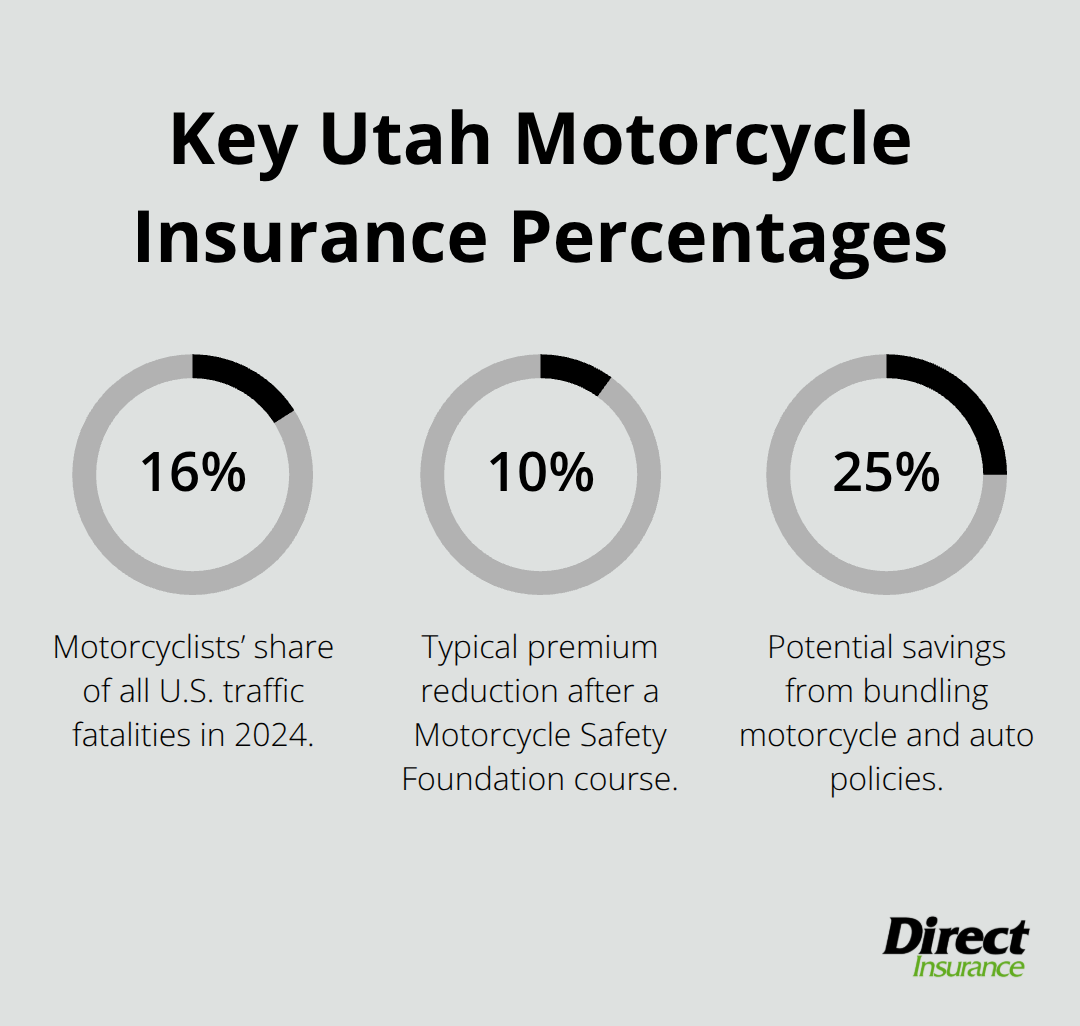
Motorcycle insurance premiums in Utah run significantly higher than auto insurance, and insurers have concrete reasons for this gap. The National Highway Traffic Safety Administration reports that motorcycle riders continue to be overrepresented in fatal traffic crashes. In 2024, there were 6,228 motorcyclists killed – 16% of all traffic fatalities. This stark reality directly translates to higher claim payouts, which is why insurers charge more.
A typical motorcycle policy in Utah costs between $200 and $500 annually for basic coverage, while comprehensive and collision add-ons can push premiums to $800 or higher (depending on your bike’s value and riding history). Age matters considerably-riders under 25 face substantially steeper rates because insurance data shows this group files claims at higher rates than older riders.
Coverage Types Specific to Your Motorcycle
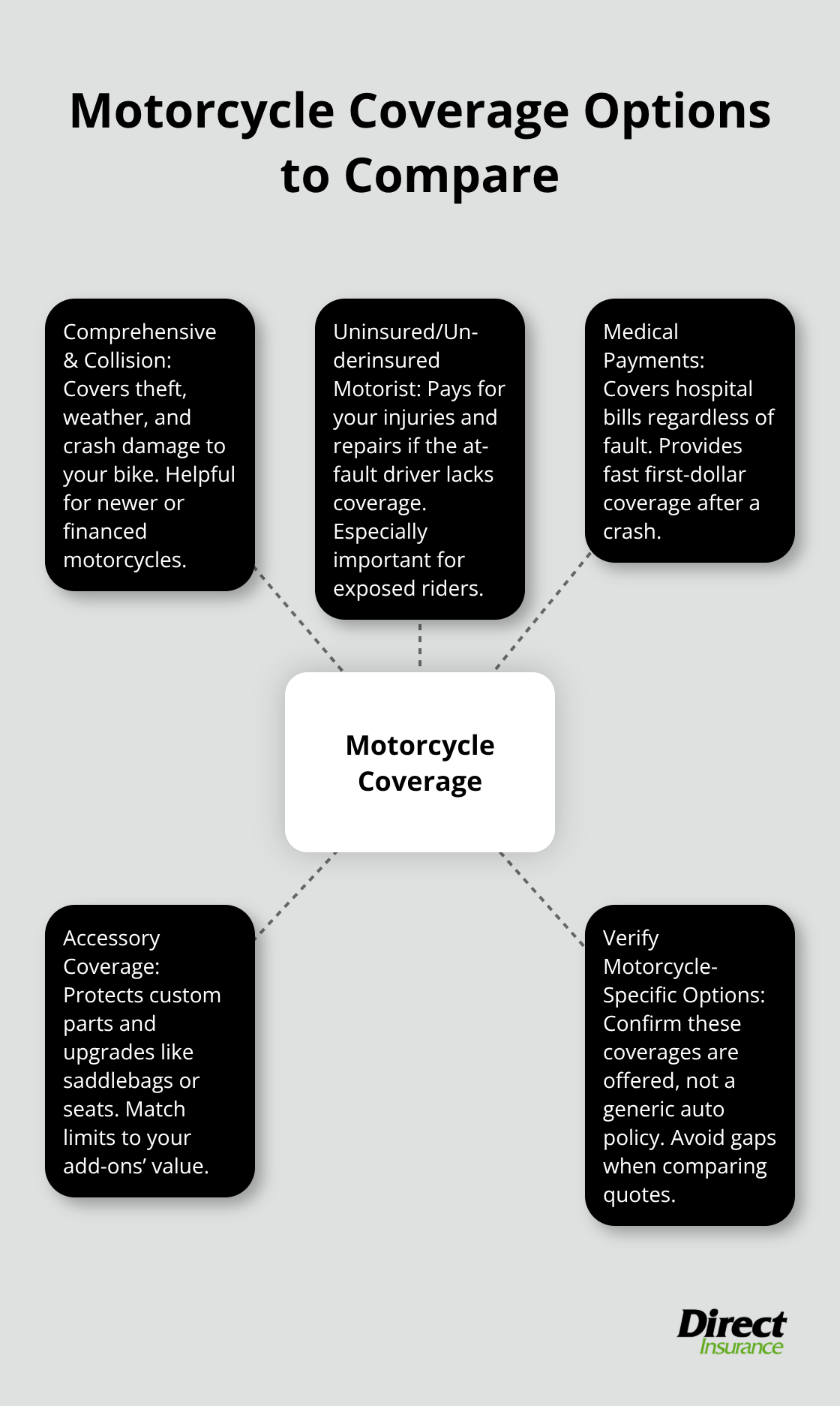
Standard auto insurance simply doesn’t cover motorcycles because bikes require different protection. Motorcycle-specific coverage includes comprehensive and collision protection for your bike itself, which addresses theft, weather damage, and accidents. Uninsured and underinsured motorist coverage becomes even more critical for riders since you lack the protective shell a car provides-if an uninsured driver hits you, this coverage pays your medical bills and bike repairs. Many Utah riders overlook medical payments coverage, which covers your hospital costs regardless of who caused the accident. Accessory coverage protects custom parts like saddlebags or upgraded seats that aren’t included in standard policies. When you compare quotes, verify that each insurer offers these motorcycle-specific options rather than trying to force you into a generic auto policy.
Liability Limits That Actually Protect You
Utah requires minimum liability coverage of 25/50/20, meaning $25,000 for one person’s injuries, $50,000 total per accident, and $20,000 for property damage. This minimum is dangerously low for motorcycle riders. If you cause a serious accident, these limits disappear quickly-a single hospitalization can exceed $100,000. You should try carrying at least 100/300/100 coverage, which provides $100,000 per person and $300,000 per accident for bodily injury. This higher limit costs only slightly more but protects your personal assets if you’re found liable for a major accident. Riders with significant savings or home equity should consider umbrella policies that add an extra $1 million in liability protection for roughly $150 to $300 annually (a smart investment that prevents a single accident from destroying your financial future).
Why Your Riding Habits Shape Your Rates
Insurers don’t treat all riders the same. Your annual mileage, commute distance, and how often you ride directly affect your premium. A rider who commutes 40 miles daily on highways faces higher rates than someone who rides only weekends on back roads. Utah’s weather patterns also influence rates-riders who store their bikes during winter months typically pay less than year-round riders. You should disclose your actual riding habits honestly when you apply for coverage, as misrepresenting this information can lead to claim denials. Insurers also consider your motorcycle type; sport bikes attract higher premiums than cruisers or touring bikes because claims data shows sport bike riders file more claims.
Getting Accurate Quotes for Your Situation
Comparing quotes from multiple insurers reveals significant price differences for identical coverage. When you request quotes, provide the same information to each company-your bike’s year, make, model, VIN, annual mileage, and riding history. Small variations in how you describe your situation can swing quotes by hundreds of dollars. You should also ask each insurer about available discounts (safety course completion, bundling home and auto policies, or installing anti-theft devices can reduce your premium). Local agents who understand Utah’s specific riding conditions and insurance landscape can help you navigate these options and find coverage that actually fits your needs and budget.
Finding the Right Motorcycle Insurance Coverage in Utah
Match Coverage to Your Actual Riding Situation
The biggest mistake Utah riders make is selecting coverage based on price alone rather than their specific riding patterns. Your insurance costs reflect how you actually use your motorcycle, so accurately describing your habits matters far more than trying to game the system. When you contact insurers for quotes, you’ll need specifics: annual mileage, whether you commute year-round or store your bike seasonally, the roads you typically ride, and your experience level.
A rider who logs 3,000 miles annually on weekend back roads pays substantially less than someone commuting 200 miles weekly on Interstate 15. Utah’s geography works in your favor here-riders who store bikes during winter months (November through March) qualify for reduced premiums because insurers recognize the lower risk period. If you ride only spring through fall, tell your insurer this explicitly; some companies offer seasonal policies that pause coverage during storage months, cutting your annual cost by 20 to 30 percent.
Your bike type also determines pricing, and sport bikes consistently cost more to insure than cruisers or touring bikes because claims data shows higher accident rates for sport bike riders.
Request Quotes from Multiple Insurers
Requesting quotes from at least three insurers reveals how much your riding profile influences pricing. When you gather quotes, provide identical information to each company-your motorcycle’s year, make, model, and VIN matter because insurers price based on repair costs and theft rates for specific models. A 2024 Harley-Davidson Street Glide may quote differently than a 2024 Kawasaki Ninja because their damage claims profiles differ.
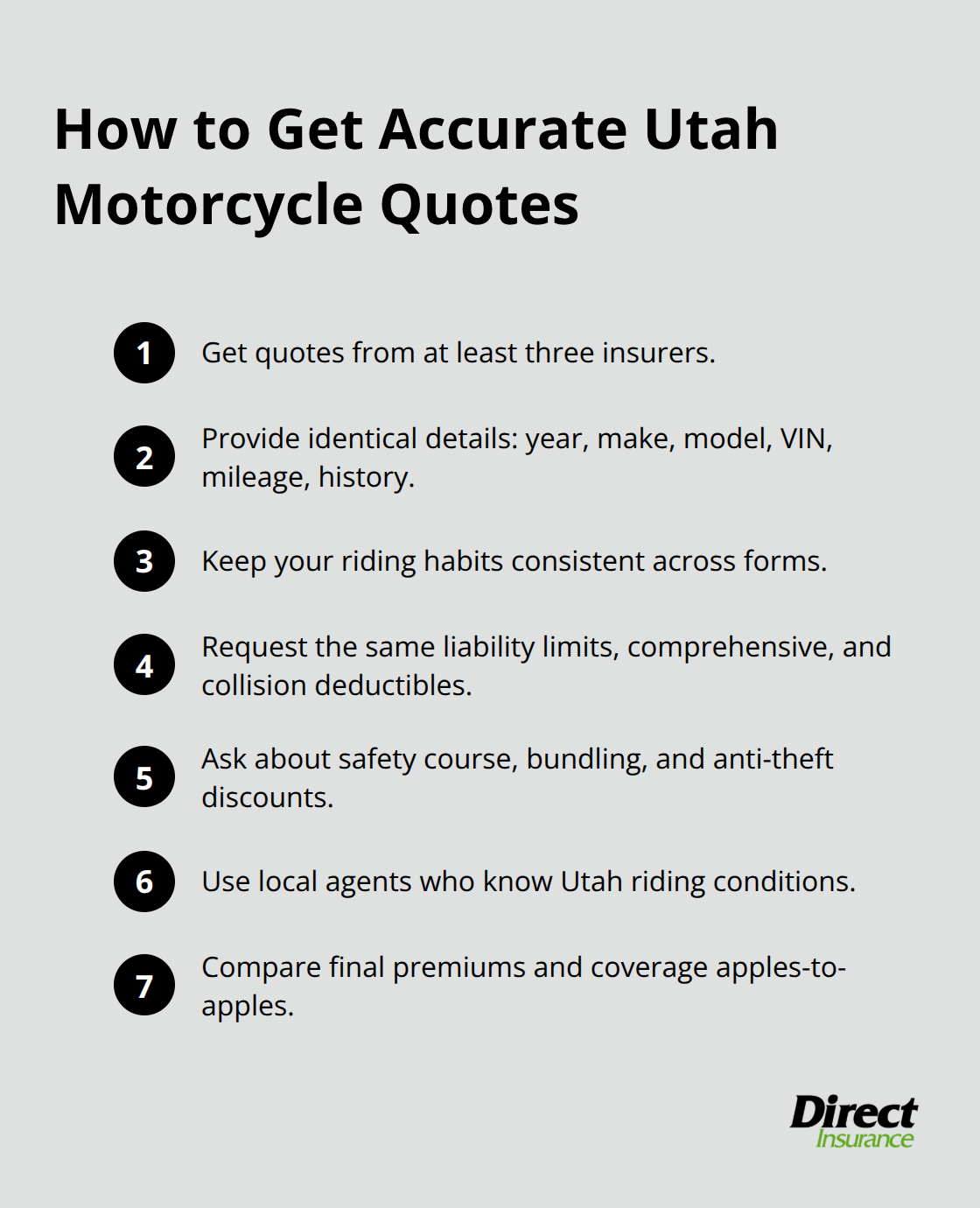
Request the same coverage limits from each insurer so you’re actually comparing apples to apples; this means asking for Utah’s minimum liability coverage of $30,000/$65,000/$25,000 plus comprehensive and collision at the same deductible level. You’ll likely see price swings of $200 to $400 annually for identical coverage, which means getting multiple quotes directly saves you money.
Ask each insurer about specific discounts that apply to you-completing a Motorcycle Safety Foundation course through a provider like the Utah Department of Public Safety can reduce premiums by 10 to 15 percent, bundling motorcycle and auto policies typically saves 15 to 25 percent, and installing GPS tracking or anti-theft devices sometimes qualifies for additional discounts. Many riders skip this step and leave hundreds of dollars on the table annually.
Select Deductibles Based on Your Financial Situation
Your deductible choice directly determines your out-of-pocket costs if you file a claim, so this decision should reflect your emergency savings rather than wishful thinking. A $500 deductible costs more upfront but means you pay only $500 if your bike is damaged; a $1,000 deductible reduces your monthly premium but increases your personal financial risk.
Utah riders with less than three months of emergency savings should stick with $500 deductibles because a major accident could devastate their finances otherwise. Coverage limits matter equally-carrying higher liability limits costs only slightly more than minimum coverage but protects your home and savings from a judgment. A single hospitalization with surgery and rehabilitation easily exceeds $100,000, which means you’d be personally liable for the remaining amount if you only carry minimum coverage.
Carrying 100/300/100 liability limits costs roughly $30 to $50 more annually than minimum coverage but protects your home and savings from a judgment. Riders with significant assets should absolutely consider umbrella policies adding $1 million in additional liability protection for approximately $150 to $300 per year-this is genuinely cheap protection against financial catastrophe. These decisions shape how well your policy actually protects you when accidents happen, which is why the next section focuses on the mistakes riders make when they rush through this process.
Common Mistakes Utah Riders Make with Insurance
Underinsuring to Save on Premiums
Utah riders consistently select minimum liability coverage (25/50/20) because it costs less upfront, but this creates massive financial exposure. A single serious accident with medical bills exceeding $100,000 means you personally owe the difference if you only carry minimum coverage. Your home, savings, and future wages become vulnerable to collection efforts.
Riders often choose $1,000 deductibles instead of $500 deductibles to save $100 annually, only to face $8,000 in damages from a collision and realize they made a terrible trade. Saving $100 per year while risking $500 more out-of-pocket is a losing bet. Riders with actual financial cushions should carry 100/300/100 liability limits, which costs roughly $30 to $50 more annually than minimum coverage. This higher limit protects your home and savings from a judgment.
Umbrella policies add $1 million in protection for $175 to $300 yearly-this isn’t expensive insurance, it’s cheap protection against financial devastation. A single hospitalization with surgery and rehabilitation easily exceeds $100,000, which means you’d be personally liable for the remaining amount if you only carry minimum coverage.
Ignoring Utah’s Seasonal Riding Patterns
Many riders pay for full-year coverage even though they store their motorcycles from November through March. Insurance companies recognize that stored bikes face minimal risk, yet riders keep paying full premiums during winter months. Some insurers offer seasonal policies that pause coverage during storage periods, reducing annual costs by 20 to 30 percent.
If you ride only spring through fall, contact your insurer and explicitly request seasonal coverage. Don’t assume they’ll volunteer this option. Utah’s geography works in your favor here-riders who store bikes during winter months qualify for reduced premiums because insurers recognize the lower risk period. This simple step saves hundreds of dollars annually for many Utah riders.
Overlooking Discount Opportunities
Riders who skip requesting quotes from multiple insurers leave $200 to $400 on the table yearly. Completing a Motorcycle Safety Foundation course through providers like the Utah Department of Public Safety cuts premiums by 10 to 15 percent. Bundling motorcycle and auto policies typically saves 15 to 25 percent annually.
Installing GPS tracking or anti-theft devices qualifies for additional discounts with many insurers. When you request quotes, ask each company about available discounts specific to your situation. Many riders never ask, which means they miss substantial savings. Local agents who understand Utah’s specific riding conditions can help you identify these discounts and match them with coverage that actually fits your riding habits.
Final Thoughts
Utah motorcycle insurance works best when you match coverage to your actual riding habits, compare quotes from multiple insurers, and avoid the mistakes that leave riders financially exposed. Carrying minimum liability limits to save money puts your home and savings at risk, while paying for full-year coverage when you store your bike seasonally wastes hundreds of dollars annually. Skipping discount opportunities means you miss substantial savings that could reduce your premiums by 20 to 30 percent.
We at Direct Insurance Services understand Utah’s unique riding conditions and can help you navigate these decisions with confidence. Our local agents shop multiple top-rated insurance companies to find you the best coverage at competitive rates, and we identify available discounts specific to your situation rather than pushing you toward one company’s products. Contact Direct Insurance Services to start your Utah motorcycle insurance quote-our team will explain how different coverage levels protect you financially while keeping your premiums reasonable.
Getting started takes just a few minutes when you provide details about your motorcycle, annual mileage, and riding habits. Our agents request quotes from multiple carriers and adjust your policy as your riding patterns change throughout the year, so you always have protection that actually fits your needs. The goal is finding coverage that protects you when accidents happen, not selling you the cheapest policy available.
Disclaimer: The information provided in this blog is for general informational purposes only and does not constitute legal, financial, or insurance advice. Coverage options, terms, and availability may vary. Please consult with a licensed professional for advice specific to your situation

