Understanding Home Insurance Costs Utah: What Affects Your Premiums
Home insurance costs in Utah vary significantly based on where you live and what risks your property faces. At Direct Insurance Services, we’ve helped thousands of Utah homeowners understand why their premiums are what they are.
Your home’s value, location, and local hazards like wildfires and hail all play a role in determining your rate. The good news is that several practical steps can help you reduce what you pay.
What Determines Your Home Insurance Premium in Utah
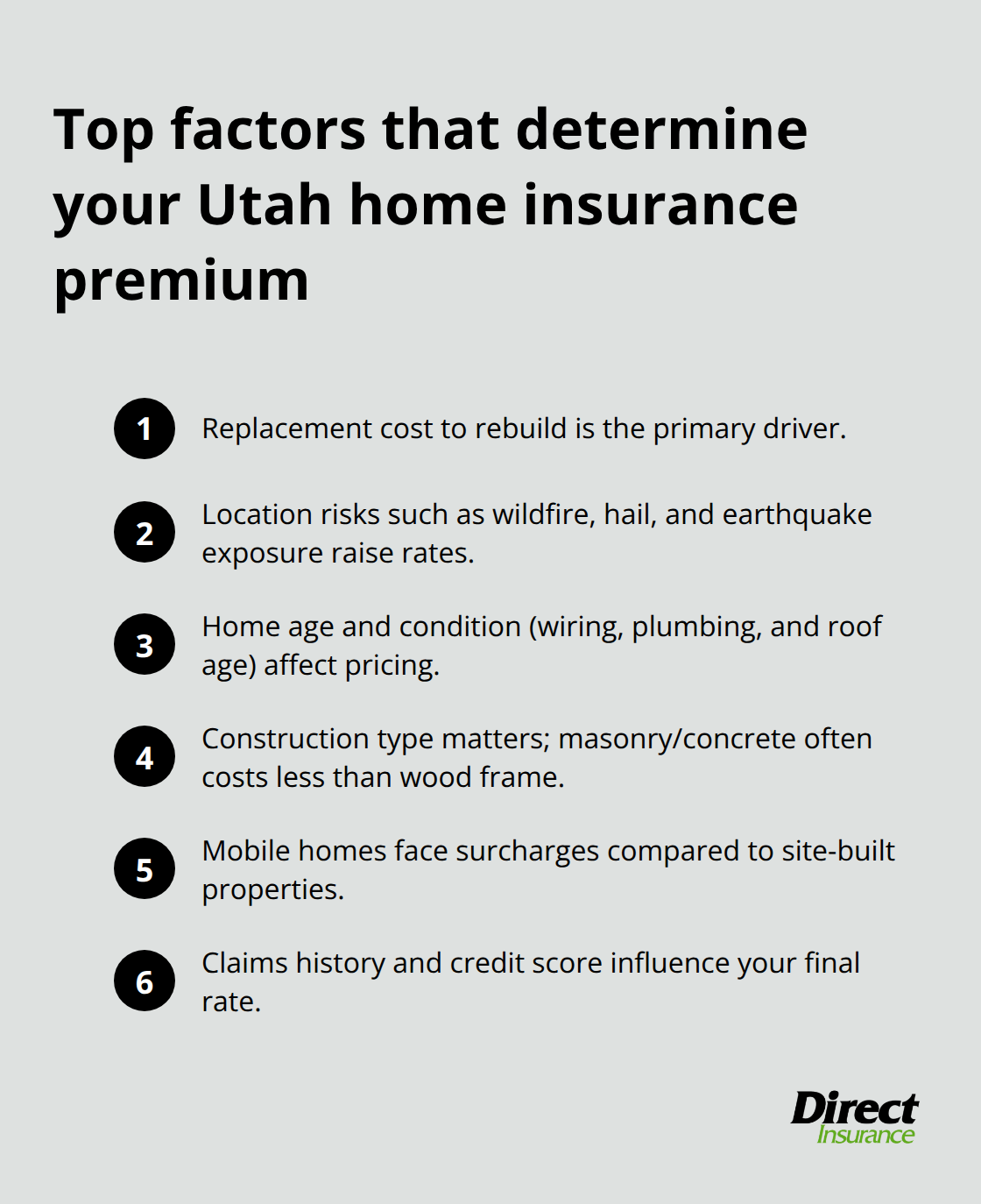
Your home’s replacement cost to rebuild your home stands as the primary driver of your premium. Insurers calculate this based on what it would cost to rebuild your home from scratch, not its market value. In Utah, construction costs range from $200 to $500 per square foot, with current labor rates between $38 to $58 per hour. If your home was built in 1985, you likely underestimated reconstruction expenses. Modern building codes, updated electrical systems, and current material prices push actual replacement costs higher than most homeowners assume.
Many Utah homeowners underinsure their homes by 20 to 30 percent, leaving them vulnerable if disaster strikes.
How Location Shapes Your Rate
Where your home sits on a Utah map matters enormously. Properties in Salt Lake City’s foothills face higher wildfire risk than homes in Provo or Ogden, translating directly into premium increases of 15 to 40 percent depending on proximity to forested areas. Hail damage affects the Wasatch Front disproportionately-the National Weather Service recorded over 100 hail events annually in Utah during the past decade, with the highest concentration along the I-15 corridor. Homes near the Wasatch fault line in Salt Lake, Davis, and Weber counties face earthquake exposure that eastern Utah properties don’t, affecting premiums accordingly. Local water availability also plays a role; areas with adequate fire hydrant coverage and municipal water systems receive better rates than rural properties relying on wells or distant hydrants.
Your Home’s Age and Construction Matter More Than You Think
Homes built before 1980 typically cost 10 to 25 percent more to insure than newer construction. Older wiring, outdated plumbing, and aging roofs present genuine claim risks that insurers price into premiums. A home with a roof over 20 years old will see a rate increase, while a roof under 10 years triggers discounts from most carriers. Masonry or concrete construction lowers premiums compared to wood frame homes, while mobile homes face surcharges of 30 to 50 percent over site-built properties.
Claims History and Credit Score Impact Your Rates
Your claims history and credit score round out the equation. One claim in the past five years increases rates by 10 to 40 percent, and insurers use credit scores as predictive tools, with lower scores correlating to higher premiums regardless of the reasoning behind the score. These factors work together with your home’s characteristics to shape what you ultimately pay each month.
Understanding these premium drivers positions you to make informed decisions about your coverage. The next section explores Utah-specific risks that insurers factor into their calculations and how seasonal threats affect your rates.
What Makes Utah Home Insurance Rates Higher Than Other States
Utah faces a combination of natural hazards that most states don’t contend with simultaneously, and insurers price premiums accordingly. Wildfires have become the dominant concern for Utah homeowners, particularly those in the Wasatch Front corridor.
Wildfire Risk Dominates Utah’s Insurance Landscape
The state experienced over 350,000 acres burned in 2023 alone, according to Utah Division of Forestry, Fire and State Lands data. Properties within 5 miles of wildland-urban interface zones see premium increases of 25 to 60 percent compared to homes in safer areas. If you live in Salt Lake City’s foothills, Ogden Canyon, or near Park City, your insurer likely applies a wildfire surcharge that directly impacts your monthly bill.
Some carriers have stopped writing new policies in high-risk zones entirely, leaving homeowners with fewer options and higher costs. The wildfire threat extends beyond summer months-fall winds in September and October create dangerous conditions that insurance companies track closely when calculating rates.
Hail Damage Creates Widespread Claims
Hail damage ranks as Utah’s second-largest insurance concern, and the numbers justify this focus. Between 2010 and 2023, Utah averaged 120 hail events annually according to the National Weather Service, with the Wasatch Front experiencing the heaviest concentrations. Homeowners along the I-15 corridor from Ogden to Provo report hail damage claims at rates two to three times higher than national averages.
A single hailstorm in 2020 generated over 20,000 insurance claims across the state. Roof age becomes critical in hail-prone areas-carriers often require roof inspections and may deny coverage for roofs over 15 years old in these zones. Winter storms compound the problem by bringing heavy snow loads that stress aging roofing systems already weakened by hail impact.
Earthquake Risk Affects Specific Regions
Earthquake risk, while less frequent than fire and hail events, affects specific Utah regions substantially. The Wasatch fault line runs directly through Salt Lake, Davis, and Weber counties, and insurers charge 5 to 15 percent premiums in these areas compared to eastern Utah properties outside the fault zone. Most standard homeowners policies exclude earthquake damage, requiring separate endorsements that cost $300 to $800 annually depending on your home’s value and construction type.
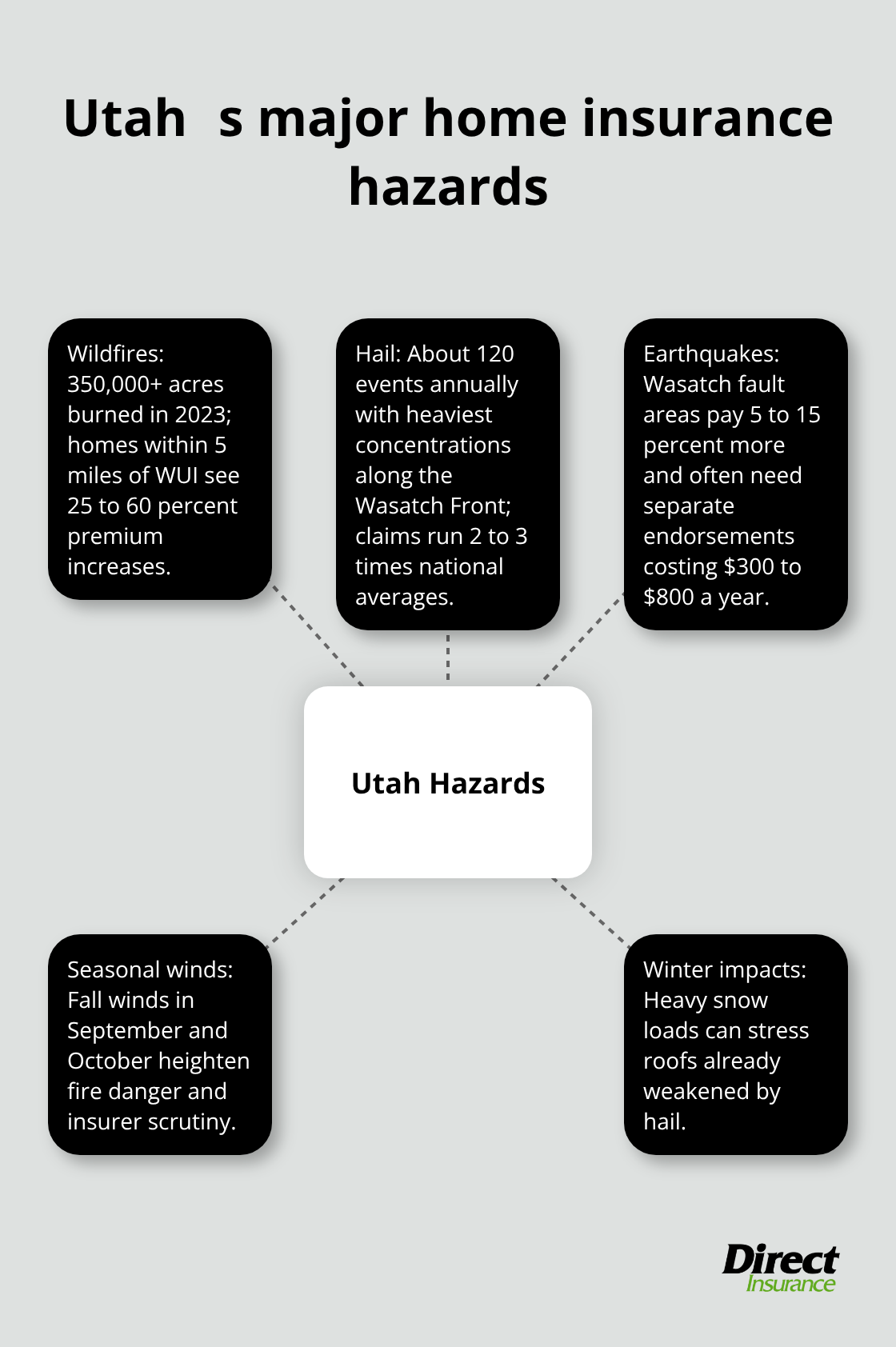
These three hazards-wildfires, hail, and earthquakes-combine to make Utah’s insurance market distinct from the rest of the country. Understanding how each threat affects your specific location helps explain your premium, and it also reveals opportunities to reduce what you pay through targeted actions.
How to Reduce Your Utah Home Insurance Premium
Knowing what drives your premium higher puts you in position to take action. Utah homeowners who actively manage their coverage typically save between $300 and $800 annually compared to those who simply accept their initial quote. The most effective strategy combines multiple approaches rather than relying on a single tactic.
Raise Your Deductible Strategically
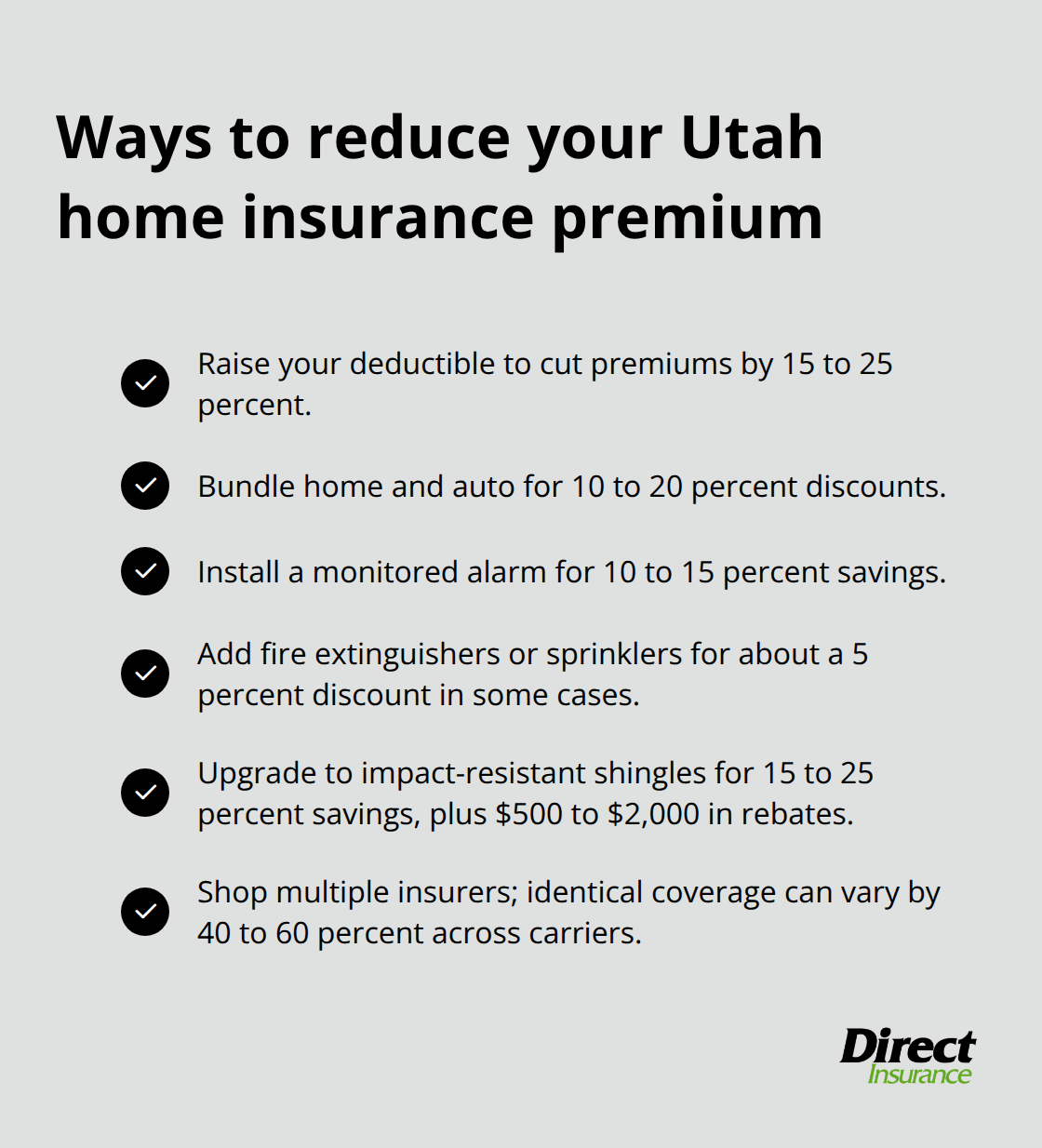
A deductible increase from $500 to $1,000 cuts premiums by 15 to 25 percent immediately, though you’ll pay more out-of-pocket if a claim occurs. This works best if you have emergency savings set aside and live in a lower-risk area where major claims remain unlikely. The trade-off between monthly savings and potential claim costs requires honest assessment of your financial situation and risk tolerance.
Bundle Policies for Substantial Discounts
Combining your home and auto insurance with the same carrier generates 10 to 20 percent discounts on both policies according to National Association of Insurance Commissioners data. Some insurers offer additional reductions when you add umbrella coverage or business policies to the mix. This approach simplifies your billing while rewarding loyalty with meaningful savings across your entire insurance portfolio.
Invest in Home Security and Safety Features
Home security upgrades deliver tangible savings that vary by upgrade type. Dead-bolt locks reduce premiums by 2 to 5 percent, monitored alarm systems knock off 10 to 15 percent, and fire extinguishers or sprinkler systems add another 5 percent in some cases. Storm shutters in hail-prone areas along the Wasatch Front qualify for specific discounts that can reach 10 to 12 percent given Utah’s documented hail risk.
Upgrade Your Roof for Maximum Impact
Roof upgrades matter tremendously in this state-replacing an aging roof with impact-resistant shingles rated for hail resistance drops premiums by 15 to 25 percent and often qualifies for manufacturer rebates worth $500 to $2,000. This investment protects your home while immediately lowering your insurance costs, making it one of the most cost-effective improvements you can make in Utah’s climate.
Shop Multiple Insurers for the Best Rates
Rates for identical coverage vary by 40 to 60 percent across carriers in Utah, making comparison shopping your most powerful lever. An independent insurance agency can access quotes from numerous companies simultaneously rather than requiring you to contact each insurer individually, saving hours of work while identifying the best rates available in your specific risk zone. Direct Insurance Services, based in Salt Lake City since 1973, shops multiple top-rated insurance companies to help Utah homeowners find competitive coverage that fits their needs and budget.
Final Thoughts
Your home insurance costs in Utah reflect real risks in your area and genuine characteristics of your property, but that number isn’t fixed. Multiple strategies work together to lower what you pay-raising your deductible, bundling policies, upgrading your roof, and installing security features all contribute to meaningful savings. Shopping multiple insurers remains your most powerful tool, since rates for identical coverage vary dramatically across carriers in Utah’s market.
Your coverage needs shift as your home ages, your family situation evolves, and new risks emerge in your area. An annual policy review catches opportunities to apply new discounts, adjust deductibles based on your current financial situation, and verify that your replacement cost estimate still reflects actual rebuilding expenses in today’s market. This simple habit prevents you from overpaying for coverage you don’t need while maintaining adequate protection for what matters most.
Direct Insurance Services has helped Utah homeowners since 1973 by shopping multiple top-rated insurance companies to find competitive rates tailored to your specific needs and budget. As locals who understand Utah’s unique risks and insurance landscape, we guide you through securing the right coverage at the right price for your home insurance costs in Utah.
Disclaimer: The information provided in this blog is for general informational purposes only and does not constitute legal, financial, or insurance advice. Coverage options, terms, and availability may vary. Please consult with a licensed professional for advice specific to your situation

