

Utah Personal Umbrella Policy: Extra Liability You Can Count On
Your standard home and auto insurance policies have limits. When a lawsuit or major accident pushes past those boundaries, your personal assets face real danger.
A Utah personal umbrella policy fills that gap by providing additional liability coverage-often $1 million or more-that kicks in when your regular policies max out. We at Direct Insurance Services help Utah families understand how this protection works and why it matters for their financial security.
How Umbrella Coverage Works Above Your Standard Policies
An umbrella policy operates as a second layer of liability protection that activates only after your homeowners or auto insurance reaches its limit. According to the Insurance Information Institute, a typical umbrella policy starts at $1 million in coverage and costs far less than you might expect relative to the protection it provides. If someone sues you for $2 million after a serious accident on your property, and your homeowners policy covers only $300,000, your umbrella fills the remaining $1.7 million gap. This isn’t theoretical-Utah residents with rental properties, teenage drivers, or valuable assets face genuine exposure to six-figure lawsuits.
The Layering Structure
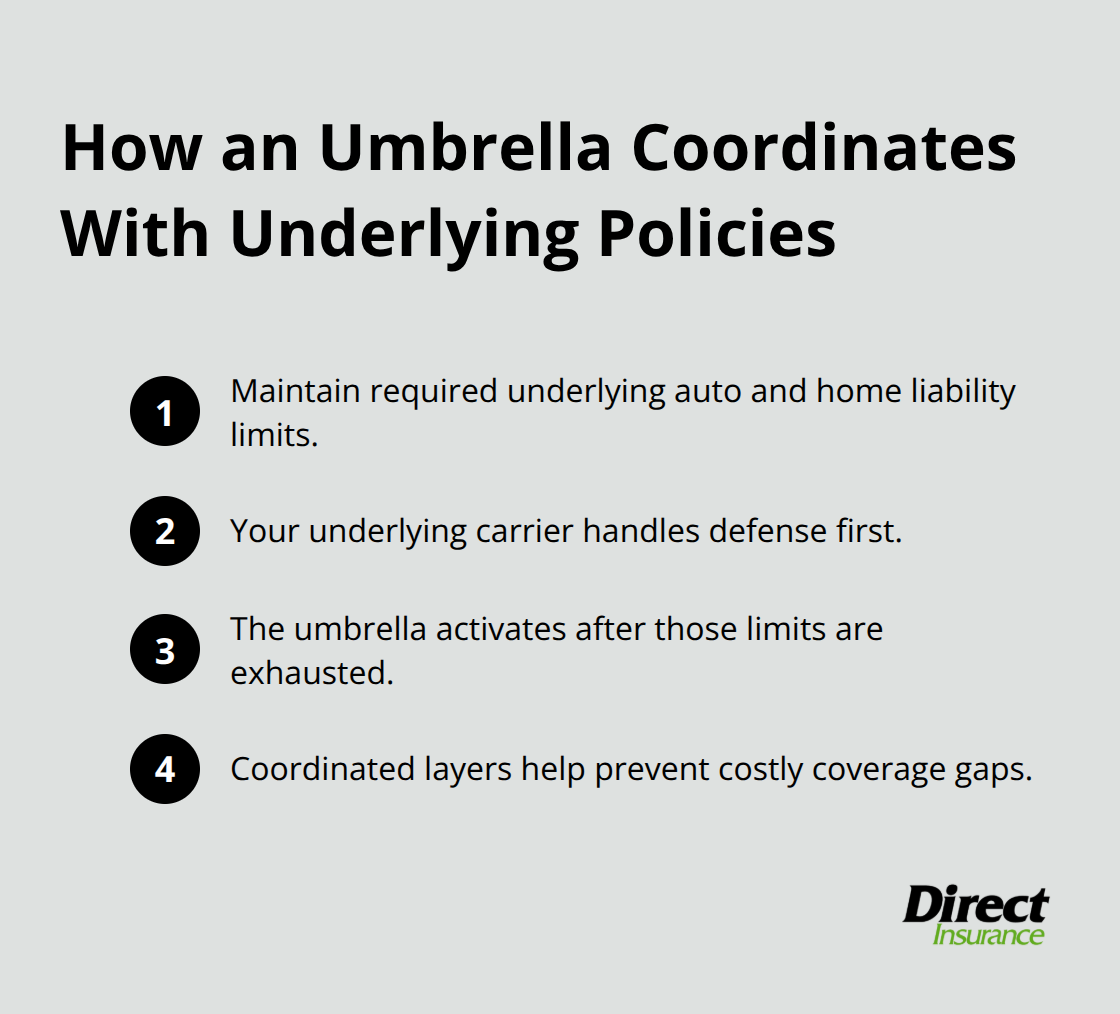
Your umbrella doesn’t replace your standard policies; it requires you to maintain specific underlying liability limits on auto and home coverage before it activates. Most insurers demand minimums like $250,000 to $300,000 in underlying auto liability and $300,000 in homeowners liability. Your umbrella coordinates directly with these policies, meaning your underlying carrier handles the defense first, then the umbrella kicks in once those limits are exhausted. This coordination protects you from gaps that could otherwise drain your personal assets.
What Your Umbrella Actually Covers
Umbrella coverage provides liability protection for injuries to others, damage to others’ property, and certain lawsuits-areas where standard policies often cap out quickly. The National Association of Insurance Commissioners notes that some policies offer worldwide liability coverage, which matters if you rent vacation properties or travel internationally. Defense costs typically fall under umbrella coverage as well, though you should verify whether those expenses count toward your policy limit or sit outside it. Utah residents should know that certain activities carry exclusions: intentional acts, professional services, and high-risk activities won’t be covered.
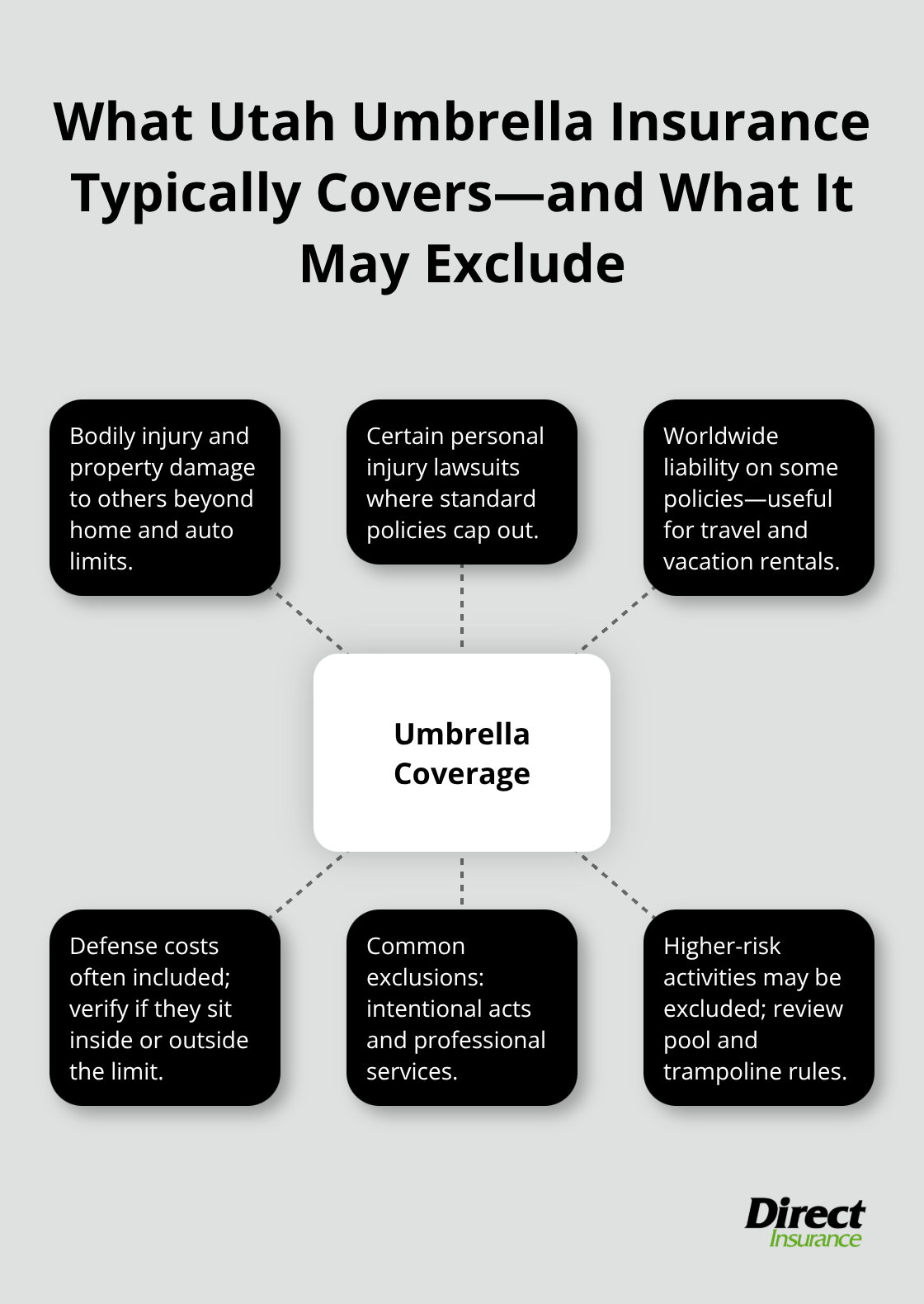
Someone with a swimming pool, a trampoline, or regular social gatherings faces higher liability exposure than someone in a low-traffic residential situation.
Calculating Your Coverage Needs
The right umbrella limit depends entirely on your assets and earning potential. If you own a home worth $500,000, have $200,000 in retirement savings, and earn $100,000 annually, a $1 million umbrella provides reasonable protection. If you own rental properties or have multiple vehicles with teenage drivers, you should consider $2 million or higher. The Insurance Information Institute recommends that you inventory your current assets and projected future earnings, then select an umbrella limit that sits comfortably above your underlying policy limits.
Finding Affordable Coverage
Bundling umbrella coverage with your auto and homeowners policies often yields discounts in Utah-ask any agent about multi-policy pricing before committing. Premium costs vary based on your assets, household drivers, driving history, and location, but most Utah families find umbrella coverage surprisingly affordable given the exposure it eliminates. Working with a local agent who understands Utah’s specific risks helps you match your coverage to your actual situation rather than overpaying for protection you don’t need. Your next step involves assessing your personal liability exposure and determining which coverage limit truly protects your financial future.
Why Utah Residents Face Real Liability Gaps
Utah’s Outdoor Lifestyle Multiplies Liability Exposure
Utah’s geography and lifestyle create specific liability exposures that standard homeowners and auto policies simply don’t cover adequately. The state’s outdoor recreation culture means more residents own property with pools, trampolines, and open land where guests gather frequently. Families with these features face substantially higher lawsuit risk than average households. A single slip-and-fall incident at a backyard gathering or a trampoline injury can trigger medical claims exceeding $500,000 in treatment and ongoing care. Your homeowners policy typically caps liability at $300,000 to $500,000, leaving you personally responsible for anything beyond that threshold.
Rental Properties and Investment Real Estate Compound Your Risk
Utah’s growing population also means more rental properties and investment real estate among residents, which multiplies liability exposure since you remain legally liable for injuries occurring on rental units. A tenant or visitor injured on your rental property can sue you for damages that far exceed your standard policy limits. This exposure stacks on top of your primary residence liability, creating a compounded financial threat that most Utah property investors underestimate until a claim arrives.
Teenage Drivers and Multi-Vehicle Households
Teenage drivers present another Utah-specific risk: households with multiple drivers face compounded exposure, especially when young drivers cause serious accidents. A single at-fault collision involving a teenager can generate medical claims, lost wages, and pain-and-suffering damages totaling $1 million or more. Your auto policy’s $250,000 to $300,000 limit evaporates quickly in these scenarios, leaving your home equity and savings vulnerable.
Hidden Gaps in Standard Coverage
Standard policies also contain significant gaps that most Utah residents overlook until a claim occurs. Your homeowners liability doesn’t cover injuries or damage related to business activities, so if you operate any home-based enterprise, you face exposure. Defense costs in major lawsuits consume policy limits rapidly; a single lawsuit can cost $50,000 to $150,000 just to defend, leaving less money for actual claim settlement. Umbrella coverage typically includes defense costs outside the main limit or as part of it, depending on the policy structure you choose.
The Real Cost of Underinsurance
Utah residents with valuable assets should calculate their true exposure honestly: if you own a $600,000 home, have $300,000 in retirement accounts, and earn $120,000 annually, a lawsuit for $1.2 million wipes out your financial security entirely. An umbrella policy starting at $1 million in coverage costs roughly $150 to $300 annually for most Utah families, making it extraordinarily cost-effective insurance against catastrophic personal liability. The gap between your current coverage and your actual assets represents real financial danger-one that an affordable umbrella policy eliminates. Understanding which specific coverage limits protect your situation requires honest assessment of your assets, your family’s activities, and your earning potential over the next decade.
Choosing Your Right Umbrella Limit
Calculate Your Total Asset Base
Start with honest math, not guesswork. Add up everything you own: your home value, retirement accounts, investment properties, vehicles, and any other significant assets. If your home is worth $550,000 and you have $250,000 in retirement savings plus $180,000 in investment real estate equity, your total asset base sits at roughly $980,000. A good rule of thumb is to choose umbrella coverage at least equal to the total asset base, which means a $1 million policy barely covers you. You need breathing room above your actual assets because lawsuits often seek damages beyond just property value-they target future earnings, pain and suffering, and punitive damages. Utah residents with $1 million in assets should seriously consider a $2 million umbrella, not the minimum $1 million most people default to. The difference in annual premium between these two limits typically runs only $200 to $400 more per year, making the upgrade practically mandatory for anyone with substantial equity.
Account for Your Household Composition and Activities
Your household composition matters enormously: a family with teenage drivers needs higher limits than an empty-nester couple with no kids at home. Each additional driver under your roof increases accident probability, and teenage drivers specifically produce claims at rates far exceeding adult drivers. Add a rental property to your situation and your liability exposure doubles instantly since you remain legally responsible for injuries on tenant-occupied units. The National Association of Insurance Commissioners recommends that property investors carry umbrella coverage matching their total real estate portfolio value, not just their primary residence. A swimming pool, trampoline, or frequent social gatherings also multiplies your exposure significantly compared to households without these features.
Shop Multiple Carriers for Your Specific Profile
Stop treating umbrella shopping as a commodity purchase. Call three different local agents in Utah and describe your exact situation-don’t just ask for quotes on a $1 million umbrella. Tell them about your pool, your teenage drivers, your rental properties, your business activities, everything that creates liability exposure. Different insurers price umbrella coverage differently based on these specific risk factors, and some carriers offer better rates for bundled policies while others specialize in high-risk households. One carrier might charge $250 annually for your profile while another quotes $450 for identical coverage. Verify that your underlying auto and homeowners policies meet each insurer’s minimums-typically $250,000 to $300,000 in auto liability and $300,000 in homeowners liability-because you cannot activate an umbrella without these foundations in place.
Review Policy Details Before You Commit
Ask each agent whether defense costs sit inside or outside your umbrella limit, since this distinction matters tremendously when claims arrive. Most Utah families find umbrella coverage costs between $150 and $400 annually depending on their assets and household composition, making it extraordinarily affordable relative to the financial catastrophe it prevents. Your final step involves reviewing the policy language for exclusions specific to your situation: if you run a home-based business, confirm that the umbrella covers business liability; if you have a trampoline or swimming pool, verify those activities aren’t excluded; if you travel internationally, confirm whether worldwide coverage applies.
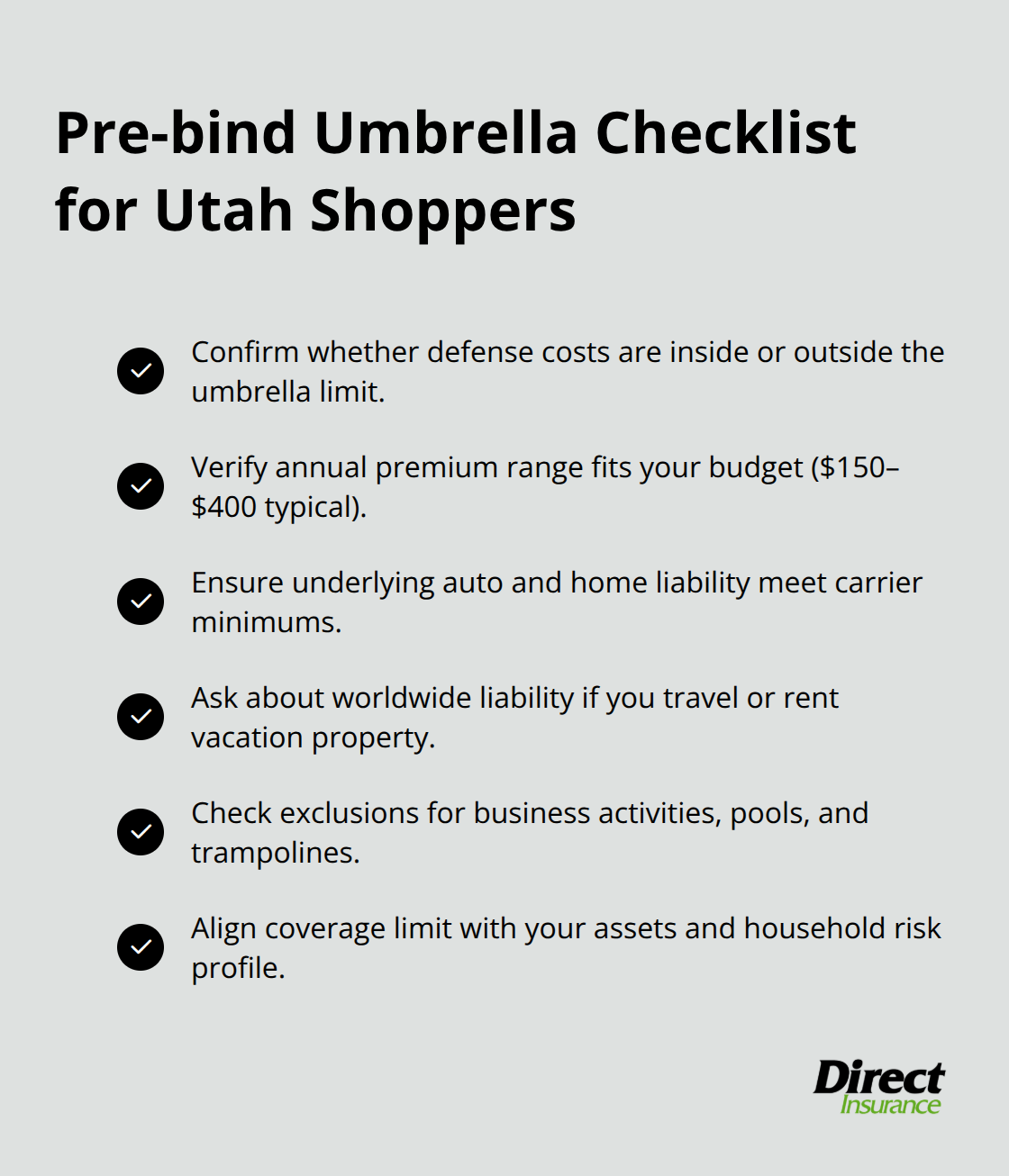
The cheapest umbrella policy means nothing if it excludes the exact scenario that eventually triggers a claim.
Final Thoughts
A Utah personal umbrella policy protects your financial future by filling the gaps that standard homeowners and auto insurance leave exposed. Your home equity, retirement savings, and future earnings face genuine risk from a single lawsuit or serious accident. An umbrella policy starting at $1 million in coverage costs between $150 and $400 annually for most Utah families, making it extraordinarily affordable protection against catastrophic liability claims.
Calculate your total assets, account for your household composition and activities, then select a coverage limit that sits comfortably above that number. If you own rental properties, have teenage drivers, or host frequent gatherings at your home, you need higher limits than the minimum $1 million most people default to. Review policy details carefully before committing, particularly whether defense costs sit inside or outside your limit and which activities carry exclusions (some carriers exclude trampolines or business activities while others don’t).
Contact us at Direct Insurance Services today to review your current policies and assess your liability exposure. Our team knows which carriers offer the best umbrella pricing for households with pools, rental properties, teenage drivers, and other high-exposure situations. We’ll help you find the right Utah personal umbrella policy that protects everything you’ve worked to build.
Disclaimer: The information provided in this blog is for general informational purposes only and does not constitute legal, financial, or insurance advice. Coverage options, terms, and availability may vary. Please consult with a licensed professional for advice specific to your situation

