
Homeowners Insurance Quotes Utah: Get The Best Deal
Finding the right homeowners insurance quotes in Utah means understanding what actually drives your rates. Location, home value, claims history, and credit score all play a role in what you’ll pay.
At Direct Insurance Services, we’ve helped countless Utah homeowners cut through the confusion and find coverage that fits their needs and budget. This guide walks you through the factors that matter, how to compare quotes effectively, and the mistakes to avoid.
What Drives Your Insurance Rates in Utah
Your homeowners insurance premium in Utah depends on factors you cannot always control and some you absolutely can. Location stands as the biggest rate driver. If you live in Ogden or Provo, you pay around $1,524 annually for a $300,000 dwelling policy, while Salt Lake City runs about $1,548, according to Insurify data. Utah ranks ninth nationally for wildfire risk, with nearly 60,000 structures at high risk, which pushes premiums upward for homes in vulnerable areas. Flood risk spreads even more widely-approximately 465,000 Utah structures face flood danger, though standard policies do not cover flood damage at all. Your ZIP code matters because insurers price in these local hazards. If you live in a high-risk wildfire zone, some carriers will decline coverage entirely, forcing you to explore surplus lines insurers or the Wildfire Prepared Home program if your home meets upgrades.
How Your Home’s Age and Construction Affect Your Quote
A 1980s home costs more to insure than a newly built one because older construction typically means outdated electrical systems, roofing that approaches end-of-life, and plumbing prone to failures. Insurers factor in the cost to rebuild-not what you paid for the house. Conversely, if you recently renovated or replaced your roof with impact-resistant materials, you qualify for discounts that directly offset premiums. The construction type also plays a role; wood-frame homes cost more to insure than masonry or concrete construction because they face greater vulnerability to fire and weather damage.
Why Your Credit Score and Claims History Matter
Your credit score directly affects what you pay. Insurers use credit-based insurance scores to predict claim likelihood, and a poor score can add hundreds annually to your premium. If you filed multiple claims in the past five years, carriers view you as higher risk and charge accordingly. One claim might not move the needle, but two or more within five years will. This is why some homeowners strategically skip minor claims-paying $800 out of pocket for water damage prevents a rate increase that could cost thousands over the next three to five years. Conversely, maintaining a clean claims history and good credit keeps your rates competitive when you shop around.
Why Shopping Quotes Across Multiple Insurers Reveals Real Savings
The same home at the same address produces wildly different quotes from different carriers because each insurer weighs risk factors differently. One carrier heavily penalizes older roofs while another focuses on flood exposure. Another prioritizes your credit score more aggressively than its competitors. This variation means you cannot rely on a single quote to understand your true market rate. When you obtain quotes from five or six insurers, you uncover the range of what the market will charge and identify which carriers view your specific risk profile most favorably. Shopping multiple quotes takes time, but the savings often exceed $500 annually for Utah homeowners.
How to Compare Quotes Without Wasting Time
Establish Your Coverage Baseline First
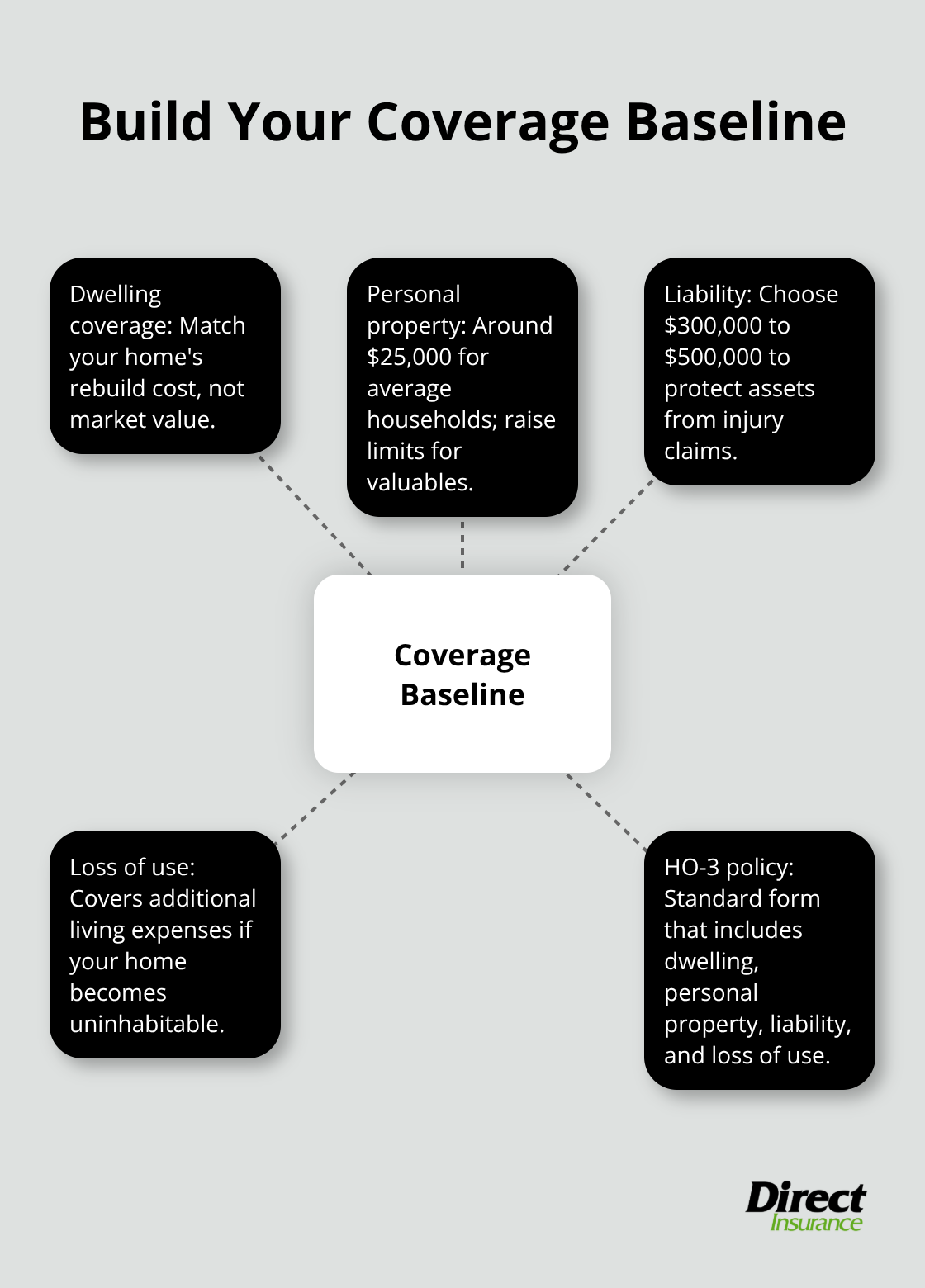
Comparing homeowners insurance quotes in Utah requires a structured approach, not random shopping. Start by determining your baseline coverage needs before you request a single quote. A standard HO-3 policy in Utah typically includes dwelling coverage, personal property protection, liability, and loss of use. For most Utah homeowners, dwelling coverage should match your home’s rebuild cost, not its market value-these differ significantly. Personal property coverage around $25,000 works for average households, though you may need higher limits if you own jewelry, electronics, or art. Liability coverage of $300,000 to $500,000 protects your assets if someone is injured on your property.
Request Identical Quotes Across Multiple Insurers
Once you know what you actually need, request quotes using identical coverage levels across all insurers. This apples-to-apples comparison reveals which carrier offers the best rate for your specific situation, not just the cheapest number on paper. Request quotes from at least five to six insurers because the variation in Utah is substantial. American Family averages around $1,476 annually for $500,000 dwelling coverage, while State Farm runs approximately $1,508, and USAA sits near $1,533 according to U.S. News data. Farmers Insurance, in contrast, averages $2,420 for the same coverage. That $900 spread between the cheapest and most expensive option represents real money you keep in your pocket.
Verify Discounts and Ask the Right Questions
When you gather quotes, verify which discounts each carrier actually applies to your policy. Security systems, smoke alarms, and dead-bolt locks reduce premiums, but only if the insurer credits them. Ask about online purchase discounts, bundling savings with auto insurance, and renovated home discounts if applicable. Some carriers offer substantial savings for protective devices you already own; others require professional installation. An independent agency like Direct Insurance Services can help you navigate these discount variations across carriers and identify which ones apply to your specific home.
Check Financial Strength and Complaint Ratios
The Utah Insurance Department maintains complaint data through the NAIC, which reveals which carriers resolve claims efficiently and which ones generate frequent complaints. American Family and State Farm both maintain low complaint ratios around 0.72 to 0.38, while some competitors exceed 2.0. Financial strength ratings from AM Best matter equally-you want an A or A+ rating to ensure the carrier can pay claims when disaster strikes. Price alone should never drive your decision; a $200 annual savings means nothing if the insurer denies your claim or takes months to pay. The cheapest quote often comes from a carrier that cuts corners on service or financial stability, leaving you exposed when you need protection most.
Mistakes That Cost Utah Homeowners Hundreds Every Year
Most Utah homeowners make three critical errors when shopping for coverage, and each one drains money from your wallet or leaves you dangerously exposed when a claim happens.
Underinsuring Your Dwelling Coverage
The first mistake is selecting dwelling coverage limits that fall short of your actual rebuild cost. You might own a home worth $450,000 on the market, but rebuilding it after total loss costs significantly more due to labor, permits, and material inflation. If you carry only $350,000 in dwelling coverage, you absorb the difference out of pocket. Utah construction costs have risen steadily, and many homeowners base coverage on what they paid for the house years ago rather than current replacement value. This underinsurance problem compounds over time as inflation pushes rebuild costs higher while your policy limits stay flat. The solution requires getting a professional rebuild cost estimate from your insurer or a local contractor, then setting dwelling coverage to match that figure, not your home’s market price or what feels comfortable.
Missing Discounts You Already Qualify For
The second mistake is leaving discounts on the table simply because you do not ask. Security systems, smart home technology, dead-bolt locks, and fire extinguishers reduce premiums, but carriers only credit discounts you explicitly request and verify. Many homeowners install protective devices and never mention them to their insurer, missing savings of $200 to $400 annually. Online purchase discounts apply when you quote and buy through an insurer’s website rather than through an agent, yet some people still call in to complete their purchase and forfeit that savings. Bundling homeowners insurance with auto or life policies yields discounts that can range between 5% and 30%, while also helping avoid gaps in coverage and providing extra benefits. If you have not reviewed your policy in twelve months, you are almost certainly missing discounts that became available or that you newly qualify for due to home improvements.
Treating Your Policy as a One-Time Purchase
The third mistake is treating your policy as a one-time purchase rather than an annual review. Rates change yearly, new carriers enter the Utah market, and your home’s risk profile shifts when you renovate, age, or experience claim activity. Homeowners who shop quotes every two to three years typically find they can reduce premiums by $300 to $500 by switching to a carrier that now values their specific risk profile more favorably. Utah homeowners who review their policies annually and request updated quotes from at least four to five insurers consistently secure better rates than those who set it and forget it. An independent agency can help you navigate these annual reviews and identify which carriers offer the best value for your current situation.
Final Thoughts
Finding the right homeowners insurance quotes in Utah requires you to understand your actual coverage needs, compare quotes across multiple carriers, and review your policy annually. Location, home age, credit score, and claims history drive your rates, and the same home produces vastly different quotes depending on which insurer evaluates it. The $900 spread between carriers for identical coverage is not unusual in Utah, which means shopping around directly impacts your wallet.
The cheapest quote rarely represents the best deal because a carrier offering $1,400 annually might have complaint ratios double that of a competitor charging $1,500, or it might deny claims more frequently or take months to settle them. Financial strength ratings and complaint data from the Utah Insurance Department matter as much as price. You are not just buying a policy; you are buying peace of mind and the assurance that your insurer will stand behind you when wildfire, flood, or storm damage strikes.
Direct Insurance Services transforms the shopping process from overwhelming to manageable by shopping multiple top-rated insurers on your behalf, identifying discounts you qualify for, and ensuring your coverage matches your actual rebuild costs rather than guesswork. Contact an independent agency to handle the tedious work of gathering quotes, then commit to reviewing your policy annually and shopping quotes every two to three years. This discipline typically saves Utah homeowners $300 to $500 per year compared to those who set their policy and forget it.
Disclaimer: The information provided in this blog is for general informational purposes only and does not constitute legal, financial, or insurance advice. Coverage options, terms, and availability may vary. Please consult with a licensed professional for advice specific to your situation

