
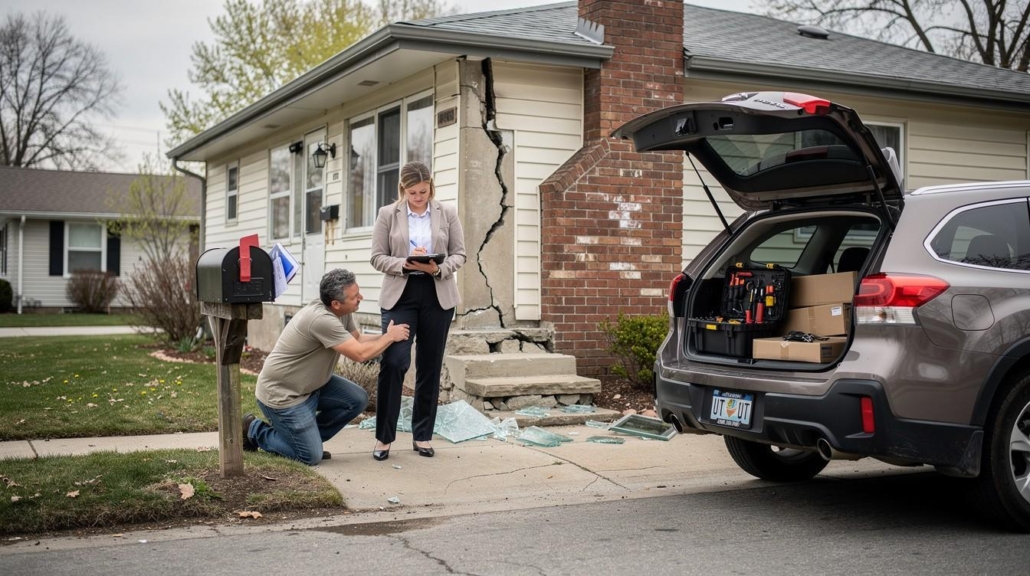
Earthquake Homeowners Insurance Utah: Is Your Policy Ready?
Utah sits on some of the most active fault lines in the western United States. A single earthquake can cause tens of thousands of dollars in damage that your standard homeowners policy won’t cover.
At Direct Insurance Services, we’ve helped countless Utah homeowners understand why earthquake homeowners insurance in Utah isn’t optional-it’s essential. This guide walks you through what you need to know to protect your home.
How Active Are Utah’s Fault Lines Really
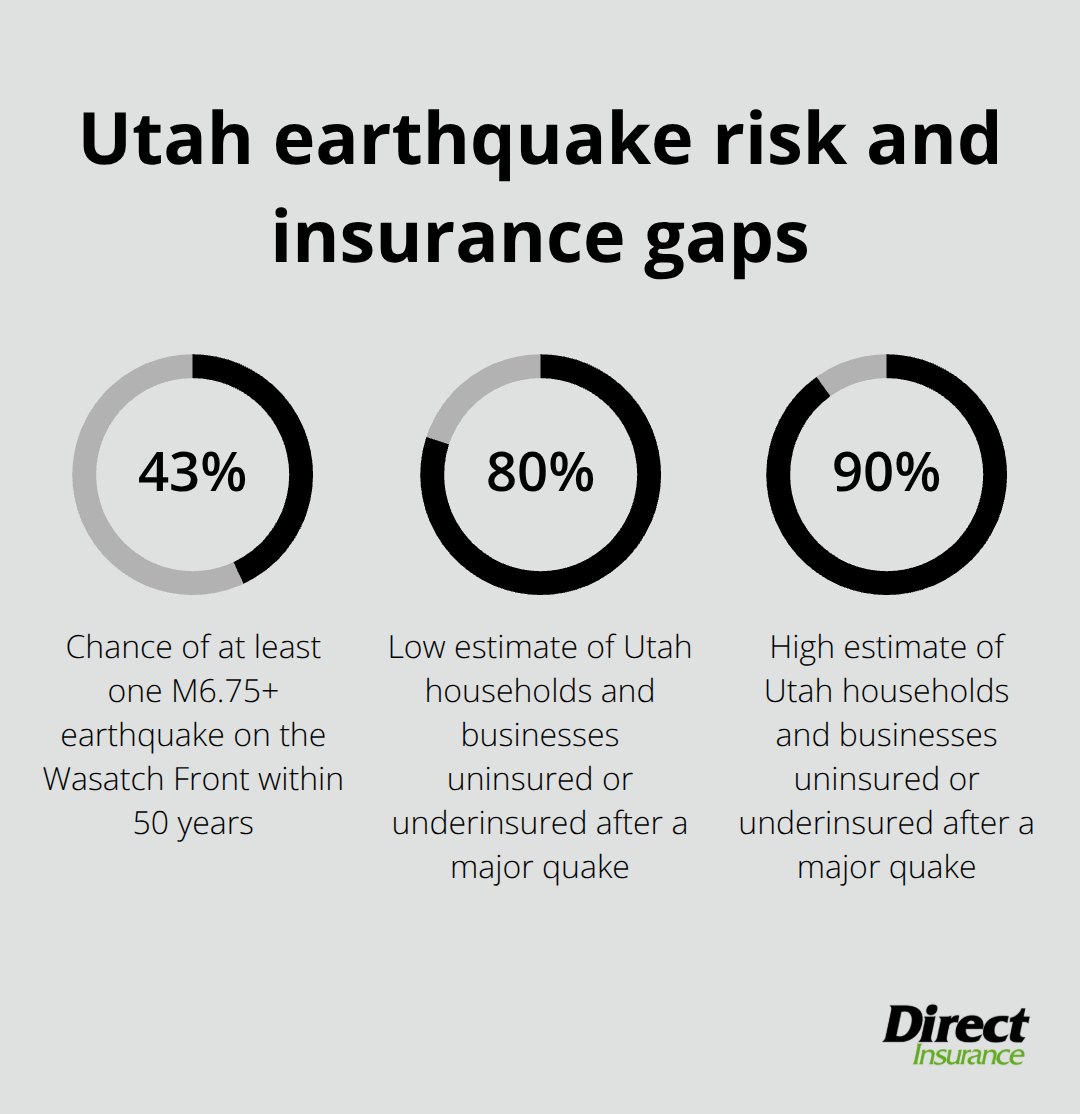
Utah experiences roughly 500 earthquakes annually across the Wasatch Front region, which spans Utah, Idaho, and Wyoming. Most of these tremors pass unnoticed, but the underlying risk is substantial. The Wasatch Front sits atop several major fault lines, and geologists estimate there’s a 43% chance of at least one large earthquake measuring magnitude 6.75 or greater within the next 50 years. That’s not a distant hypothetical threat-it’s a genuine probability that affects your home’s safety and your insurance needs right now. The 2020 Magna earthquake demonstrated this reality when it shook the region hard enough to cause visible damage to homes and prompted many Utah residents to finally consider earthquake coverage they’d previously ignored.
What Past Earthquakes Tell Us About Future Risk
Utah’s earthquake history reveals patterns that matter for your insurance decisions. The state has experienced significant seismic events that caused measurable property damage, and older construction methods make many homes particularly vulnerable. Unreinforced brick structures built in the 1920s and earlier face the highest risk during seismic events, which is why insurers scrutinize these properties closely when you apply for earthquake coverage. Modern homes built to current seismic codes perform substantially better, but even newer frame homes can suffer foundation damage, broken water lines, and structural issues that standard homeowners insurance won’t cover. The financial exposure is real-estimates suggest that 80 to 90% of Utah homeowners and businesses would be uninsured or underinsured after a major earthquake, leaving them personally responsible for tens of thousands of dollars in repairs.
Where in Utah You Face the Greatest Risk
Proximity to fault lines determines your actual risk level, and this directly affects earthquake insurance availability and cost. High-risk zones near liquefaction areas or immediately adjacent to known faults command higher premiums, and some carriers refuse to write coverage at all. Areas like Sugar House, the Avenues, and Liberty Wells contain concentrations of older brick homes that some insurers exclude entirely from earthquake coverage. Your specific address matters more than your zip code-two homes on the same street can have dramatically different insurance options based on soil conditions and distance to fault lines. Identifying whether you’re in a high-risk zone should be your first step before shopping for coverage, because your location will determine both your options and your costs.
How Your Home’s Age and Construction Affect Your Options
Home construction type and age play major roles in what insurers will offer you. Frame dwellings typically cost less to insure than solid brick buildings, which face higher collapse risk during seismic events. A 100-year-old wooden house might add roughly $1,000 per year to your insurance costs for earthquake coverage, while brick structures face even steeper premiums or outright denial from many carriers. Modern construction that adheres to seismic codes reduces vulnerability significantly, but insurers still evaluate each property individually based on its specific characteristics. Your home’s construction history directly influences both availability and pricing, so understanding your property’s vulnerabilities helps you anticipate what carriers will charge and which ones will even consider your application.
Taking the Next Step With Your Current Insurer
Your current homeowners insurer is the logical starting point for earthquake coverage. Most carriers in Utah offer earthquake protection as a rider to your existing policy rather than as a standalone product, which simplifies the process of adding protection. Contact your agent and ask specifically whether they offer earthquake endorsements and what the costs would be for your property. If your current insurer declines to provide coverage or quotes prices you find unreasonable, shopping with other carriers becomes necessary-some companies specialize in earthquake protection or work through brokers to access carriers that offer broader options. The conversation with your insurer about earthquake risk and your home’s specific vulnerabilities will clarify what coverage options actually exist for your situation.
What Your Standard Homeowners Policy Actually Protects
Your standard homeowners insurance policy covers fire, theft, wind, hail, and a dozen other perils, but earthquake damage isn’t one of them. This isn’t an oversight or a loophole you can argue your way around-it’s a deliberate exclusion written into every standard policy sold in Utah. When the ground shakes and your foundation cracks, your water lines rupture, or your brick chimney collapses, your homeowners insurance won’t pay a single dollar toward repairs. The Utah Insurance Commissioner Todd Kiser has confirmed this repeatedly: earthquake damage requires separate, dedicated coverage. Standard policies treat earthquakes as a fundamentally different risk category, which is why insurers exclude them entirely rather than simply charging higher premiums.
The Real Cost of Being Uninsured After a Major Earthquake
The financial exposure is staggering. Estimates suggest that 80 to 90 percent of Utah homeowners and businesses would be uninsured or underinsured after a major earthquake, leaving them to cover reconstruction costs entirely from savings or loans. In Utah’s hypothetical 1,000-year earthquake scenario, estimates show displaced households would require significant shelter resources. A homeowner with a $300,000 rebuild value and no earthquake coverage faces the full amount out of pocket. FEMA disaster assistance doesn’t substitute for insurance-it requires a presidential disaster declaration and covers only basic needs and temporary shelter, not reconstruction. The Small Business Administration offers disaster loans up to $200,000, but these must be repaid with interest, turning your recovery into a decades-long debt obligation.
Why Insurers Separate Earthquake Coverage From Standard Policies
Insurers separate earthquake coverage because the risk concentrates geographically and the potential losses are catastrophic. A single major earthquake can trigger thousands of claims simultaneously across a region, creating losses that exceed what standard homeowners policies can absorb. Earthquake coverage uses different underwriting rules, higher deductibles, and specialized catastrophe modeling to account for this concentrated risk. When you add earthquake protection as a rider to your existing policy, it operates under completely different terms than your standard coverage. Your dwelling coverage might have a $500 deductible for wind damage, but your earthquake deductible will be a percentage of your coverage limit-typically 5, 10, 15, or 20 percent.
How Earthquake Deductibles Work Differently
For a $300,000 dwelling limit with a 10 percent deductible, you’d pay $30,000 out of pocket before earthquake coverage kicks in. This structural separation protects insurers from insolvency while forcing homeowners to make conscious, deliberate choices about whether they want protection. Many Utah homeowners mistakenly believe their existing coverage will protect them, then face devastating financial consequences when they file a claim after a seismic event. The deductible structure (expressed as a percentage rather than a flat dollar amount) means that higher-value homes face proportionally larger out-of-pocket costs. Understanding this distinction before you purchase coverage helps you evaluate whether earthquake insurance makes financial sense for your specific situation and property value.
Moving Forward With Coverage Decisions
Your current homeowners insurer is the logical starting point for earthquake coverage, and most carriers in Utah offer earthquake protection as a rider to your existing policy rather than as a standalone product. Contact your agent and ask specifically whether they offer earthquake endorsements and what the costs would be for your property. If your current insurer declines to provide coverage or quotes prices you find unreasonable, shopping with other carriers becomes necessary-some companies specialize in earthquake protection or work through brokers to access carriers that offer broader options. The conversation with your insurer about earthquake risk and your home’s specific vulnerabilities will clarify what coverage options actually exist for your situation and what you’ll pay to add protection.
How to Get Earthquake Coverage in Utah
Start With Your Current Insurer
In Utah, earthquake coverage comes in one primary form: an endorsement added to your existing homeowners policy. Most carriers don’t sell earthquake insurance as a standalone product anymore. Instead, you contact your current agent, request an earthquake endorsement, and the coverage attaches to your policy with its own separate deductible and premium. This approach simplifies administration for insurers but creates a critical step you can’t skip-you have to actively ask for it. Your agent won’t mention it unprompted, and your standard policy absolutely will not include it. Start this conversation immediately rather than waiting for a rate renewal, because the longer you delay, the greater your exposure to a seismic event that could cost hundreds of thousands of dollars.
Understand What Your Premium Will Cost
Earthquake premiums in Utah typically range from $1,679 annually for $200,000–$300,000 in dwelling coverage, though your actual cost depends heavily on three factors: your home’s construction type, its age, and your proximity to known fault lines. Frame homes cost substantially less to insure than unreinforced brick structures, which face higher collapse risk. A modern frame home in a moderate-risk area might cost less per year for earthquake coverage, while an older brick home in a high-risk zone could exceed $1,500 annually or face outright denial from carriers.
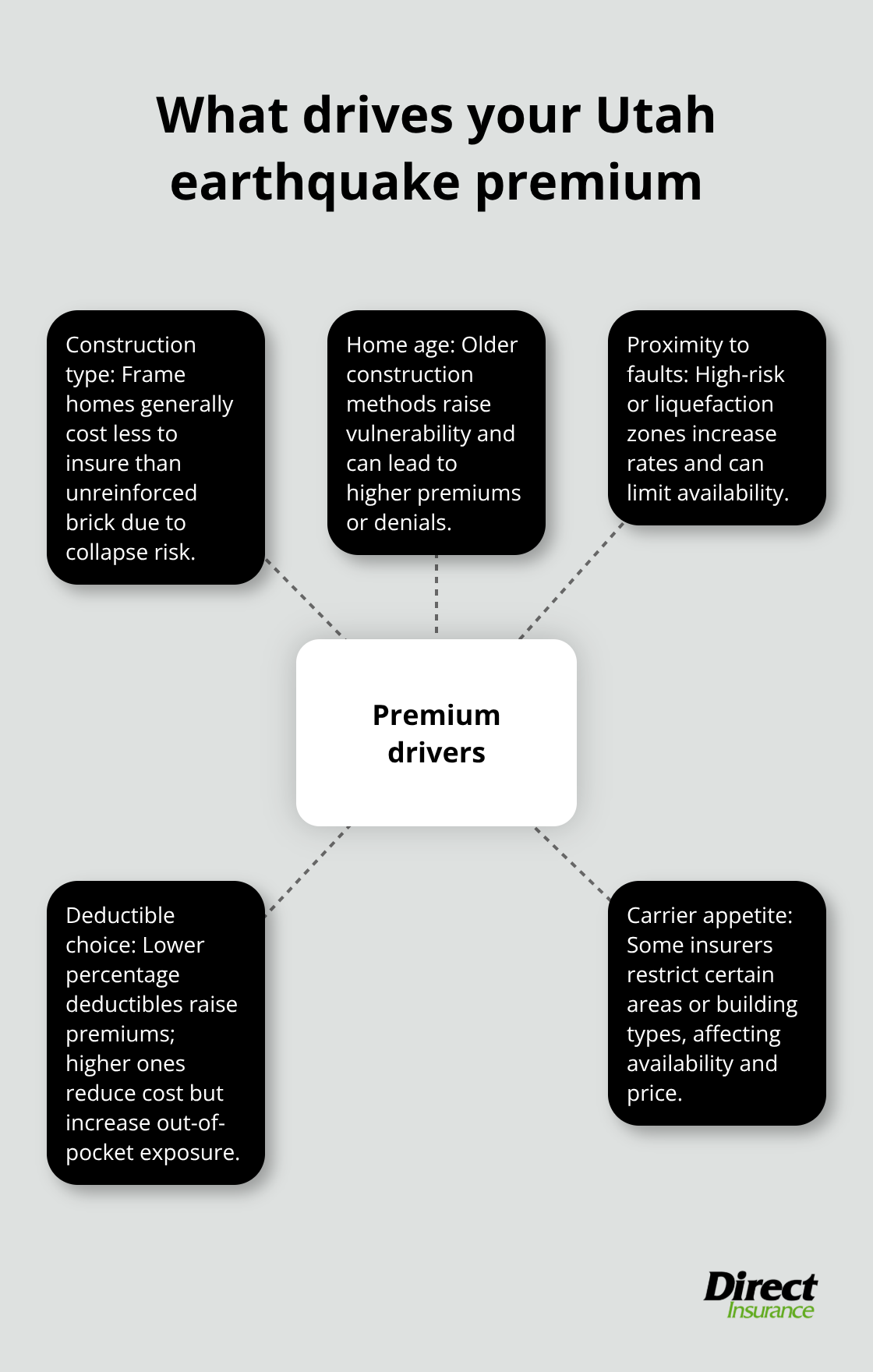
Your deductible choice directly impacts your premium-selecting a 5 percent deductible costs more than accepting a 10 percent or 20 percent deductible.
Calculate Your Out-of-Pocket Deductible Exposure
On a $300,000 home, a 5 percent deductible means $15,000 out of pocket before coverage applies, compared to $30,000 with a 10 percent deductible. Some insurers default to a 40 percent deductible, which on a $300,000 home equals $120,000 before the policy pays anything-clearly unrealistic for most homeowners. Request lower deductible options explicitly when you obtain quotes. The deductible structure (expressed as a percentage rather than a flat dollar amount) means that higher-value homes face proportionally larger out-of-pocket costs. Understanding this distinction before you purchase coverage helps you evaluate whether earthquake insurance makes financial sense for your specific situation and property value.
Shop Multiple Carriers for the Best Rate
Pricing varies dramatically across carriers, so one homeowner might pay $400 annually with State Farm while another pays $800 with a different insurer for identical coverage. United has exited the earthquake market in Utah and shifted business to Golden Bear, meaning your current carrier may have changed their earthquake options without notifying you. Contact your agent directly, obtain written quotes, and compare deductibles alongside premiums-the cheapest policy today might leave you catastrophically underinsured tomorrow.
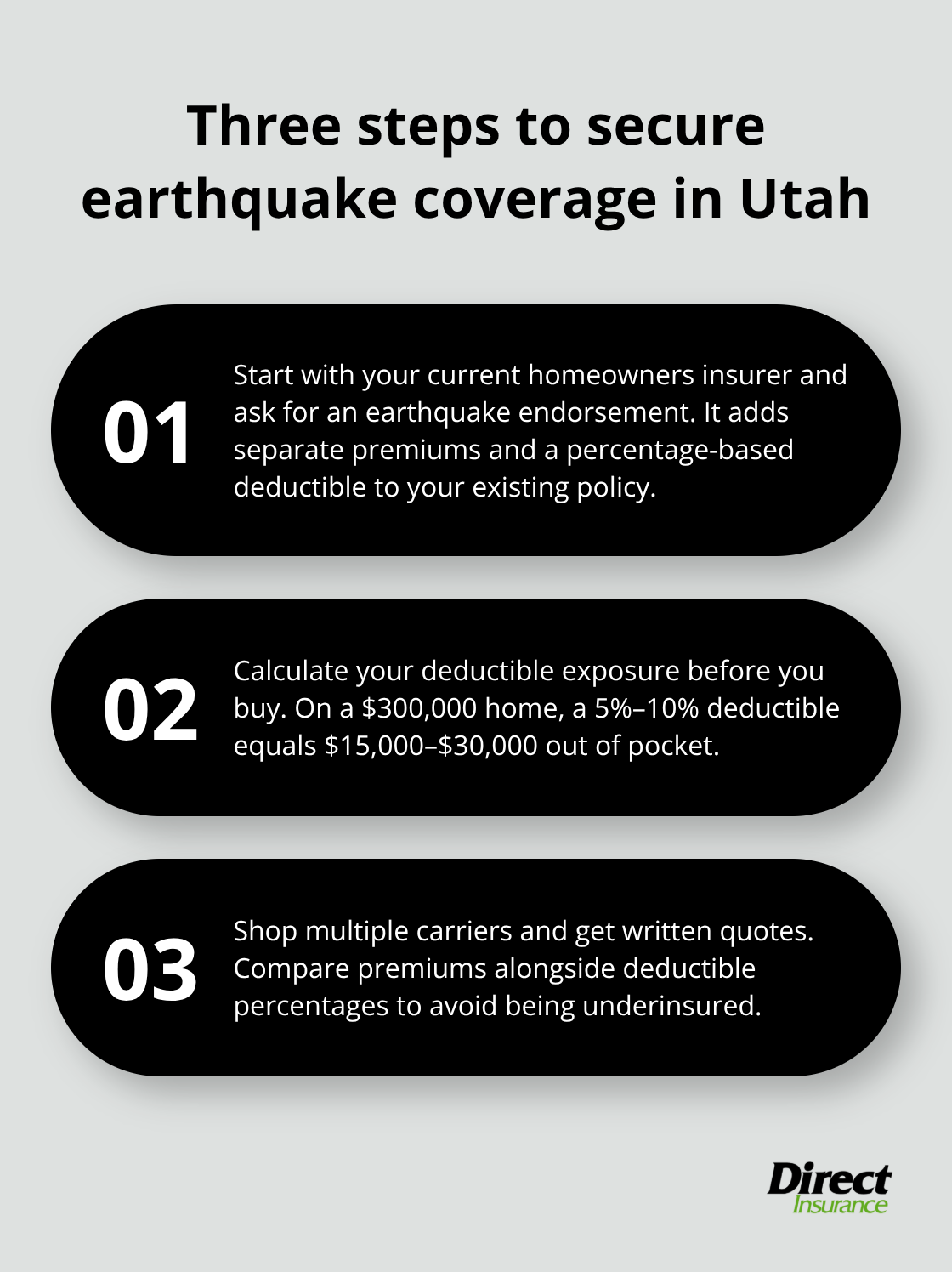
Shopping multiple carriers takes time, but the premium differences justify the effort. Some companies specialize in earthquake protection or work through brokers to access carriers that offer broader options, so don’t limit yourself to your current insurer if their quotes seem high or their coverage options seem limited.
Final Thoughts
Earthquake homeowners insurance in Utah protects your home, your savings, and your family’s stability after a seismic event. Utah sits on active fault lines with a 43% probability of a major earthquake within the next 50 years, and standard homeowners policies won’t cover a single dollar of earthquake damage. Without dedicated coverage, you face out-of-pocket deductibles ranging from $15,000 to $120,000, depending on your home’s value and the deductible percentage you select.
Contact your current insurance agent this week and request a written quote for earthquake homeowners insurance Utah as an endorsement to your existing policy. Ask specifically about deductible options and premium costs for your property type and location. Shop quotes from multiple carriers because pricing varies dramatically-the difference between insurers can easily exceed $400 annually for identical coverage.
Direct Insurance Services helps Utah homeowners navigate earthquake insurance decisions by shopping multiple top-rated carriers to find the best coverage at competitive rates. We walk you through your earthquake insurance options, compare deductible structures, and explain exactly what you’ll pay and what protects your property. Acting now matters because every day without earthquake coverage exposes your home to catastrophic financial loss.
Disclaimer: The information provided in this blog is for general informational purposes only and does not constitute legal, financial, or insurance advice. Coverage options, terms, and availability may vary. Please consult with a licensed professional for advice specific to your situation

