
Utah Business Insurance Quotes: How to Compare Providers Like a Pro
Getting Utah business insurance quotes from multiple providers takes time, but it’s worth it. The difference between a cheap policy and the right policy can cost you thousands when a claim happens.
At Direct Insurance Services, we’ve seen business owners pick the wrong coverage because they only looked at price. This guide walks you through comparing quotes like someone who actually knows what to look for.
Getting the Right Information to Insurers
The biggest mistake Utah business owners make when requesting quotes is providing incomplete or inaccurate information. Insurers cannot give you a real quote without knowing your actual business operations, and you will waste time receiving numbers that do not reflect your real situation.
List Every Detail About Your Business
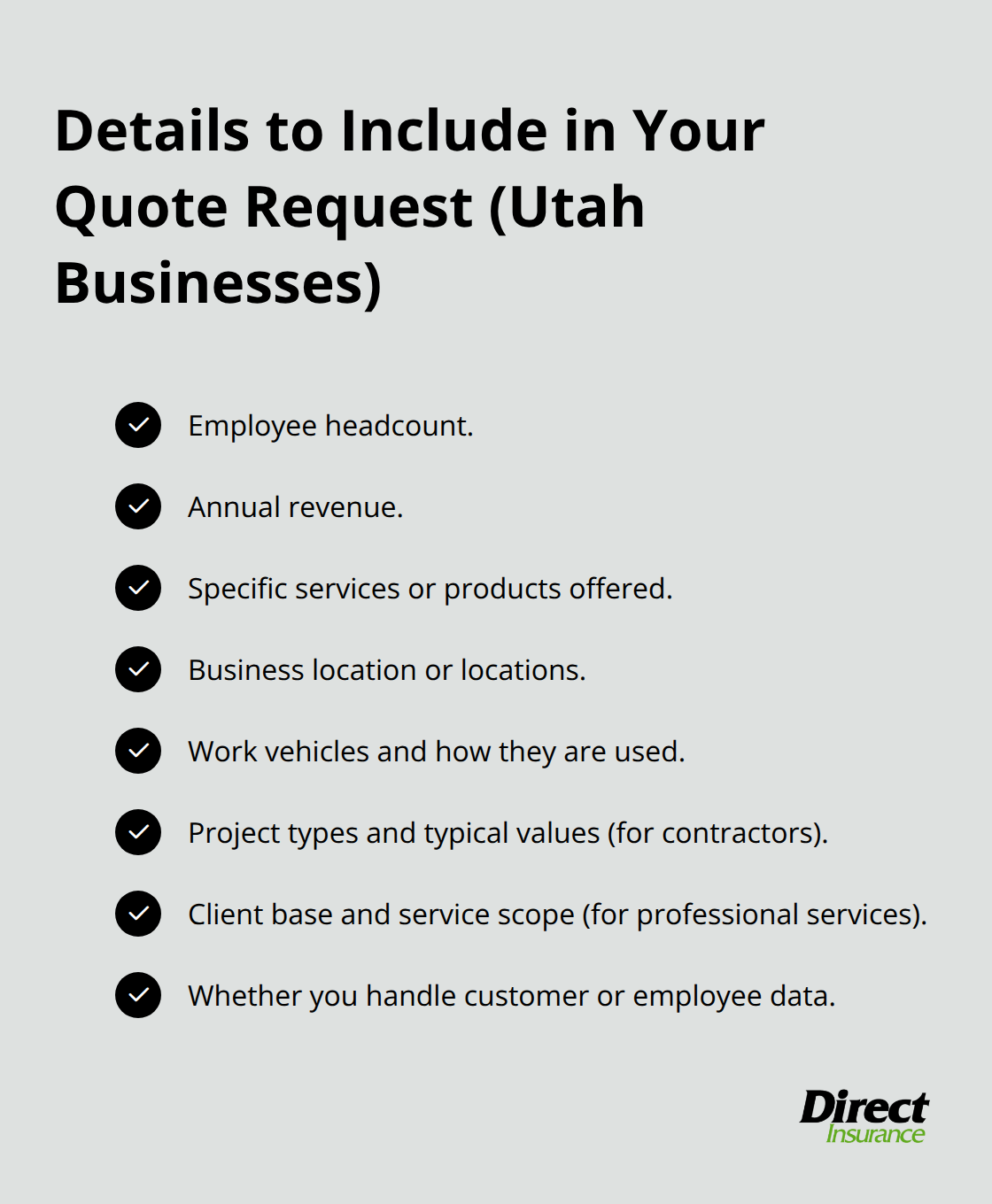
Start by listing every detail about your business: how many employees you have, your annual revenue, the specific services or products you offer, your business location, and whether you use vehicles for work. If you are a contractor, include the types of projects you handle and typical project values. If you provide professional services like accounting or consulting, specify your client base and service scope. If you handle customer data, mention that upfront because it affects cyber insurance pricing.
The Hartford reports that most small businesses they quote have fewer than five employees and annual revenue under $200,000, but the details within those ranges matter enormously for pricing. An electrician with three employees doing residential work pays vastly different rates than one doing commercial industrial projects, even with the same employee count.
Prepare Documentation Insurers Will Request
When you contact providers, have your business license number ready, details about any previous claims or losses, information about your building if you own it, and a list of equipment or inventory you need covered. Insurers will ask about your safety practices, whether you have existing insurance, and what small business insurance coverage limits you are considering. Do not guess at these answers. If you are unsure about coverage limits, say so-that is what insurance professionals are for.
Request Quotes with Identical Specifications
Request quotes from at least three providers because rates vary significantly based on how each company underwrites your specific risk profile. The Hartford, Insureon, and other major carriers price differently because they evaluate risk differently. When comparing, make sure each quote includes the same coverage types and limits so you are actually comparing apples to apples.
A quote for a Business Owner’s Policy with a $1 million general liability limit and a $500,000 per-occurrence cap is fundamentally different from a $2 million limit with a $1 million per-occurrence cap, even if the base premium looks similar. Get quotes with identical specifications first, then experiment with different deductible levels to see how that affects your out-of-pocket costs versus monthly premiums.
Once you have collected quotes with matching coverage details, the real work of comparison begins-and that is where most business owners stumble.
Comparing Utah Business Insurance Quotes Effectively
Price Matters Less Than Coverage
Premium price is what most Utah business owners fixate on, but it’s the least important number on the quote. A $45 monthly general liability policy means nothing if it excludes the exact risk that could shut down your business. Price matters less than coverage, and many Utah business owners select the lowest available coverage limits to keep premiums down. The Hartford data shows their average Business Owner’s Policy costs around $141 monthly, but that number only matters if the coverage actually protects you.
Start by comparing what each quote actually covers, not what it costs. A policy with a $1 million limit and a $500,000 per-occurrence cap leaves you personally responsible for anything above that per-incident threshold, while a $1 million limit with a $1 million per-occurrence cap protects you far better on single large losses.
Examine Coverage Limits, Deductibles, and Exclusions
Request identical coverage specifications from each provider, then look at what exclusions each one lists. Some policies exclude flood damage, professional errors, or equipment breakdown, while others include these as standard. Your deductible choice directly affects both your monthly cost and your financial risk.
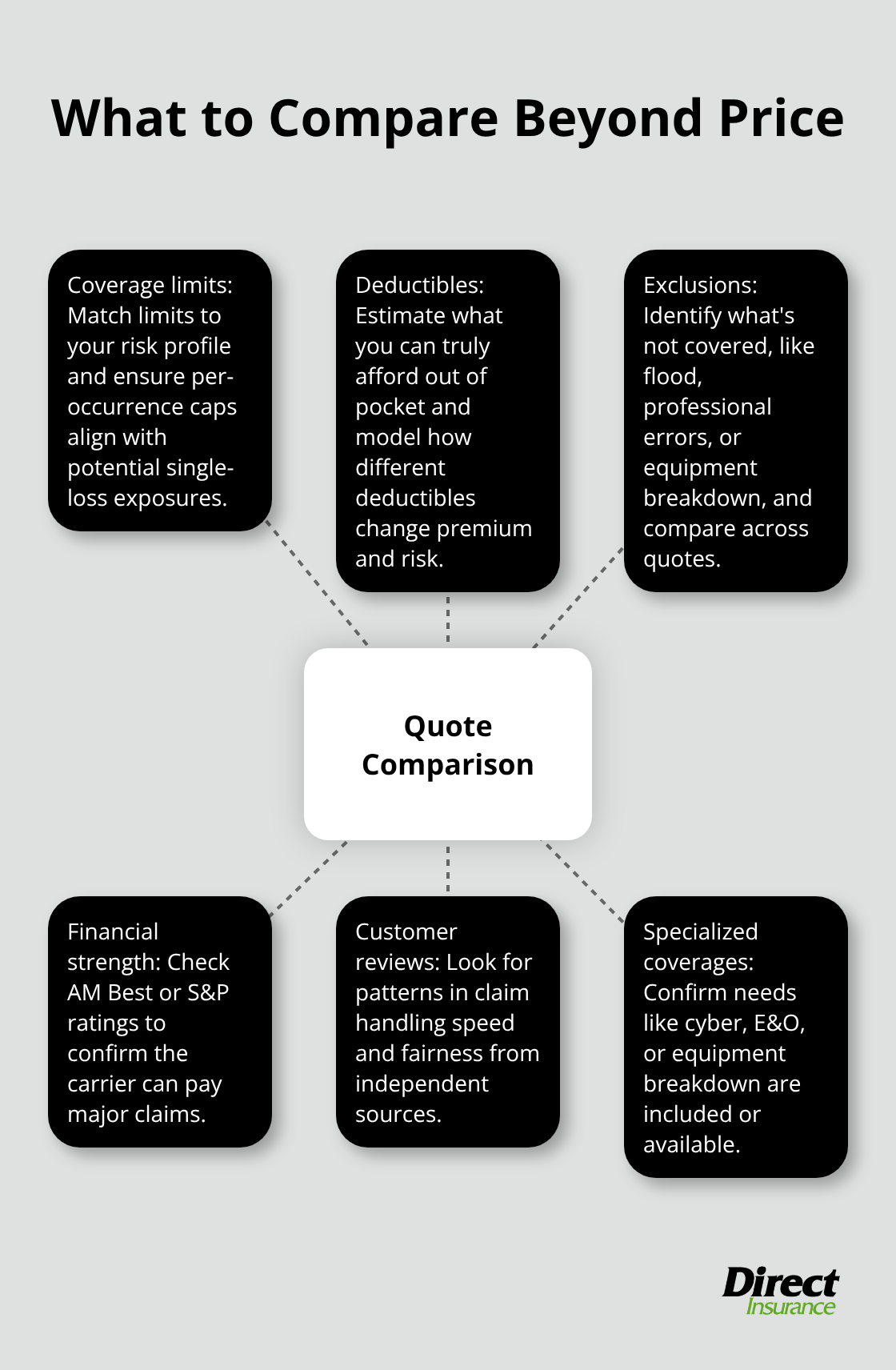
Higher deductibles lower premiums but increase what you pay out of pocket before coverage starts.
If your business operates on tight cash flow, a $2,500 deductible might sound good until you file a claim and can’t afford it. Try a deductible that matches your actual ability to cover unexpected expenses, not just what sounds cheap. Utah businesses should verify that quotes include required state minimums: bodily injury liability of $25,000 per person and $65,000 per accident, plus $15,000 property damage liability for commercial vehicles.
Verify Financial Strength and Customer Experience
Financial strength and actual customer experience separate policies that pay claims from policies that fight them. Check ratings from AM Best or Standard & Poor’s to confirm your insurer can actually pay if you file a major claim. The Hartford has 200 years of experience and serves 1.3 million small business customers, which tells you they have the resources to handle claims.
Read actual customer reviews on independent sites, not just testimonials on the insurer’s website. Look for patterns about claim processing speed and whether the company actually paid what they promised.
Account for Specialized Coverage Requirements
If you handle employee data or customer information, cyber insurance isn’t optional in Utah due to state data breach notification laws. That coverage typically costs around $76 monthly according to Insureon data, but skipping it could expose you to notification costs, legal fees, and regulatory fines that far exceed annual premiums.
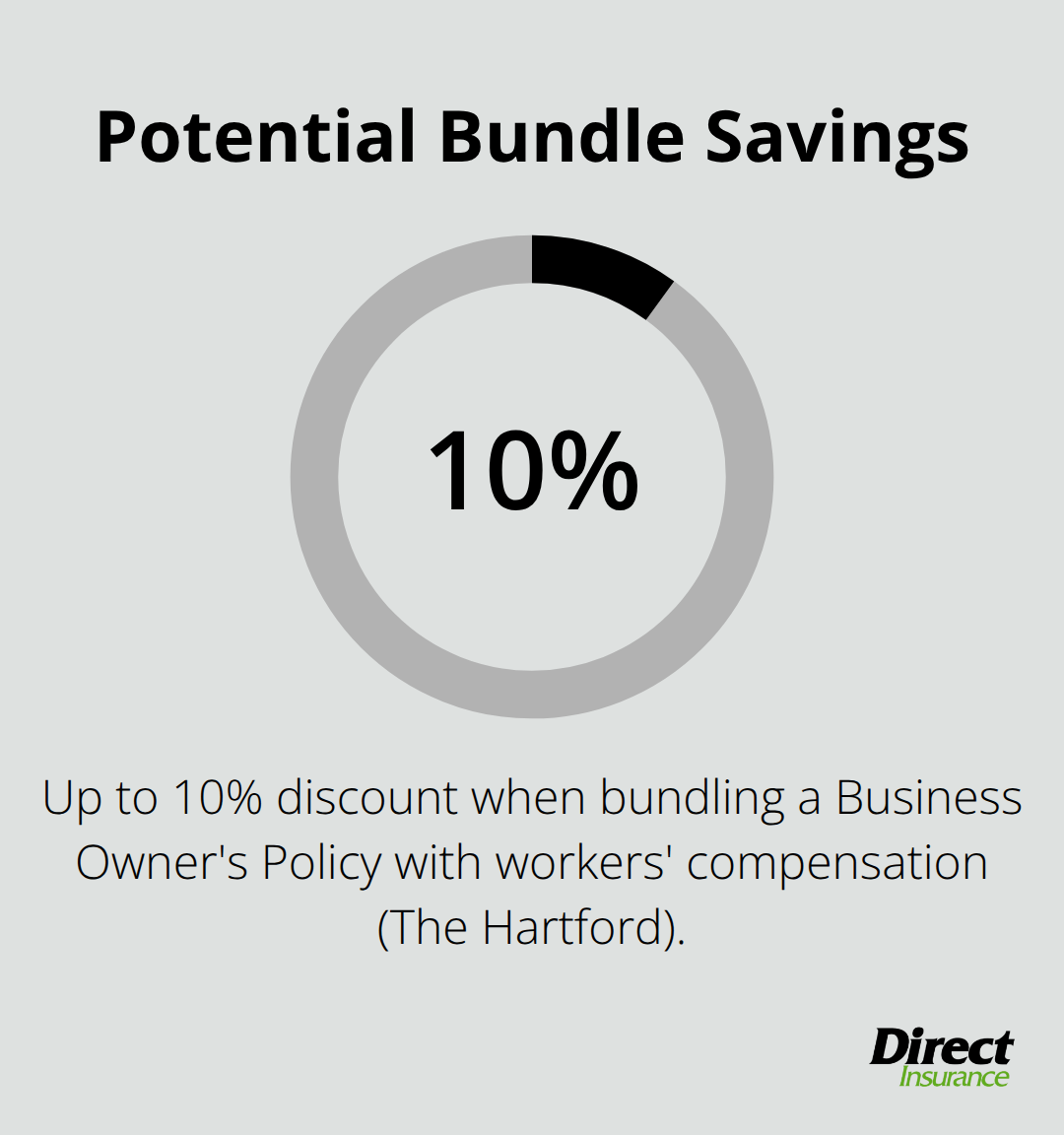
Compare coverage breadth alongside price. One provider might offer general liability, workers’ compensation, and commercial property bundled at a discount, while another makes you buy each separately at higher individual rates. The Hartford often provides discounts up to 10% when bundling a Business Owner’s Policy with workers’ compensation, which directly reduces your total annual cost compared to buying policies piece by piece.
Now that you understand what separates a good quote from a bad one, you need to recognize the mistakes that trip up most Utah business owners during this comparison process.
Common Mistakes When Comparing Business Insurance Quotes
The moment you have three or four quotes in front of you, the temptation hits hard: pick the cheapest one and move on. We watch this decision destroy business owners’ finances every year. A $30 monthly savings on premium sounds smart until a claim lands on your desk and you discover your $500,000 per-occurrence limit doesn’t cover the $750,000 liability judgment against you. Utah business owners consistently make three specific mistakes during quote comparison that haunt them later, and each one is entirely avoidable if you know what to watch for.
The Cost Trap Destroys More Businesses Than Underinsurance
Selecting based purely on monthly or annual premium is the mistake that generates the most expensive consequences. The Hartford’s data shows their average Business Owner’s Policy costs around $141 monthly, but that number means absolutely nothing if you selected the lowest coverage limits to reach that price point. A $45 monthly general liability policy with a $250,000 limit exposes you to massive personal liability on any claim exceeding that threshold, while a $65 monthly policy with a $1 million limit might save you hundreds of thousands if something goes wrong. The difference between these two scenarios is $20 per month, yet one protects your business and one leaves you vulnerable.
Utah contractors and service providers fall into this trap constantly when they prioritize monthly cash flow over actual protection. Your deductible choice compounds this problem because higher deductibles lower premiums dramatically, but only if you can actually afford to pay them when a claim happens. If your business operates with limited cash reserves, a $5,000 deductible might be financially impossible to cover, turning your insurance policy into a useless piece of paper. Calculate what deductible your business can genuinely afford to pay, then work backward to find the premium that fits your budget at that deductible level. Do not reverse this process when you pick a deductible based on premium savings alone.
Coverage exclusions hide in Plain Sight and Destroy Your Protection
Every insurance policy lists exclusions, and most Utah business owners never read them. One provider excludes flood damage while another covers it. One excludes professional errors while another includes them. One policy excludes equipment breakdown while another offers it as an add-on. These exclusions directly determine whether your insurance actually covers the specific risks that could shut down your business.
If you provide professional services like accounting, consulting, or engineering, errors and omissions coverage costs around $76 monthly according to Insureon data, but only if you actually purchase it. Many business owners buy general liability alone, assuming it covers their professional mistakes, then file a claim and discover they have zero coverage for the exact loss they experienced. Read the exclusions section of every quote line by line and compare them directly against each other. If one provider excludes something and another doesn’t, that difference affects your actual risk exposure.
Annual Policy Reviews Prevent Coverage Gaps
Annual policy reviews fail to happen in most Utah businesses, which means coverage gaps persist year after year. Your business changes constantly: you hire new employees, you take on different project types, you expand to new locations, or you start handling customer data. Your insurance should change with your business, but most owners never revisit their policies after the initial purchase.
Set a calendar reminder for your policy renewal date three months in advance, then review whether your current coverage still matches your actual business operations. If you started handling customer information or payment data, cyber insurance becomes essential due to Utah’s data breach notification laws, yet most business owners skip this coverage until after a breach occurs. That oversight can cost far more than the annual premium you tried to save.
Final Thoughts
Comparing Utah business insurance quotes effectively comes down to one principle: coverage matters infinitely more than price. You now understand how to request quotes with identical specifications, evaluate what each policy actually covers, and spot the exclusions that could leave you exposed. The most expensive insurance policy you can buy is the cheap one that doesn’t cover your actual risk.
Gather quotes from at least three providers using the specifications that match your real business operations. Request identical coverage limits and deductibles so you can compare apples to apples, then spend time reading what each quote excludes rather than fixating on the monthly premium. A $20 difference in monthly cost means nothing compared to a $500,000 coverage gap that could bankrupt you.
As your business grows and changes, your insurance must change with it. Set a calendar reminder to review your coverage annually, especially if you hire employees, expand to new locations, or start handling customer data (Utah’s data breach notification laws make cyber insurance essential if you collect any customer information). Contact us at saltlakeinsurance.com to get started with Utah business insurance quotes that actually protect what you’ve built.
Disclaimer: The information provided in this blog is for general informational purposes only and does not constitute legal, financial, or insurance advice. Coverage options, terms, and availability may vary. Please consult with a licensed professional for advice specific to your situation
