

Umbrella insurance quotes: Finding Coverage You Can Trust
Most people don’t realize that homeowners and auto insurance have limits. When a lawsuit exceeds those limits, your personal assets are at risk.
Umbrella insurance quotes reveal how affordable extra liability protection actually is. At Direct Insurance Services, we help customers understand what coverage they need and how to compare policies from multiple insurers without overpaying.
Understanding Umbrella Insurance Coverage
What Umbrella Insurance Actually Covers
Homeowners and auto insurance policies have limits that most people underestimate. When a lawsuit exceeds those limits, your personal assets face direct exposure. Umbrella insurance sits above your existing homeowners and auto policies, covering liability claims that exceed your underlying limits. Most homeowners carry $100,000 to $300,000 in liability coverage through their standard policies, according to the Insurance Information Institute. A single serious accident-a guest injured on your property or a car crash where you’re found liable-can quickly exhaust those limits.
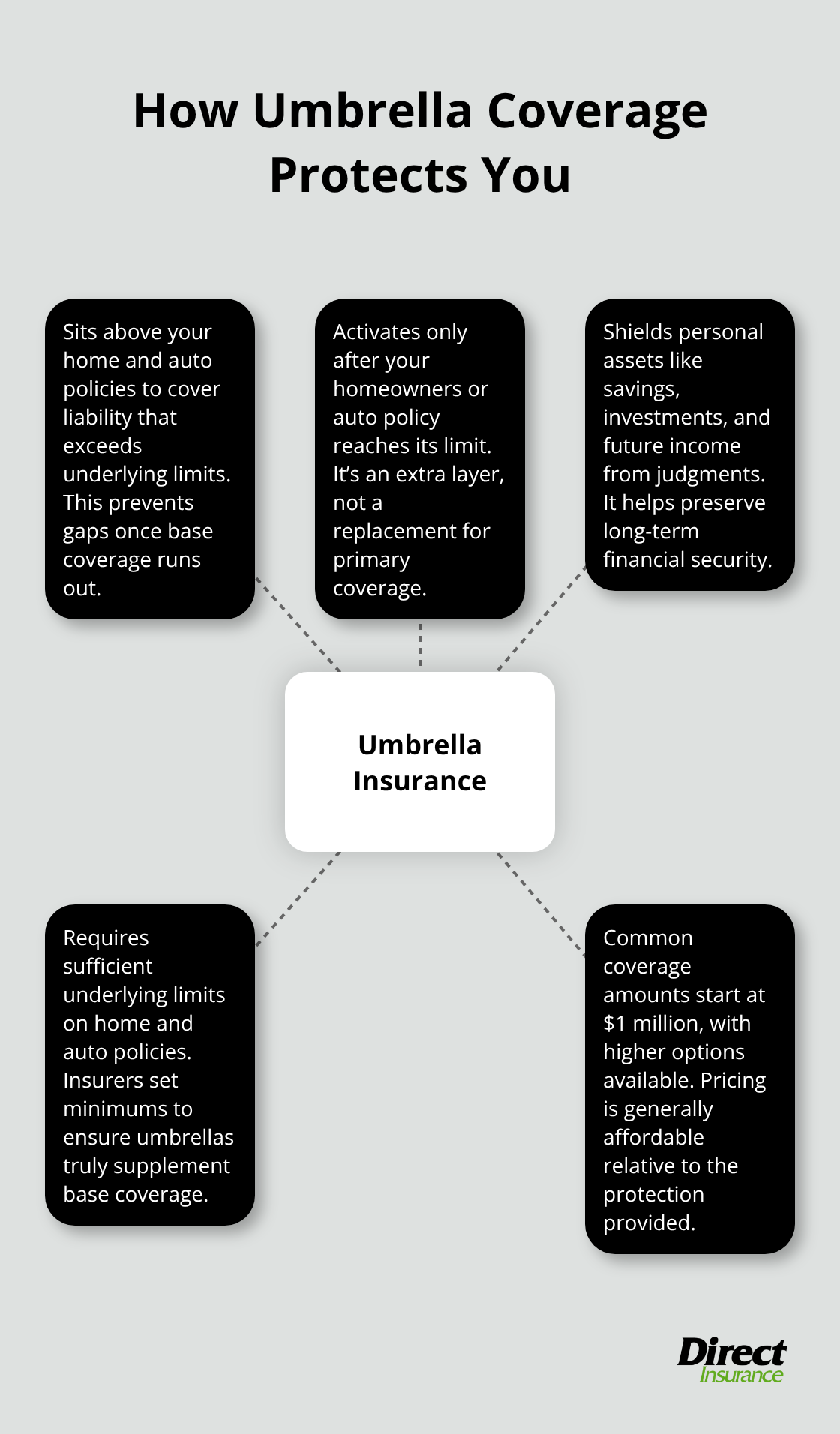
Medical bills alone for a severe injury can reach $500,000 or more. Umbrella coverage activates once your base policy maxes out, protecting your savings, investment accounts, and future income from judgment claims.
How Coverage Limits Actually Work
Umbrella policies typically start at $1 million in coverage, with options extending to $5 million or higher. The cost for that first million is surprisingly low-often $150 to $300 annually-because it only activates after your underlying policies pay their limits. A $2 million umbrella policy runs roughly $300 to $500 per year for most homeowners. You cannot purchase umbrella coverage without sufficient underlying limits; insurers require minimum underlying coverage of $250,000 to $300,000 on auto policies and $300,000 on homeowners policies. This requirement exists because umbrella policies supplement, rather than replace, your primary coverage. The underwriting process examines your driving record, claims history, and property details to determine your specific premium and available limits.
When You Actually Need This Coverage
High-income households, business owners, and anyone with significant assets should consider umbrella protection immediately. If your net worth exceeds $500,000, a lawsuit judgment could wipe out decades of savings without umbrella coverage. Professionals like doctors, contractors, and consultants face elevated liability exposure through their work and should prioritize this coverage. Parents of teenage drivers should recognize that young drivers cause roughly 1.9 million crashes annually in the United States, according to the CDC-another strong reason for umbrella protection. Even moderate-income families benefit from $1 million in umbrella coverage given how litigation costs have risen. Your age matters too; younger policyholders typically pay less for umbrella coverage than older applicants due to actuarial data on claim frequency.
Now that you understand what umbrella insurance covers and when you need it, the next step involves finding accurate quotes that reflect your actual risk profile and financial situation.
Getting Accurate Umbrella Insurance Quotes
What Determines Your Quote Price
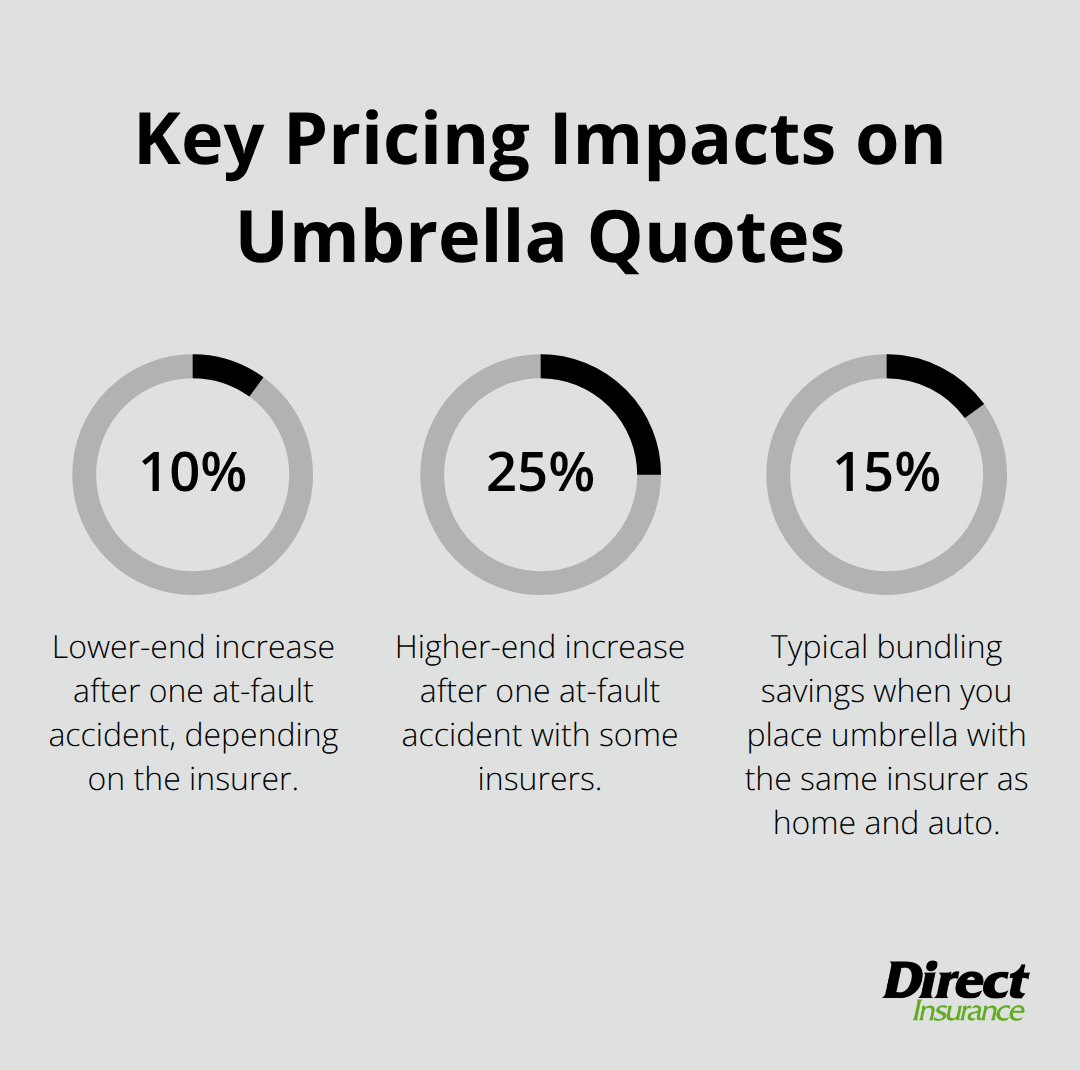
Your driving record, home value, and claims history determine your umbrella quote more than anything else. Insurers pull your Motor Vehicle Record and homeowners claims history before calculating your premium, so dishonesty about past incidents will surface during underwriting and delay your coverage. If you’ve had accidents or claims in the past five years, expect higher premiums or coverage restrictions. A clean driving record typically qualifies you for the lowest rates available, while even one at-fault accident can increase your quote by 10 to 25 percent depending on the insurer.
Your credit score also matters significantly; some insurers use credit-based insurance scores to determine eligibility and pricing. The number of properties you own, whether you have a swimming pool or trampoline, and if you own recreational vehicles all factor into your umbrella quote. Bundling umbrella coverage with your homeowners and auto policies at the same insurer usually saves 10 to 15 percent compared to purchasing it separately, so request quotes only from companies where you already carry underlying coverage.
How to Compare Quotes Effectively
Obtain quotes from at least three different insurers to reveal massive price variations for identical coverage. One homeowner might pay $200 annually at Company A for $1 million in coverage while another pays $350 at Company B for the same limit, according to comparative shopping data from insurance brokers. Contact insurers directly or work with an independent agency that accesses multiple carriers simultaneously, which saves hours of individual research.
When you compare quotes, verify that underlying policy limits are identical across all options, since higher underlying limits sometimes result in lower umbrella premiums. This step prevents you from accidentally comparing different coverage levels and misinterpreting price differences.
Red Flags to Watch
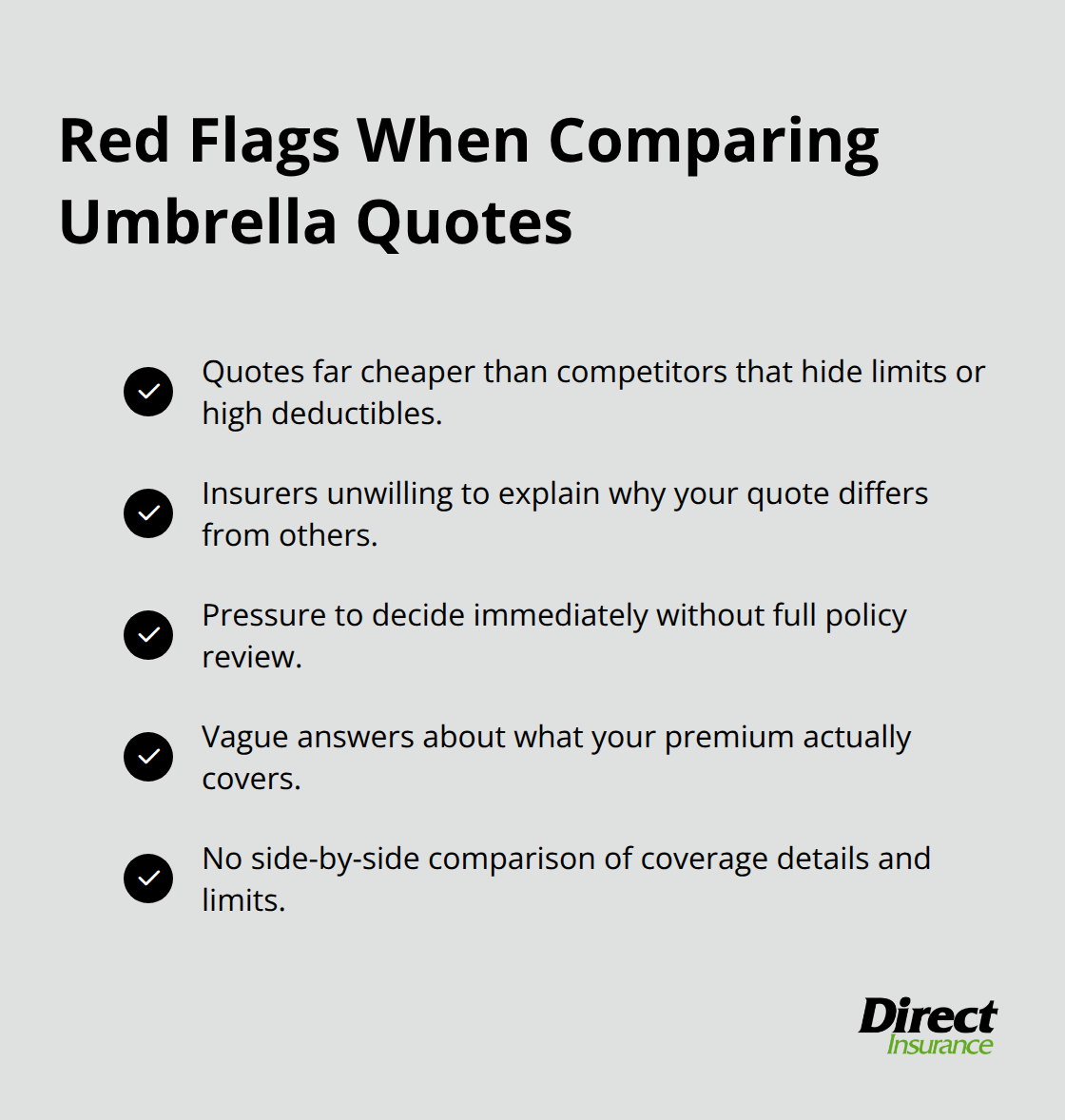
Red flags include quotes that seem unusually cheap compared to competitors, which often signals limited coverage or high deductibles you didn’t notice. Avoid any insurer that refuses to explain why your quote differs significantly from others or that pressures you to decide immediately without reviewing the policy details. An insurer should walk you through exactly what your premium covers and why your rate differs from competitors’ offers.
Independent agencies compare umbrella quotes from multiple top-rated carriers so you see exactly how coverage and price differ between options. This approach eliminates the pressure of dealing with individual insurers and gives you a complete picture before you move forward.
Types of Umbrella Policies for Different Needs
Personal Umbrella Insurance for Homeowners
Homeowners and business owners need fundamentally different umbrella policies because their liability exposures differ dramatically. A homeowner’s umbrella protects against injuries occurring on the property or liability from their vehicles, while a business owner faces exposure from employee actions, customer injuries on business premises, and professional liability claims. Most homeowners should start with $1 million in umbrella coverage, which costs between $150 and $300 annually when bundled with existing homeowners and auto policies. This amount protects most households with net worth below $2 million, though families with swimming pools, rental properties, or teenage drivers should consider $2 million coverage instead.
Business Umbrella Insurance for Liability Protection
Business owners carrying general liability policies need substantially higher umbrella limits, typically $2 million to $5 million, because a single customer injury claim or employee lawsuit can reach six figures quickly. A construction contractor, for example, faces greater per-incident exposure than a homeowner simply due to the nature of their work and the number of people on job sites. The nature of your business operations determines how much umbrella coverage you actually need to stay protected.
Specialized Policies for High-Risk Situations
Specialized umbrella policies exist for high-risk situations that standard homeowners or business policies won’t adequately cover. Landlords renting out properties need umbrella coverage specifically designed for rental properties, since standard homeowners policies exclude liability from tenant-caused injuries. Young drivers or households with multiple vehicles benefit from higher underlying auto limits paired with umbrella coverage, given that teenage drivers have crash rates three times higher than drivers aged 20 and older.
Professionals like doctors, attorneys, and contractors often purchase professional liability umbrella coverage in addition to standard umbrellas because their work creates unique exposure beyond standard homeowner or business liability. High-net-worth individuals with investment properties, significant assets, or public visibility should secure $5 million umbrellas regardless of their primary business, since lawsuit amounts against wealthy defendants frequently exceed standard coverage limits. Your specific situation-not standardized options-should determine which umbrella type fits your exact needs.
Final Thoughts
Finding trustworthy umbrella insurance quotes requires comparing multiple carriers and understanding exactly what each policy covers. Umbrella coverage activates only after your underlying homeowners and auto policies reach their limits, making it an affordable way to protect assets that took years to build. The price difference between carriers for identical $1 million coverage can exceed $150 annually, which means shopping around directly impacts your wallet.
Your next step involves gathering quotes from at least three insurers where you already carry homeowners or auto policies. Bundling umbrella coverage with existing policies typically saves 10 to 15 percent compared to purchasing separately, so contact your current carriers first. When you receive quotes, verify that underlying policy limits match across all options before comparing prices, since this detail significantly affects your premium.
An independent insurance agency eliminates the tedious process of contacting multiple carriers individually. Direct Insurance Services shops multiple top-rated insurance companies simultaneously to show you exactly how coverage and pricing differ between options. Contact us to request umbrella insurance quotes and see how much protection costs when you work with an agency that prioritizes your financial security.
Disclaimer: The information provided in this blog is for general informational purposes only and does not constitute legal, financial, or insurance advice. Coverage options, terms, and availability may vary. Please consult with a licensed professional for advice specific to your situation

