Commercial Property Insurance Utah: Safeguard Your Business Real Estate
Your business property is one of your largest investments. Without commercial property insurance in Utah, a single disaster-fire, hail, or theft-could wipe out years of growth.
At Direct Insurance Services, we help Utah business owners understand what coverage they actually need and how to avoid paying for protection they don’t. This guide walks you through the essentials.
What Your Commercial Property Insurance Actually Covers
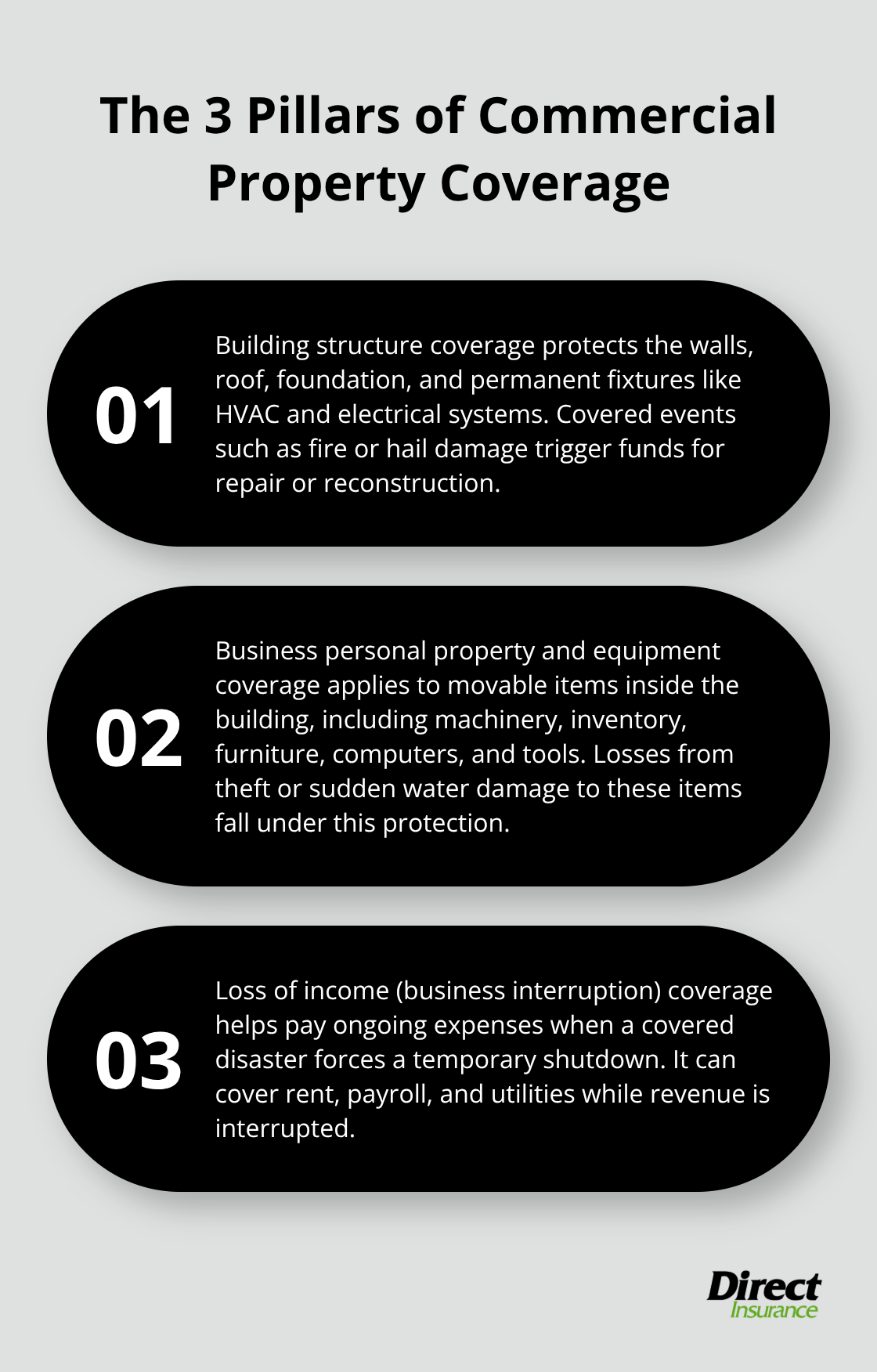
Your commercial property insurance protects three distinct areas of your business, and understanding each one prevents you from buying duplicate coverage or leaving gaps. Your building structure comes first-this includes the walls, roof, foundation, and permanent fixtures like HVAC systems and electrical wiring. A hail storm that damages your roof or a fire that destroys your warehouse triggers this coverage for reconstruction costs. The second area is your business personal property and equipment, which covers everything movable inside the building: machinery, inventory, furniture, computers, and tools. Theft or water damage that ruins $50,000 worth of equipment gets covered here. The third component is loss of income coverage, also called business interruption insurance. A covered disaster that forces you to close temporarily activates this coverage to pay your ongoing expenses-rent, payroll, utilities-while you cannot generate revenue. Without it, you personally absorb those costs during recovery, which can run thousands of dollars per day depending on your operation size.
Standard Policies Leave Critical Gaps
Most standard commercial property policies exclude certain high-risk events, and this is where Utah business owners make costly mistakes. Flooding almost never appears in basic coverage, which matters significantly in Utah where flash floods occur in canyons and low-lying areas. You need a separate flood insurance policy purchased through the National Flood Insurance Program or private insurers. Earthquakes are similarly excluded, despite Utah’s location near the Wasatch Fault, which has produced magnitude 7+ earthquakes in the past and could again. Wear and tear, maintenance issues, and gradual deterioration never receive coverage-insurance pays for sudden, unexpected events only. Losses from poor business decisions or market downturns also fall outside coverage. When evaluating your needs, identify what specific risks threaten your operation and confirm they appear explicitly in your policy’s covered perils section.
Correct Asset Valuation Prevents Underpayment at Claim Time
Most Utah business owners underestimate their property values, then face a shock at claim time when they discover they are underinsured. When you file a claim, the insurance company pays the lesser of two amounts: your actual loss or your policy limit. If you insure a warehouse for $300,000 but it actually contains $500,000 in inventory and equipment, you recover only $300,000 maximum. Conduct a physical inventory count and obtain professional appraisals for high-value items like machinery or specialized equipment. Document everything with photos and serial numbers. For inventory-heavy businesses, update your valuations annually since stock levels fluctuate seasonally. Many business owners also overlook items stored off-site or in vehicles-these often need separate coverage or riders added to your main policy.
Choosing the Right Coverage Limits Requires Honest Assessment
Underinsurance creates far more problems than overinsurance, yet many business owners choose lower limits to reduce premiums. A $50,000 annual savings on premiums disappears instantly when a fire causes $500,000 in damage and your policy covers only $300,000. Work through your property systematically: calculate replacement costs for your building (not just market value), list every piece of equipment with current replacement prices, and estimate your monthly operating expenses for the loss of income calculation. If your business operates seasonally or your inventory fluctuates, set your limits based on peak periods, not average months. Some policies include coinsurance clauses that penalize you for underinsurance-if you carry only 70% of your property’s actual value and suffer a partial loss, the company may pay less than the damage amount. Understanding these mechanics before you purchase coverage prevents expensive surprises later.
Now that you understand what commercial property insurance covers and what gaps exist in standard policies, the next step is recognizing why Utah businesses specifically need this protection. Utah’s geography and weather patterns create distinct risks that differ from other states, and your coverage strategy must account for these local realities.
Why Utah Businesses Face Unique Property Risks
Earthquakes and Seismic Activity Threaten Your Building
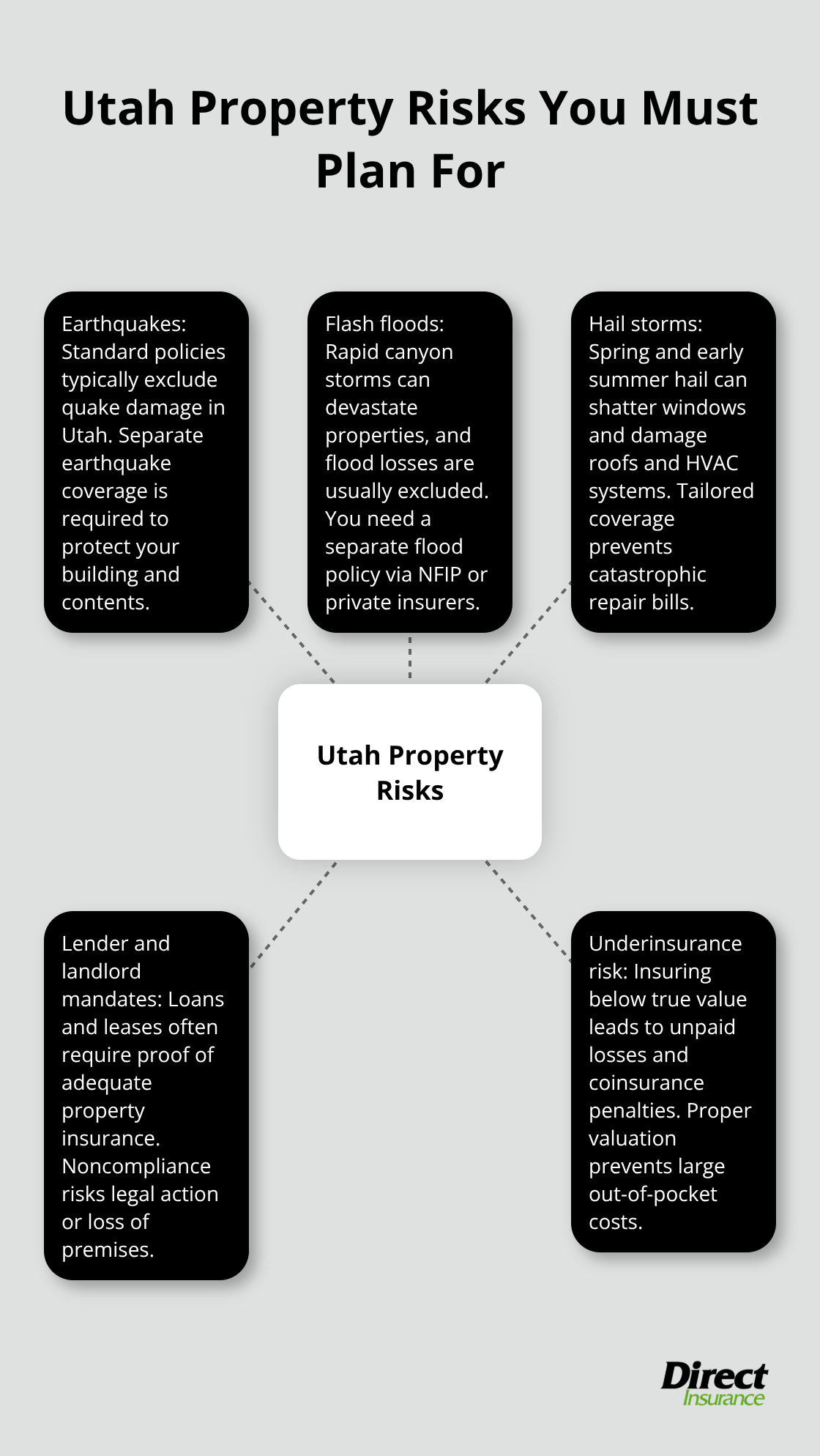
Utah sits directly above the Wasatch Fault, which has produced earthquakes exceeding magnitude 7 in the past and continues generating seismic activity today. The U.S. Geological Survey classifies Utah as a moderate-to-high earthquake risk zone, yet most standard commercial property policies exclude earthquake damage entirely. This exclusion leaves your building, equipment, and inventory completely unprotected when the ground shakes. You must purchase separate earthquake coverage through your insurance provider to address this gap. A single significant earthquake could force you to rebuild your entire operation from scratch, and without specific earthquake insurance, you absorb that cost alone.
Flash Flooding and Hail Storms Cause Millions in Annual Damage
Utah’s canyon areas and Wasatch Front experience sudden, violent storms that dump inches of rain in minutes, triggering flash floods that destroy commercial properties. Standard policies exclude flood damage, so you need a separate flood insurance policy purchased through the National Flood Insurance Program or private insurers. Hail storms strike Utah’s climate regularly each spring and early summer, destroying roofs, shattering windows, and damaging HVAC systems on commercial buildings. Without commercial property insurance tailored to these specific threats, your business absorbs the full reconstruction cost, which can exceed your annual revenue.
Lenders and Landlords Mandate Coverage You Cannot Avoid
Banks require borrowers to maintain property insurance equal to the outstanding loan balance before approving any commercial mortgage or business line of credit. Landlords include insurance requirements in lease agreements and can cancel your lease if coverage lapses. These aren’t optional demands-they’re contractual obligations that protect the lender’s or landlord’s financial interest in your property. Violating these requirements exposes you to legal action and loss of your business location.
Underinsurance Creates Financial Devastation You Must Prevent
If a covered disaster damages your building and equipment, you need enough coverage to repair or replace everything and cover your operating expenses during downtime. Many Utah business owners discover too late that their chosen coverage limits fall short, leaving them personally responsible for the gap (sometimes tens of thousands of dollars). When you file a claim, the insurance company pays the lesser of two amounts: your actual loss or your policy limit. If you insure a warehouse for $300,000 but it actually contains $500,000 in inventory and equipment, you recover only $300,000 maximum. Conduct a physical inventory count and obtain professional appraisals for high-value items like machinery or specialized equipment. Document everything with photos and serial numbers, and update your valuations annually since stock levels fluctuate seasonally.
Understanding Utah’s specific risks and lender requirements shapes your coverage strategy, but selecting the right policy requires more than recognizing what threats exist-you must evaluate your actual property values and compare the coverage options available to your business.
Selecting Coverage That Matches Your Utah Business
Start with a Complete Property Inventory
Walk through your building and document every asset: the structure itself, all equipment, inventory, furniture, and technology. For the building, calculate replacement cost, not market value-this means what it would cost to rebuild from scratch with current materials and labor, not what you could sell the property for today. Utah construction costs average $150 to $200 per square foot for commercial buildings according to recent construction data, so a 5,000-square-foot warehouse runs $750,000 to $1,000,000 in replacement value alone.
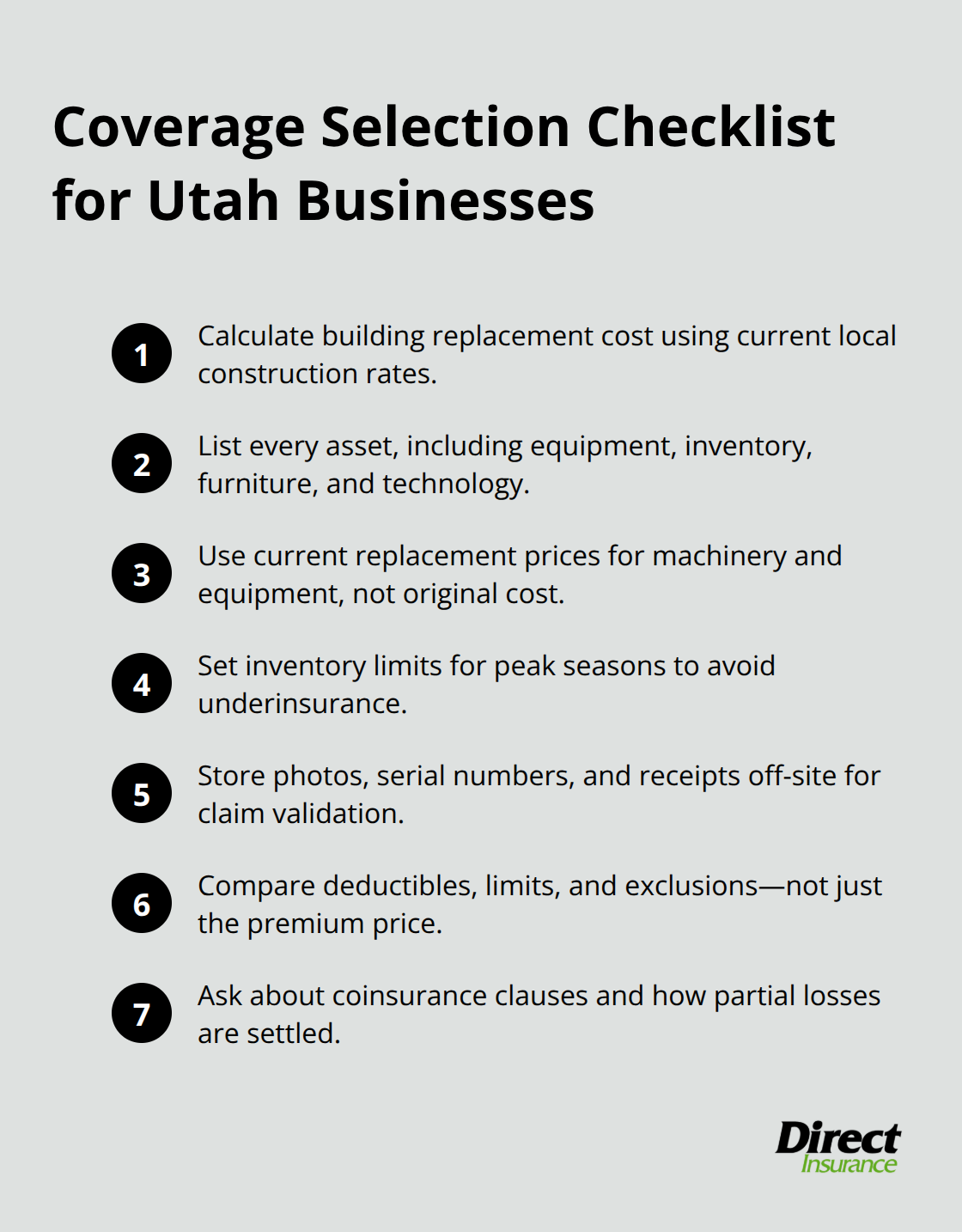
For equipment and machinery, obtain current replacement prices from manufacturers or distributors rather than guessing based on original purchase dates. Inventory valuation matters enormously for retail, manufacturing, or wholesale businesses-track your peak inventory levels (not average), since this is when you face maximum loss exposure. Many Utah business owners miss seasonal spikes in stock and underinsure accordingly.
Document everything with photos, serial numbers, and purchase receipts stored separately from your business location. This documentation becomes essential when you file a claim and the insurance company questions your asset values.
Compare Policies Beyond Premium Price
Two policies with identical premiums can offer dramatically different protection because deductibles, coverage limits, and exclusions vary significantly. A $2,500 deductible saves you money monthly but costs thousands more when you actually need the coverage-Utah businesses with tight cash flow often choose higher deductibles and regret it during recovery.
Coinsurance clauses in some policies penalize underinsurance; if you carry only 80% of your property’s actual value, the company may pay only 80% of your partial loss claim. Request quotes from multiple insurers and ask each one specifically how they handle partial losses and whether coinsurance clauses apply. Don’t accept the first quote-shop multiple top-rated insurance companies to find better rates and coverage combinations for your business, and you should demand the same approach.
Work with Agents Who Understand Utah’s Specific Risks
Local agents who work in Utah understand the Wasatch Fault earthquake risk, flash flood patterns in specific canyons, and hail exposure on the Wasatch Front. They know which carriers offer the best earthquake and flood coverage add-ons and which ones apply Utah-specific underwriting rules that affect your premium. An agent familiar with your region can identify gaps in standard policies that would otherwise leave your business exposed to significant financial loss.
Final Thoughts
Commercial property insurance in Utah protects your business from financial devastation when disasters strike. You now understand what coverage actually protects your building, equipment, and income during downtime, and you recognize why Utah’s earthquake risk near the Wasatch Fault and flash flooding in canyon areas demand specific coverage beyond standard policies. Lenders and landlords require this protection, making it non-negotiable for your operation.
Your next step requires three concrete actions. First, conduct a complete inventory of your property and calculate replacement costs using current Utah construction rates, not outdated estimates. Second, obtain quotes from multiple insurers and compare deductibles, coverage limits, and exclusions rather than choosing based on premium alone. Third, work with agents who understand Utah’s specific risks and can identify gaps that would leave your business exposed.
Contact Direct Insurance Services to discuss your property values, business operations, and coverage gaps. A conversation with our team takes less than an hour and prevents the financial devastation that underinsurance creates. We help Utah business owners find commercial property insurance in Utah that matches their actual needs and budget.
Disclaimer: The information provided in this blog is for general informational purposes only and does not constitute legal, financial, or insurance advice. Coverage options, terms, and availability may vary. Please consult with a licensed professional for advice specific to your situation

