
Utah Personal Umbrella Insurance: A Safety Net For Your Family
Your homeowners and auto insurance policies have limits. If someone sues you for more than those limits cover, your personal assets are at risk.
Utah personal umbrella insurance fills that gap. At Direct Insurance Services, we help families protect their savings, homes, and future earnings from liability claims that exceed standard policy limits.
What Umbrella Insurance Actually Covers
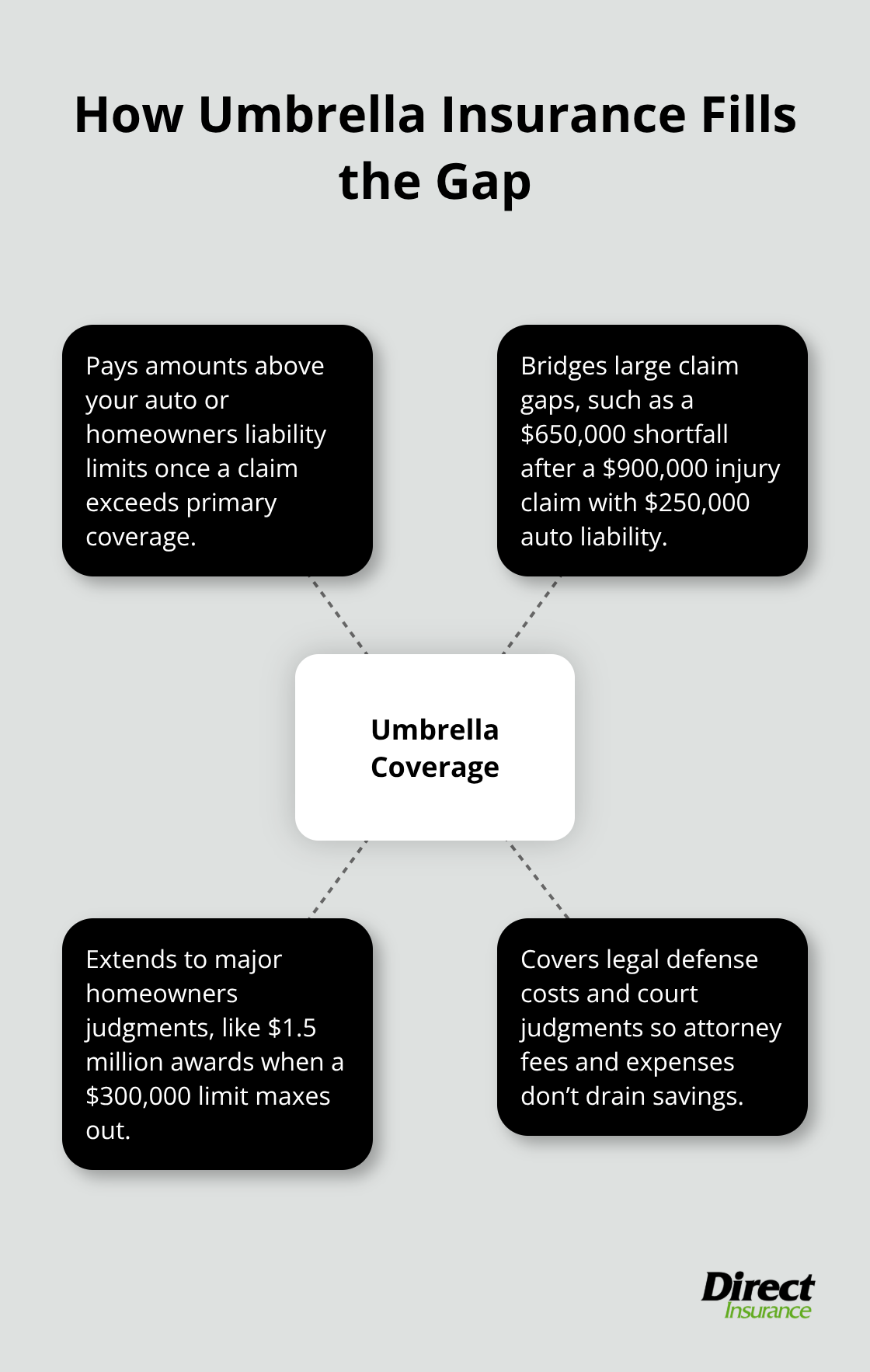
Umbrella insurance activates when a liability claim exceeds the limits of your homeowners or auto policy. If someone sues you for bodily injury or property damage, your umbrella policy covers the amount above what your primary insurance pays. A $900,000 injury claim with $250,000 in auto liability coverage leaves a $650,000 gap-your umbrella policy covers that remaining amount up to your chosen limit. The same applies to homeowners claims. A neighbor injured on your property who wins a $1.5 million judgment against you receives coverage from umbrella insurance if your homeowners policy maxes out at $300,000. Your umbrella also covers legal defense costs and court judgments, so attorney fees and court expenses don’t drain your primary policy limits or personal savings.
When Standard Policies Fall Short
Most Utah residents carry inadequate liability limits. Standard auto policies typically include $300,000 in bodily injury coverage, and homeowners policies often max out at $300,000 as well. These limits sound substantial until you face a serious accident. Medical bills, lost wages, and pain-and-suffering awards add up fast. A catastrophic car accident involving multiple vehicles and injuries can easily exceed $500,000 in damages. Homeowners claims involving drowning, dog bites, or slip-and-fall incidents on your property frequently surpass standard policy limits. Umbrella insurance starts at $1 million in coverage and extends to $5 million or more, depending on your needs and the carrier. This additional protection costs far less than most people expect-often just 10-15% of your homeowners premium for $1 million in coverage.
Coverage That Standard Policies Won’t Touch
Umbrella insurance covers liability claims that fall outside your standard homeowners and auto policies entirely. Personal injury claims for libel, slander, or defamation rarely appear in standard homeowners policies, but umbrella insurance addresses these gaps. If you own a boat, ATV, or motorcycle, umbrella coverage extends to liability from those assets as well. Vacation rental incidents involving jet skis or rental scooters fall under umbrella protection. Worldwide coverage protects you for incidents that happen abroad-a valuable feature for Utah residents who travel internationally. Defense coverage pays legal fees and investigative costs as your case proceeds through the system, preventing those expenses from exhausting your primary policy limits.
How Much Coverage You Actually Need
Your asset total determines the umbrella limit you should carry. Total the dollar amount of your assets, including your home’s value and investments, to understand your exposure. If your assets total $1.5 million and your primary policies cover only $300,000 in liability, a $1 million umbrella policy closes that gap. Most carriers require you to carry underlying liability coverage on both auto and homeowners policies before they’ll sell you umbrella protection. Some insurers also require you to insure both your home and vehicles with the same company for umbrella eligibility. These requirements exist because umbrella policies work in tandem with your primary coverage-they don’t stand alone. The next step involves comparing what different carriers offer and understanding how their requirements align with your current insurance portfolio.
Why Utah Residents Face Higher Liability Risks
Outdoor Recreation Multiplies Your Exposure
Utah’s geography and lifestyle create specific liability exposures that standard insurance limits don’t adequately address. The state’s outdoor recreation culture and liability risks in Utah means more residents own boats, ATVs, motorcycles, and RVs-assets that significantly increase liability risk. A jet ski accident on a Utah lake, an ATV incident on private land, or a boat collision generates damages that far exceed standard auto or homeowners coverage. Each recreational asset you own adds another layer of potential liability that your primary policies may not cover fully.
Winter Weather and Urban Density Compound Risk
Utah’s population density in the Wasatch Front corridor creates higher accident frequency in metro areas like Salt Lake City, Provo, and Ogden, where multi-vehicle collisions and complex injury claims occur regularly. Winter weather compounds these risks-icy roads lead to more severe accidents with multiple vehicles and higher medical costs.
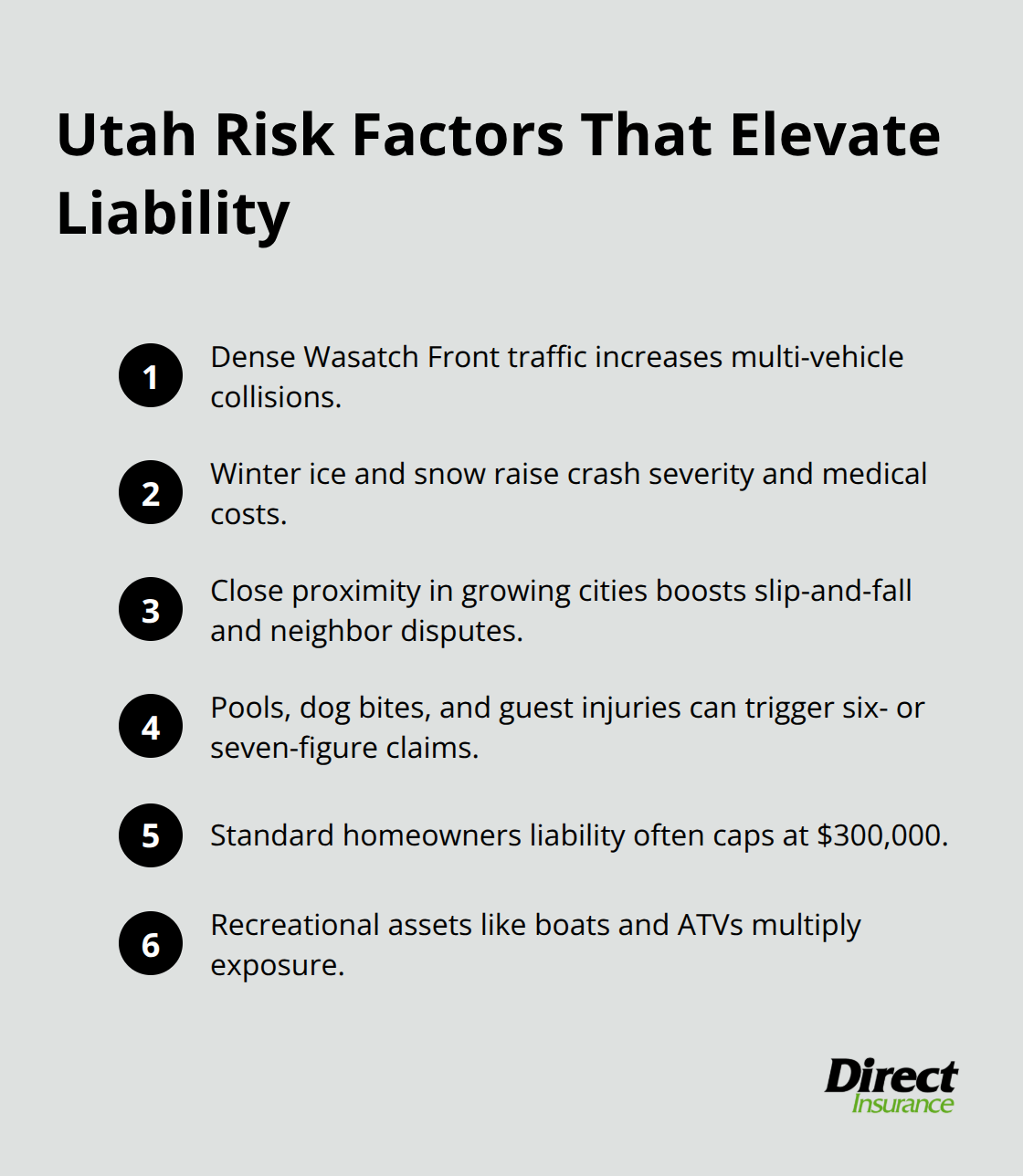
Additionally, Utah’s growing urban areas mean more people live in close proximity, increasing slip-and-fall risks on residential properties and the likelihood of disputes between neighbors. A drowning incident at your pool, a dog bite involving a neighbor’s child, or a guest injured on your property can result in six-figure or seven-figure judgments. Standard homeowners policies typically cap liability at $300,000, which covers only the most minor incidents in today’s litigation environment. When you add recreational assets like boats or ATVs to the equation, your exposure multiplies rapidly.
Why Minimum Coverage Falls Short
Utah’s strict auto insurance requirements create a false sense of security among drivers. State law requires liability coverage, but many residents carry only the minimum limits to reduce premiums. A serious injury claim from a multi-vehicle accident easily reaches $1 million or more when medical expenses, lost wages, and pain-and-suffering awards combine. Your home equity, investment accounts, and future earnings become vulnerable once primary coverage exhausts. Umbrella insurance protects these assets by stepping in after your auto and homeowners policies max out.
The Affordability Factor Changes Everything
For Utah residents with significant assets-home equity above $500,000, retirement savings, or investment portfolios-umbrella coverage becomes essential protection. The cost remains remarkably low, typically $150 to $300 annually for $1 million in coverage when bundled with existing policies. This affordability means protecting your family’s financial future costs less than many people spend on dining out monthly. Without umbrella protection, a single serious accident or liability claim forces you to liquidate retirement accounts, tap home equity, or face wage garnishment for years. The next step involves understanding exactly how much coverage your specific situation requires and how to select the right policy for your family’s needs.
Selecting Your Umbrella Limit
Start by listing every asset you own. Home value, investment accounts, retirement savings, vehicles, rental properties, and even future earnings all count. If your home is worth $600,000 and you have $400,000 in retirement accounts, your total asset base is $1 million before considering other holdings. Most Utah residents underestimate this number significantly. Add up everything, then compare it to your current liability coverage across all policies. If you carry $300,000 in auto liability and $300,000 in homeowners liability, you have $600,000 total protection against a $1 million asset base. That $400,000 gap represents real financial exposure.
Umbrella insurance should cover that gap and then some. A $1 million umbrella policy costs approximately $383 per year for an individual with one home, two cars, and two drivers, making it one of the cheapest forms of asset protection available. If your assets exceed $1.5 million, a $2 million umbrella becomes more appropriate. Many carriers allow you to stack coverage up to $5 million, and some go higher depending on your situation and risk profile.
Getting Quotes That Actually Compare
Contact at least three different carriers before making a decision. Each insurer weighs risk factors differently, and premiums can vary significantly for identical coverage. When requesting quotes, provide the same information to each carrier so you can compare apples to apples. Specify your home’s replacement cost, your vehicle values, any recreational assets like boats or ATVs, and your desired umbrella limit.
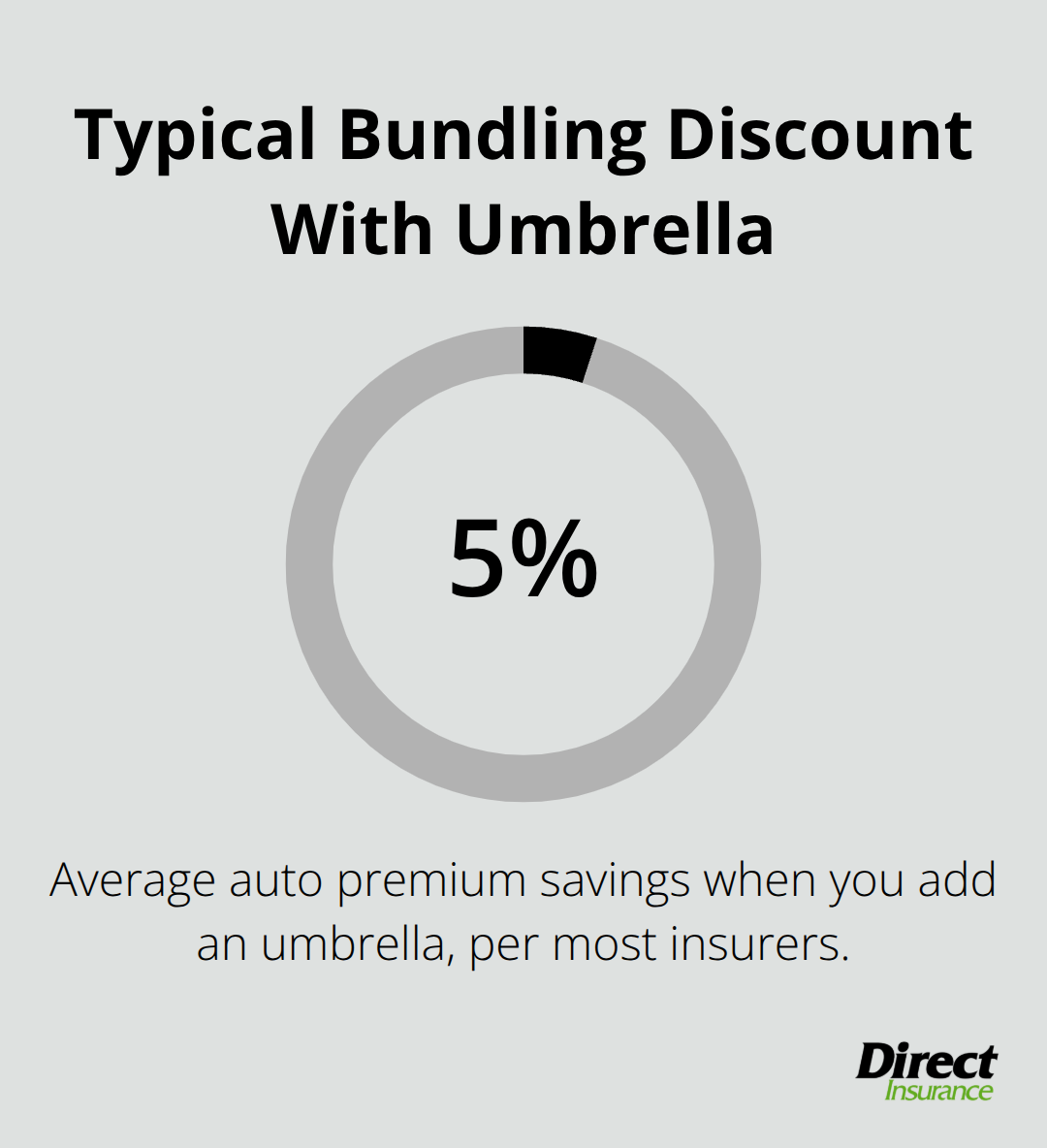
Ask each carrier about bundling discounts, which typically save around 5 percent on auto premiums according to most insurers when you add umbrella coverage. Some carriers require you to insure both your home and vehicles with them before selling umbrella protection, while others remain more flexible.
This requirement matters because it affects your total premium picture and whether consolidating policies makes financial sense for your situation.
Understanding Carrier Requirements and Coverage Gaps
Different insurers include different coverages within their umbrella policies. Some cover defamation and personal injury claims automatically, while others exclude them or charge extra. Worldwide coverage appears standard with most carriers, but verify this if you travel internationally. Ask specifically about vacation rental liability if you frequently use rental equipment or own recreational property.
Defense coverage should be included, covering your legal fees and court costs as claims proceed. Some carriers apply deductibles to umbrella claims, typically $250 to $500, so understand these details before selecting a policy. Your primary policies must meet minimum liability limits before any umbrella carrier will insure you. Most require at least $250,000 in auto bodily injury coverage and $300,000 in homeowners liability. If your existing policies fall short of these minimums, increase them first before umbrella protection activates properly.
Shopping Multiple Carriers for Your Best Rate
Try contacting multiple top-rated insurance companies to compare rates and coverage options. Each carrier structures its umbrella offerings differently, and what works for one family may not suit another. When you shop multiple insurers, you uncover which ones offer the specific protections your Utah household needs (whether that’s boat liability, ATV coverage, or international protection). Premium differences between carriers can reach hundreds of dollars annually for the same coverage limits, making this comparison step worth your time.
Final Thoughts
Utah personal umbrella insurance protects your family’s financial future when liability claims exceed what your standard policies cover. Standard auto and homeowners policies max out at $300,000 in most cases, but serious accidents generate damages far beyond that amount. A single catastrophic incident forces you to liquidate retirement accounts, tap home equity, or face wage garnishment for years. Umbrella coverage starting at $1 million costs only $150 to $300 annually when bundled with existing policies, making it one of the cheapest forms of asset protection available.
Calculate your total assets and identify the gap between that number and your current liability limits. List your home value, investment accounts, retirement savings, and any recreational assets like boats or ATVs, then compare that total to your existing auto and homeowners coverage. If the gap exceeds $400,000, a $1 million umbrella policy becomes essential. If your assets exceed $1.5 million, consider $2 million in coverage instead.
Contact at least three different insurance carriers before deciding, since each insurer weights risk factors differently and premiums can vary significantly for identical coverage. Ask about bundling discounts, which typically save around 5 percent on auto premiums, and verify that each carrier covers the specific risks your family faces (whether that involves boat liability, ATV coverage, or international protection). We at Direct Insurance Services shop multiple top-rated insurance companies to find you the best coverage at competitive rates, and our team understands the unique liability risks Utah residents face. Contact us today for a personalized quote on Utah personal umbrella insurance.
Disclaimer: The information provided in this blog is for general informational purposes only and does not constitute legal, financial, or insurance advice. Coverage options, terms, and availability may vary. Please consult with a licensed professional for advice specific to your situation

